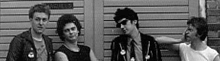
Welcome to the History page. Below is the complete history of Blitzkrieg Bop. Written and edited by John Hodgson. The entire history, all thirty two chapters are on this page. Feel free to read it or you can read a particular chapter by clicking on any of the links below.
Introduction | Chapter 1 | Chapter 2 | Chapter 3 | Chapter 4 | Chapter 5 | Chapter 6 | Chapter 7 | Chapter 8 | Chapter 9
Chapter 10 | Chapter 11 | Chapter 12 | Chapter 13 | Chapter 14 | Chapter 15 | Chapter 16 | Chapter 17 | Chapter 18 | Chapter 19 Chapter 20 | Chapter 21 | Chapter 22 | Chapter 23 | Chapter 24 | Chapter 25 | Chapter 26 | Chapter 27 | Chapter 28 | Chapter 29 Chapter 30 | Chapter 31 | Chapter 32
BLITZKRIEG BOP - A HARD ROAD TO NOWHERE
ACKNOWLEDGEMENTS
Although the author of this book is me, John Hodgson, aka Blank Frank, I thought it best if it wasn’t littered with “I” and “me”, so I have written it as if a friend of the band has done it. I believe it makes the story more readable. I hope the readers will agree.
The reason for writing the book stems from the extended sleeve notes I wrote for ‘Top Of The Bops’. I felt that so much had been left out that a more complete version would be worthwhile. It has taken nine months of occasional hard work for this little “baby” to pop out, but in reality I have been writing it off and on for about fifteen years.
During research for the book I had the pleasure of once again speaking to ex-members of the band, some of whom I hadn’t seen or spoken to for 18 years. Most of them were happy to talk about the band, with Micky Dunn, Mick Hylton, Graham Moses and Ray Radford in particular raiding their memory banks to provide useful anecdotes.
Bop’s drummer, Alan Cornforth, is almost as obsessed with trivia as I, and I was delighted to be granted permission to trawl his tape and document archive, the latter of which proved invaluable, especially the set lists and lyrics.
The enthusiasm of John Esplen of Overground made sure that ‘Top Of The Bops’ became a reality, and I will be eternally grateful.
I would like to acknowledge the contributions of Mick Todd and Alan Savage of Basczax, both of whom provided material for this book.
I would also like to thank our main ‘roadie’, John ‘D.P.’ Butterfield for use of his notes, which confirmed many events of which I wasn’t certain.
There are some annoying gaps, with a lack of reviews for the ‘UFO’ single being the most frustrating. I’ve also had to leave out a major part of the Index/Information section, due to time restrictions. The plan was to include a complete list of taped songs in the archive, but release of the book would have been delayed, probably for months. However, if anyone wants the ‘Complete Tape-ography’ as a supplement, please let me know.
I am always looking to add to the archive, so if anyone out there has bootleg tapes of gigs, or even photographs of the band in action, I would be glad to hear from them.
If anyone wishes to contact the band, here is a list of emails:
John Hodgson (aka Blank Frank) e-mail: blitzkrieg.bop@ntlworld.com
Micky Dunn (aka Bert Presley) e-mail: M.Dunn@derby.ac.uk
A HARD ROAD TO NOWHERE © 1998 - JOHN HODGSON
back to top
INTRODUCTION
Punk Rock. What was all that about, then?
Looking back from a distance, the hacks and historians have sorted and sieved all the mayhem (dare I say anarchy?) into neat compartments, serving it up in byte-size chunks of trivia. There's nothing new about this, of course. The liberal, post-war, post-colonial liberation, coupled with pre-packed consumerism, positively encouraged the passion for the parcelling of micro-culture.
As the Millennium Joyride hurtles towards its predictable conclusion, the flotsam and Uncle-Sam of Western Ephemera becomes increasingly fragmented.
Punk occupied an infinitesimally small space in this universe, but if it was in your space, it was in your face. A full-on freak-out of fans and fanzines, a riot of ripped T-shirts and ripped-off bands.
Opinion is divided as to who started the party. Certainly the American strand, The Ramones/Patti Smith/Television/Talking Heads gang (via Iggy & The Dolls) had time on their side, but it's the UK crowd who offered the complete package. It was the political angle, the class & snobbery debate, that was the (not so) secret ingredients in the final mix.
Although the enduring image of UK punks, both groups and groupies alike (male and female) were of working class wastrels, many were middle class, adopting a pose of poverty. Students and Social Secretaries were in on the act too - the booking of The Doctors Of Madness one week and The Damned the next didn't faze them. It was just music after all, wasn't it?
The problem with history, of course, is that there's always a pre-history. A picture of Mick Jones in the early 70's with hair down his back speaks a thousand (swear) words. The barbers were working overtime in 1976 as thousands of likely lads lopped off their locks and re-vamped their record collections. Most punk bands cited the same bands at the forefront of the Influence Invasion; Roxy Music, Iggy, Sparks, Bowie, Alex Harvey, The Dolls, The Velvets, Bolan, Slade. The list almost writes itself.
But those who lived through the mid-70's know better. The local Record Vaults were suddenly filled to bursting with never-ending ELP LP's, gatefold Genesis, racks of Rod...this was the ultimate Vinyl Solution.
The saddest (but most predictable) thing about Punk was that it was so short lived. Although the Pistols first gig was in November 1975, the UK as a whole didn't really catch on until the Autumn of 1976, and by the end of 1978 it really was All Over. There were very few bands that succeeded in lasting the pace. The Clash were undoubtedly the jewel in the crown. Some suggest The Jam and The Stranglers, but many argue (rightly) that they would have shone in any era. My favourites were The Damned, once they had disposed of the witless Brian James and moved Captain “Guitar Hero” Sensible to the six strings. The Etiquette/Black Album/Strawberries LP’s were infinitely more interesting than the one-dimensional thrash of their first two albums.
The Pistols were the leaders, despite producing just one gem (Bollocks!) before imploding. But in the end, it didn't matter. It's what they said, what they looked like, their attitude, that mattered.
What Punk gave to hundreds of bands was a belief in their (in)ability, a hope that, against all odds, they would Make It. Behind all the Anti-Star bullshit was the usual dream of fame, a natural impulse to be the cream of the crop.
The Blitzkrieg Bop story could probably be written a thousand times over, by Inserting Your Band's Name Here. Just fill in the gaps and this could be your story. Your fifteen minutes. This is my fifteen minutes.
Why did I write it? Because it wasn't there!
JOHN HODGSON - 23rd July 1998.
back to top
CHAPTER ONE - ROOTS
The history of Blitzkrieg Bop should start with the founding members of a rock band called Adamanta Chubb, which began life in 1974.
The seeds of the band lie in the early months of that year. In their fifth year at a crummy Hartlepool Comprehensive School, four young lads were tired of being told what to think and where their careers should lie.
Alan Cornforth, Kevin McMaster, Stephen Sharratt and Mike ‘Duck’ Macdonald were four friends who were bored. Four teenagers who were looking for excitement. Not easy to find in the industrial wasteland that is Teesside.
Alan Cornforth was a studious, sandy-haired teenager with a slightly stocky build, that would suit him well for his role in the band. He had two major passions; music, where he was influenced in his tastes by his elder brother, David, and what might be called ‘toys for the boys’, namely tape recorders, mixers, and countless other more exotic gadgets. His bedroom was nick-named ‘Jodrell Bank’ due to the amount of gizmo’s and flashing lights. He always spoke his mind, and this led to many arguments that, through perseverance, he usually won.
Alan’s first musical passion was for The Who, at aged 14 he took guitar lessons to try and emulate his hero, Pete Townshend. The guitar proved difficult to master, so dreams of drumming like Keith Moon took over his thoughts.
In March of 1974 Alan decided to use his mother’s mail-order catalogue to send for some musical instruments with a view to forming a rock band. As soon as the delivery van had dropped off a drum kit, a bass guitar, and a microphone and amplifiers, Alan and his friends slowly began the process of learning how to use them.
One of the first problems was to choose a name for the band. Alan was keen on ‘Lord Of The Rings’, an epic fantasy adventure written by J.R.R. Tolkien featuring a mythical world inhabited by wizards, warriors and strange creatures with hairy feet called Hobbits. In the back of Tolkien’s book is an extensive family tree, and nestling amongst the branches is a character called Adamanta Chubb.
Alan decided to try the drums, with Mike on bass, Stephen on lead guitar and Kevin on vocals and rhythm guitar.
They had to settle for practising at Alan’s house, much to their neighbours chagrin. Alan was always thorough in everything he did, and he meticulously wrote down song parts for each song for each instrument.
They tackled songs like ‘I Can’t Explain’ by The Who and ‘Hold Your Head Up’ by Argent. Gigs were far from their minds, but eventually they managed to play crude versions of their favourite songs.
By May 1974 it was clear that Mike was never going to master the bass, so he and Alan swapped instruments. Mike, however, found the drums equally as difficult and soon lost interest in the band altogether. By the end of July Alan returned to the drum stool, Mike was thrown out and they started looking for a replacement.
Damien ‘Dimmer’ Blackwell was an old school friend who lived on a nearby farm. His major influences at the time were Rory Gallagher, Cat Stevens, Uriah Heep, Genesis and The Groundhogs. He had been playing guitar for several years, and had even performed solo whilst on holiday in Switzerland. However, the vacancy was for a bass player, so Dimmer had to switch (sic) to bass in order to get in the band.
Dimmer, like his great guitar hero, Rory Gallagher, had a Fender Stratocaster, and long flowing locks. Because Dimmer’s parents owned a farm, it seemed inevitable that he would end up working in the family business, like his brothers and sisters. While not exactly the black sheep of the family, he did resist enough to forge his own ‘career path’ away from the family business.
As soon as he joined their fortunes changed for the better. They re-located from Alan’s house to a barn at Dimmer’s farm. It meant that they could make as much noise as they liked without disturbing anyone. The barn (actually different barns at different times) soon became a nerve centre of musical activity. With the gleaming new instruments standing proudly amongst the hay bails, the pungent aromas, mainly cigarette smoke and cow shite, were overpowering. The band soon decorated the walls with posters of their favourite bands.
With the new line-up they commenced intense rehearsals and were rewarded in November 1974 with the bands first gig at St. Mary’s Youth Club in nearby Stockton. The gig, by all accounts, was an unmitigated disaster. Most of the band drank a little too much and the set was a shambles, at one point the band were actually playing two different songs at once. The band retreated to the barn, licking their wounds over the Christmas holidays.
Dimmer was invited to a party over the holiday period at a friends house. Also invited was a 19 year old Thornaby lad called John Hodgson. At the party they discussed their musical interests. Dimmer mentioned that he was in a band, but that they were having problems writing their own material. The two had common ground, especially about the idea that rock music should not be for ‘bread heads’. They agreed the priority should be the music, not making money playing Working Men’s Clubs, pandering to the tastes of the masses.
John Hodgson was born in Thornaby on 9th October 1955, ten years to the day after John Lennon, one of his heroes. He began his musical ‘career’ in 1966 when he started writing crude pop songs with his school chum Michael Charlton. They had many names, including The Elastic Band and The Citizens, but eventually settled on Purity, although the sound they made was far from pure. John bashing away on biscuit tins with two bits of kindling, and Michael strumming a Red Jet Electric Beatles guitar.
Several ancillary members passed through their ranks, one of whom was Robert Moss, who went on to publish the highly regarded ‘Book Of Football Lists’ in 1983. He later became a football agent, responsible for the transfer of numerous foreign players into the English game.
Between 1966 and 1974 John and Michael wrote and recorded hundreds of songs, many of which survive to this day. Towards the end Michael lost interest and by the end of 1974 John was a ‘solo’ songwriter, looking for a band that he could collaborate with.
John spent lunch breaks writing lyrics and dreaming of becoming a pop star at his day-job as a telephone sales clerk at Parson & Crosland, a steel stockholders based in Middlesbrough. He was skinny as a teenager, with dark, wavy hair. He had a wide range of musical influences, including Elton John, Roxy Music, The Beatles, David Bowie, Yes, Genesis, E.L.P., and even the jazz fusion of Al Di Miola.
Dimmer and John had met long before the party. On 3rd February 1973 they both met their future wives at the Stockton YMCA disco. John danced with a girl called Denise Liddell and her friend, Kay Walsh, teamed up with Dimmer. Their paths crossed regularly after that, and they even had a jam session in 1974 with John on piano and Dimmer on acoustic guitar.
So it was an ideal opportunity for John when Dimmer told him of Chubb’s problems with songwriting. They agreed to meet up in the new year with a view to working together.
In January 1975 John made several trips to the barn to meet the rest of the band. He brought with him some of his songs, and vocalist Kevin McMaster was particularly impressed with the lyrics. The rest of the band (especially Alan) were wary of any newcomers and gave John a frosty welcome.
Before long however, it was decided that the band would be improved if John joined as a proper member. John had to go into debt to a local music store, where he purchased a Galanti electric piano, a ‘combo’ amplifier, a mike stand and microphone. It soon became apparent that the cheap and nasty piano was not powerful enough for a ‘heavy’ rock band, and it was exchanged for an equally nasty electric organ.
The band rehearsed for a couple of weeks, learning not only cover versions, but some original material supplied by John, including ‘Landslide’, ‘Fly Away’ and ‘Carnage’.
Fast approaching were a couple of gigs at a local church hall, St. Joseph’s in Norton. John felt that he wasn’t ready to take the stage so he settled for being a roadie for the first gig on 13th April 1975. He recorded the gig on a stereo reel-to-reel tape recorder, and a listen to the performance reveals an out of tune band playing a selection of plodding heavy rock. Dimmer did a brief ‘acoustic’ set, playing two of John’s own songs, ‘Fly Away’ and ‘Landslide’.
Three days later John felt confident enough to join them on stage at the same venue. Word had got round the local area that a really bad band were playing, and the 70 or so kids who suffered the first gig stayed away in their droves for the second. Barely a dozen people watched, and most of them had gone well before the end. With John they were not much different, with his noisy organ just adding to the general cacophony.
Undeterred, the band carried on rehearsing, and eventually on June 13th 1975 they managed to secure another gig at a local youth club, St. Cuthbert’s. The band had agreed to play two sets, and they were also going to get paid. The club was packed and a nervous Adamanta Chubb tore through their rather predictable repertoire to the slack-jawed amazement of the assembled throng.
To be fair, there had been improvements in performance, but the manager of the club didn’t appreciate it. Towards the end of the first set he asked them to finish and not play the second half. As a leaving present Alan kicked his drums over in a Keith Moon style fit of pique.
After the gig guitarist Stephen Sharratt broke the news that he was leaving the band to concentrate on his education. It turned out a wise decision as Stephen went on to a career in television as a set designer. His name has cropped up regularly on the end credits of BBC programmes, most notably East Enders.
This change prompted a re-think in the band, and Dimmer moved from bass to lead guitar, a position he had coveted since joining. Kevin added to his vocal duties by strapping on the bass guitar, and the line-up was again settled.
Several months of hard practise eventually paid off. Tapes from this period show a band that had tightened up considerably. They had also started to play shorter, poppier material, including ‘Fox On The Run’ (The Sweet), ‘Virginia Plain’ (Roxy Music) and ‘Delilah’ (Tom Jones via Alex Harvey)
Sadly the wider public did not get to hear the improvement as no gigs were forthcoming.
Kevin grew increasingly disillusioned with his dual role, as attempts to recruit a new vocalist proved fruitless. By October 1975 Kevin had left and the band were down to a three-piece, with John handling the bass on his keyboards.
In November they were successful in their quest for a singer. Jackie Bradley was a local girl who had some experience with local club bands. She wasn’t over burdened with talent, so she fitted in quite well!
Initially rehearsals went smoothly, the band learnt new songs such as ‘Feel Like Making Love’ (Bad Company) but over Christmas John, Alan and Dimmer held a meeting at which it was decided to dispense with Jackie’s services. It was left up to John to break the news.
January 1976 saw the band enter their most artistically productive phase. With a pile of new recording gear acquired over Christmas, the band threw themselves into a frenzy of song-writing and recording.
John also added to his keyboards, buying a second-hand electric piano which sounded like a budget Fender Rhodes, and a monophonic synthesizer called the Yamaha SY1, which he bought on the never never, eventually paying over six-hundred quid for it.
With the new equipment they were able to lay down backing-tracks, and overdub several times with vocals and additional instruments. It was a crude set-up, but with patience they produced listenable versions of ‘The Knife’ (Genesis), ‘Fog On The Tyne’ (Lindisfarne), ‘Black Night’ (Deep Purple), ‘More Fool Me’ (Genesis), ‘Stealin’ and ‘Gypsy’ (both Uriah Heep), as well as self-penned songs such as ‘Landslide’, ‘The Old Man’, ‘Fly Away’, ‘Palooka’ and ‘Black Queen’.
During this period (January-April 1976) they also spent time trying to add to the line-up, with vocalist Brian Day and bassist Brian Robertson having brief spells in the band. Neither of these feature on any of the ‘studio’ recordings. John, Alan and Dimmer had moulded themselves into a tight little unit, and this period was certainly the most rewarding for Adamanta Chubb.
Things looked even better when they were booked to play for Alan’s brother at his engagement party. A night club in Stockton, The Electric Onion, was chosen for the bash. The group threw themselves into intense rehearsals and played a rambling two hour set featuring a number of new original songs that reflected their passion for bands such as Genesis and Yes. ‘Hatred Lost…Love Won’ and ‘Seven Sisters’ were prime examples of pomp rock, with tempo changes and lengthy soloing from Dimmer and John.
The night went well, but the tape of the gig was of poor quality because of a microphone placed underneath a carpet. Despite this, it revealed a performance that was out of tune. Further bad news came when they were thrown off the farm by Dimmer’s father for playing too loud.
May 1976 saw the band drift apart and when John was told of a vacancy in a band called Contrast by his old Purity partner Michael Charlton, he took the opportunity to leave Adamanta Chubb.
back to top
CHAPTER TWO - ERECTING A CAREER
Contrast were a soul/funk band, similar to bands like Earth Wind & Fire. John was very nervous at his audition, but he was delighted to learn at the end of the night that he was officially in the group.
At the next rehearsal the band changed their name to Erection, which was prone to double entendres, and the band knew it. They were a ‘multi-cultural’ set-up, bassist Eddie Hall, saxophone player Steve Brown, and vocalist Dee Dee Patterson were black. John, guitarist Ray Radford, and drummer Jed Duffy were white, and congo player Yusef Nimar was of mixed race.
Though soul wasn’t John’s favourite music, he was pleased to be involved in a band that aimed higher than the rehearsal room. He also had to re-think his policy on ‘bread-heads’ because Erection’s main source of gigs was the Northern Club circuit, where they were expected to play material to please the audience, rather than themselves.
A set list from an early gig includes ‘Sunshine Day’ (Osibisa), ‘Gimme Some’ (Brendon), ‘Living For The City’ (Stevie Wonder), ‘Low Rider’ (War) and ‘No Woman, No Cry’ (Bob Marley).
John had to get used to a different stage presentation pretty quickly. Out went the jeans and T-shirt and in came sky-blue satin suits, kaftans and maracas. On several occasions sax player Steve Brown finished the set with a fire-eating routine and a dance with a snake.
Within a week of joining, John was thrown in at the deep end with a gig at Whinney Banks Youth Club. Two days later they played at Bowes Wine Cellar, Darlington. This pattern of regular gigs continued, in stark contrast to his time with Adamanta Chubb. Highlights included several gigs at The Senate in Peterlee, with audiences of 500+, and a gig at The Locarno Ballroom, Sunderland complete with a revolving stage, an in-house Hammond organ, and a 1000+ crowd. They even found time to play 3 gigs at The Birdcage Disco, on the Isle Of Wight.
John got on well with all members of the band, but he was particularly friendly with guitarist Ray Radford, who shared John’s sick sense of humour and cynical outlook on life. Ray was also not keen on soul music, and he was more or less just marking time until something better turned up.
Towards the end of 1976 there was a big bust-up in the band. Steve Brown, the unofficial ‘leader’, was found to have been using the bands hard-earned gig money for personal use, buying anything from drugs to pairs of shoes. As a result both he and singer Dee Dee were thrown out. The band recruited a singer, Dave Hughes, who had actually been in the band before John had joined. They also added a proper brass section, with several sax and trumpet players coming and going.
While John was busy with Erection, (oo-err!) Dimmer and Alan were not so active. Alan more or less stopped playing, apart from almost getting an audition for White Spirit, a local heavy metal band who went on to some success in the early eighties.
Alan did find time to set up his recording equipment at Erection’s rehearsal room to produce two songs. One of them, a slow jazzy ballad written by John, was called ‘Weekend Lovers’. He also used his gear to tape a gig at Northallerton Community Centre.
Dimmer, after a couple of months inactivity, picked up the pieces by advertising in a local paper for musicians. He recruited a bass player called Mick Hylton and started rehearsing again at the farm, his father having relented on his decision to ban him. They went through several names, including Rat Killers, Concrete Bucket and Bierrites, before reverting back to Adamanta Chubb.
Mick started his musical career when he was bought a £9 guitar for his 14th birthday. He formed a band called Holocaust with friends Alan ‘Jack’ Medd and Steve ‘Austro’ Atkins which didn’t get beyond the rehearsal room. Mick was a quiet, fair-haired lad, who was a solid no-frills bass guitarist. He worked as an apprentice engineer at The Gas Board.
Numerous other members came and went, including a drummer called Laurence Crallan, who lived three doors away from John in Thornaby. Both were oblivious to each others involvement in Chubb. This line-up of the band was much more a vehicle for Dimmer’s musical tastes than anything else, with songs by Neil Young, Leonard Cohen and Rory Gallagher included in the repertoire. This line-up actually played a gig at Prisswick Youth Club. It was not well organised. Mick turned up too early, got sick of waiting and went home. Dimmer and Lawrence then arrived and had to play the gig as a two piece with only guitar and drums.
It was a chance meeting on New Years Eve 1976, that sowed the seeds for Chubb’s reformation. Dimmer met John on a bus, and told John of an imminent gig at The Olympia Club in Norton. He wanted to borrow John’s synthesizer for the event. Dimmer even hinted that it would be fun if John joined him on stage.
Predictably, the gig didn’t happen, but to John it brought into sharp focus the fact that he didn’t enjoy playing soul music, and he was really itching to get back into a ‘rock’ band. John’s diary entry for January 1st 1977 included the following prophetic passage:-
…Musical influences at the moment are some great punk rock singles, ‘So It Goes’/’Heart Of The City’ (Nick Lowe), ‘I Could Live With You In Another World’/’Blank Generation’ (Richard Hell & The Voidoids), ‘Anarchy In The UK/’I Wanna Be Me’ (Sex Pistols), also getting into The Vibrators, Eddie & The Hot Rods, Slaughter & The Dogs, Eater & The Clash…On Monday January 3rd, John visited Alan Cornforth to pay an instalment on his synthesizer. John told him about Dimmer and the aborted gig, and Alan admitted that Dimmer had been in touch, asking him if he wanted to come back. It seemed as if, almost by accident, Adamanta Chubb were re-forming.
Throughout January John continued to play gigs with Erection. Many arguments ensued concerning the brass section. Ray Radford in particular was not keen on the idea, and he became increasingly disillusioned. A little clique developed, with John and Ray becoming detached from the rest of the band. It all came to a head on February 11th 1977, when Erection played a gig at the International 58 Club in Leeds.
All the usual things happened, with drummer Jed Duffy in particular raising the hackles of John and Ray. He had the habit of vanishing whenever there was any work to do, such as packing the gear away. On this night he chose not to return until four in the morning. The Chapeltown area of Leeds is not a place to hang around in the middle of the night, especially with a van full of musical equipment.
The following day John decided to leave, and Ray also handed in his notice. Bass player Eddie Hall tried to persuade John to re-join, but he was adamant.
John’s journal and diary entries from the time clearly express his motives:-
…The date was Sunday, February 13th 1977, and I was slowly getting used to not being in Erection. In some ways it was a great relief, a feeling of peace prevailed, knowing that the van would not be picking me up anymore, I wouldn’t be carrying gear up and down stairs, no more playing out-dated music to out-dated audiences. No more late nights. All these things I was glad to put behind me, but deep inside there was still that urge to ‘tread the boards’ again, preferably with Adamanta Chubb…During the ten months he was in Erection John never really gave up the idea that Adamanta Chubb would re-form some time in the future. He didn’t waste much time in starting the ball rolling. On the above date John paid a visit to the barn with an excuse that he wanted to tape Dimmer’s group for posterity:-FEB. 13th 1977 (Sunday)
Went to Dimmer’s at about 1 o’clock. When I arrived they were playing ‘A.C. (Rock And Roll Band)’. They played a few songs and I started to tape them. Then Dimmer brought the electric piano in from his house and we did stuff like ‘Seven Sisters’ and ‘Words’. Then I started singing. We did stuff like ‘My Generation’ and ‘The Tommy Medley’.
I wrote a number on the spot called ‘Hospital Blues’. I then got talking about punk rock. We tried ‘Now I Wanna Sniff Some Glue’ by The Ramones. It was incredible, we got it off in about ten minutes. I wasn’t impressed with the drummer. He had a silver coloured ‘Pearl’ kit with Ludwig skins. He was very unsure and would hardly touch them, even when the song demanded it.
Dimmer and I decided to go to Alan’s. He was in a quiet mood. I told him I had left Erection, and he seemed surprised. I told Dimmer that I would join as a singer in Adamanta Chubb. He seemed pleased. I have always secretly wanted to sing in a group, and now was my chance…So John was set to become a vocalist and a frontman, which was something he had never considered before. He always liked the idea of hiding behind a bank of keyboards, and felt self-conscious about leaping around the front of the stage.
There was clearly no turning back now. The re-formed Adamanta Chubb still had no idea of what lay ahead, even though John was keen on punk rock, and felt that they should move in that direction.
Bass player Mick Hylton did not take kindly to John barging in on the band. He knew little of the history of the band, and didn’t appreciate the bond that John and Dimmer had forged in the original line-up. The scene was set now for a real change in their fortunes, but it wouldn’t be as simple as they had hoped.
back to top
CHAPTER THREE - BOP GOES THE WEASEL
The following Sunday, 20th February 1977, marked the real start of Adamanta Chubb Mk.2, with John Hodgson - vocals/keyboards, Dimmer Blackwell - guitar, Mick Hylton - bass guitar, and Alan Lawrence - drums.
Armed with a sheaf of half finished song ideas, John did his usual ‘tape everything’ routine and as a result we have versions of ‘I Wanna Change The World’ and ‘Destroy’ both making an appearance on ‘Top Of The Bops’, the bands debut CD that didn’t surface until 20 years later. At the time the sleeve notes for ‘Top Of The Bops’ were written, it was thought that the rehearsal take of ‘Bugger Off’ (track 25) was from this session, but it is in fact from the 15th March, after Alan Cornforth had re-joined.
Alan Lawrence was not the best drummer in the world. Listening to the tape now it’s clear that he had no sense of timing, a skill vital to a drummers prospects. He brings to mind the old rock’n’roll joke:- Q: How do you know a drummer is at the door? A: The knocking speeds up!
John decided that the only way to complete the line-up was to persuade Alan Cornforth to return. After a week or so of phone calls and pleading he finally returned on Sunday March 6th, as John recalls in his diary:-
MARCH 6th 1977 (Sunday)
…We practised today as a four piece with Alan back for the first time. The other drummer has left (before we had the chance to tell him he was out) he has gone to join a pop group. After 10 crazy months the true Adamanta Chubb are back together again. We played a few of the old numbers, most of them worked great. My amp kept blowing so eventually I had to go through the PA.
I have written a new song called ‘Knowing’ that I want us to do. I have written all the music down and it took me ages. I went to Alan’s after and we wrote a couple of lyrics…
The fact that the band took the trouble to try out a new song ‘Knowing’, which was closer to Barclay James Harvest than The Ramones, indicated that punk rock was not at the forefront of their thinking. The general plan was to continue writing original material in the style of Genesis etc., and couple that with an end-of-set blast of punk.
That week John splashed out £120 on a Vox Continental organ. He was excited by the purchase, as it was almost identical to the organ used by John Lennon at Shea Stadium in 1965. It was very distinctive with black keys where they should have been white, and vice versa. Sadly John had it stolen in 1979.
Dimmer and John went to see The Stranglers at the Middlesbrough Rock Garden, and John noted that there were no punk rockers present. John thought they were brilliant but Dimmer was not so keen.
After a couple more rehearsals (including one on 15th March, from which ‘Bugger Off’ was recorded, and released as track 25 on ‘Top Of The Bops’) the band decided that a lead singer was needed. Clearly at this stage the band were in utter confusion musically about which direction to take. John was certainly the most keen to take the punk route, but he also seemed in two minds about fronting the band. Despite two adverts no-one of any consequence expressed any interest, so the band started to look for some gigs.
Bass player Mick Hylton worked for the Gas Board, and most weeks he was working away in Manchester, which meant that he often missed the Wednesday night practise. The band usually spent the Sunday afternoon practice teaching Mick anything they had learnt during the week.
They put in an extra practise on Friday 1st April as they had two gigs, the first at The Grangefield Youth Club, Stockton, on the 2nd, and The Speedway Pub, Middlesbrough, the following night. Here are some excerpts from John’s diary concerning that weekend:-
APRIL 3rd 1977 (Saturday)
…It was a fairly large youth club, but the room we were in was small. When all the gear was set up it looked very good. Alan set the recording equipment up as well. We opened with ‘Do The Strand’ (Roxy Music). Dimmer was wearing the most bizarre white dungarees. The atmosphere was tense, yet we were very calm.
We got occasional ripples of applause, but we finished the first half to total silence. We did the punk rock spot and that was OK. We went off at the end to silence but there was at least a dozen people who liked us.
The stupid bloke who booked us was incensed at us for not playing disco shit. He was a stupid narrow minded idiot. You have to pity people like that who don’t know any better. He only gave us ten pounds instead of twenty. That wasn’t important as such, but the fact that we put a lot of hard work into getting our show over and he goes and slams the door in our face. This wasn’t a good gig to start the group off again, but it made us all determined to stick to our musical stance no matter what…
APRIL 4th 1977 (Sunday)
…We went to the pub at twelve o’clock on the afternoon and set the gear up. We were nervous (some of us wouldn’t admit it) about tonight. The attitude of the landlord was a contrast to the idiot from the youth club. He said we can play what we want, and if it goes down well, we would get return bookings. We had a bit of a rent-a-crowd because some of Dimmer’s mates were there from the Speedway. We played very well and we went down fairly well. The punk bit went down a storm…
So, with a couple of gigs under their belts, Adamanta Chubb were in a better position than ever before. Mick was a solid bass player who actually played in tune and in time, the break from playing had seemed to revitalise Alan’s drumming, John’s seventy gigs with Erection had vastly improved his keyboard playing, and Dimmer had made the guitar spot his own.
Despite this there was still conflict. Mick had resented Johns arrival, and was still unsure about the punk element of the stage act. Dimmer and Alan were constantly at each others throat, with rows and walk- outs a frequent occurrence.
The search for a vocalist continued. Here is an excerpt from John’s diary:-
APRIL 6th 1977 (Wednesday)
…Auditioned Colin Bilton. He is 27 years old and comes from Stockton. He has been in bands for twelve years now. He has played in Government (a former band of Erection drummer Jed Duffy) and Gippo. He also played in a group called Harvest who made an L.P. He has headlined Newcastle City Hall.
He is of slight build, with a beard. We did numbers like ‘Black Night’ and ‘Child In Time’ (both Deep Purple). He was a very good singer, but not as good as I expected. He has unofficially joined…
The term “unofficially joined” certainly shows that the band were not sure about Colin. He was considerably older, and his image and tastes seemed to jar with the bands emerging predilection for all things punk.
As the band had another gig at The Speedway pub on the following Sunday, they continued to rehearse without Colin. They learnt three new songs for that show, ‘Teenage Depression’ (Eddie & The Hot Rods), ‘The Kids Are Alright’ (The Who), and ‘1977’ (The Clash), significantly all ‘punk’ songs.
Here is John’s entry for the Sunday:-
APRIL 10th 1977 (Sunday)
GIG - SPEEDWAY PUB. Set the gear up as usual on the afternoon. We put the Union Jacks up and they looked great. We had been advertised all week (Yes! Even in the paper!) I was nervous when I went on. The first half was so-so. We were using the mixer for recording so everything was balanced. The last number of the first half was ‘Smoke On The Water’, it was a disaster. The second half was absolutely brilliant. The songs were being applauded and we were playing well. It was packed out and the ‘punk’ spot went down a treat. We used Colin’s P.A., it was a bit distorted.
During the gig John announced Colin to the audience, who stood and took a bow. Despite Adamanta Chubb’s improvement, it seemed strange that a singer of Colin’s pedigree would consider joining such a band. The Union Jacks were bought on a whim just before the gig. The Queen’s silver jubilee was imminent, and the country was gripped in patriotic fervour. The band took all this with a pinch of salt, and their display of flags was meant to be ironic rather than nationalistic.
Two days later the band decided that Colin was not going to fit in, as it was clear that the audiences were reacting positively to the punk songs. The enthusiasm for punk had started with John, but now Alan and Dimmer were slowly getting turned on to the fantastic energy and freshness that the music gave out. Mick was not so sure, and remained sceptical of punks musical validity.
The band, although no-one knew it at the time, were on the brink of something special. It happened so quickly that it would take everyone involved in the band completely by surprise. People would leave, people would join, and things that they had dreamt about for years would happen almost overnight. It was like a Big Bang.
back to top
CHAPTER FOUR - THE BIG BANG
As previously mentioned, Mick was a little wary of John, and things came to a head when he realised that the rest of the band were beginning, slowly but surely, to take punk rock seriously. John was excited, exhilarated and inspired by punk, thinking it the most significant development in rock music for a decade, whilst Mick was suspicious and only mildly interested.
With Mick away in Manchester, the rest of the band would meet and talk, eagerly discussing the merits of the latest punk singles, and swopping the latest stories about The Sex Pistols and The Clash, and any other bands that were making the news.
It seemed that when Mick was in Manchester he was influenced by his punk-hating mates at the Gas Board, and this is what John wrote in his diary for April 17th:-
APRIL 17th (Sunday)
Practised. Mick was getting sick of us playing punk. And this really got me angry. All last week Alan, Dim and I were radically changing our views and attitudes to the exclusion of boring old fart music. Learnt ‘Beat On The Brat’ (The Ramones) and ‘London Lady’ (The Stranglers). After this Mick said “Can’t we start learning something that isn’t punk?”, I said “Soon we’ll be playing all punk”. I told him if he didn’t like the idea it was tough shit…
Within a matter of five weeks, from Mick’s viewpoint, John had gone from a tentative newcomer to the leader of the band, and he didn’t like it. John was convinced that punk music was the only thing that mattered. Mick thought it a novelty to be tinkered with, but John was deadly serious. He realised that the band weren’t great musicians, and never likely to be, so punk rock was a real chance to make their mark.
The band decided that they needed a second guitarist, as punk rock required less keyboards, and John would be spending most of his time at the front of the stage.
To this end Dimmer brought along a friend of his called Ann Hodgson (no relation to John) to the next rehearsal on Tuesday, 19th April. She appeared nervous and shy, and was a competent rhythm guitarist, although she could not play any lead guitar. This didn’t seem to matter to the band, as punk music didn’t require guitar solos all over the place.
After a few songs Dimmer started behaving as if she was in the band, which she certainly wasn’t at that point, as John and Alan hadn’t been consulted. As it turned out, they didn’t object. Mick was away in Manchester and didn’t even know about her joining until the following weekend.
Another significant event took place that night. They decided to give themselves stage names to reflect their new punk image. Most other bands had done it, Johnny Rotten, Rat Scabies, Captain Sensible were all novelty monikers. John Hodgson became Blank Frank, taken from a Brian Eno lyric, (Blank Frank is the messenger of your doom and your destruction…) Alan Cornforth became Nicky Knoxx, Dimmer Blackwell became Fred Fret, and Ann Hodgson became Pat Pussy. The next day Pat Pussy changed to Gloria, Dimmer would stick with Fred Fret until the end of May, when he changed it to Telly Sett.
The band soon got used to the idea of having Ann in the band. A fan of The Beatles from an early age, she took music lessons as a child, and reached Grade 4 on the piano. She soon lost interest in the piano when, at eleven, she was given her first guitar. She made her stage debut with a school band playing songs by people like Leonard Cohen and James Taylor. They entered and won a Battle Of The Bands competition, and Ann even managed to come second in the same event as a solo performer, playing Dimmer’s beloved Fender Stratocaster guitar.
At Sixth Form College she joined another band, this time playing heavier music, including ‘Silver Machine’ by Hawkwind. Later still she had a brief stint with a showband called Last Chance before being invited to the barn for her ‘audition’ with Blitzkrieg Bop.
There was a scare the next day, Wednesday April 20th, when Alan declared he was leaving. The rest of the band were shocked, as it was over such a trivial matter. Dimmer had planned to go to London the following weekend, and Alan was annoyed because they could have practised. He was particularly vexed because the weekend was the only time that Mick was home from Manchester. They somehow persuaded him to stay.
At this time the band briefly considered changing their name, at least for the punk set. Frank Blank & The Planks was chosen, but it was never seriously adopted by the band for gigs.
After several rehearsals at the end of April Mick announced he was leaving as soon as we could find a replacement. The band responded by giving him the punk name Mick Sick and telling him not to be silly.
May 1st 1977 saw Adamanta Chubb’s last gig, and Ann Hodgson’s first. It was again at The Speedway, a venue the band had made their own. Each successive appearance attracted bigger crowds, with news spreading by word of mouth about a noisy rock band that was actually playing real live punk rock. In the North East of England this was certainly a novelty.
The first half they performed as a four piece, dressed normally. They played their usual standard rock fare, including original material such as ‘Sad Sadistic Sorrow’ and ‘The Old Man’ and cover versions such as ‘Virginia Plain’ (Roxy Music) and ‘Fog On The Tyne’ (Lindisfarne). For the final song of the first half they were joined on stage by Ann to play ‘Hanging Around’ (The Stranglers) as a taster for their punk dominated second set.
As punk songs were so short it took a lot of songs to fill 45 minutes. Amongst others they blasted through were ‘Gloria’ (Van Morrison via Eddie & The Hot Rods), ‘Heart Of The City’ (Nick Lowe) and ‘I Remember You’ (Yet another by The Ramones).
The only original punk song performed that night was ‘Bugger Off’. For some reason that cannot be explained in hindsight the band took the decision to play cover-versions of punk songs rather than concentrate on original material. They were to be the subject of a lot of criticism for this. The band felt as they were playing music audiences might react badly to, it would help if they at least played something people might have heard before.
The band realised that the name Adamanta Chubb was not in keeping with their new image. At the next practise on the 4th May 1977 they changed it to Blitzkrieg Bop, which was suggested by John. It was taken from the title of a Ramones song, and again the band was criticised for choosing such an unoriginal name. Again in hindsight they would probably have done it differently, but decisions like this were being taken without a lot of thought. Once they had changed it, it was silly to change it again, so in a sense they were stuck with it. Things could have been worse, some of the initial suggestions included The Shits and The Twats, both of which would have caused their own problems.
On the Friday Mick returned from Manchester and came to the practise with good news. He was seriously thinking of staying with the band. The hardest nut was finally cracking, realising at last the band were on a roll.
Alan arrived at the practise in a white boilersuit daubed in black paint. He had ‘Stranglers’ down one leg and ‘Damned’ down the other. There was an unofficial competition between group members to out do each other fashion wise. Each time they met they tried to shock each other with increasingly outlandish and gaudy attire.
The rehearsal was a frantic run through to bring Mick up to speed with the new material. They even found time to learn ‘Blitzkrieg Bop’ (The Ramones) to fit in with their new name.
The band had another weekend brace of gigs on the 7th and 8th May, the first one at Ormesby Youth Club, Middlesbrough. This gig has the honour of being the first ever gig by the band. Blitzkrieg Bop were now on a crusade, spreading the word about punk rock to anyone who would listen. When they arrived at Ormesby Youth Club to set up the gear, there was another band practising on the stage. As they were a bunch of “boring old farts” the band adopted a superior attitude towards them.
Punk was often linked to obnoxious behaviour, and the band didn’t disappoint with their gig at the youth club. They got into an argument with the local residents about the parking of the van, then annoyed them again with excess noise, with a local councillor rushing off to get a decibel meter. They incurred the wrath of the organiser by drinking bottles of whisky on stage, and during the punk set the stage was invaded by schoolgirls. John wore white make-up, and Dimmer had an enormous Union Jack cape draped over his shoulders. All pretty tame stuff by the usual standards, but these were a bunch of law-abiding kids who all loved their mothers.
The next night they did their usual two set routine at The Speedway, with the audience dancing and leaping in the aisles. A storming second half of manic punk anthems brought the house down.
Playing punk meant that they could concentrate more on putting on a show rather than worrying if every note played was in tune and in time. To a band that had previously played (or attempted to play) intricate pomp rock this was a liberating experience.
It was an important weekend for the band. They were playing to people who actually enjoyed the music, who came to the gig deliberately to see Blitzkrieg Bop. This was an alien concept to them. John, in particular, had experienced both extremes, from the social club ‘prostitution’ of Erection, to the self indulgent pretensions of Adamanta Chubb.
back to top
CHAPTER FIVE - THE VINYL COUNTDOWN
As the band progressed, they gave presentation top priority. To this end, on Thursday May 12th Alan and Ann spent the whole night painting a bass drum skin with a new logo, white letters on a black background:- Blitzkrieg Bop.
The next night John, Dimmer, Ann and Alan retired to a local hostelry for a songwriting session. The titles were ‘Police State’ (later to become a staple of their live set), ‘No Sweat’ (never heard of again), and more importantly, ‘9 Till 5’ and ‘Disco’s & Friscos’, both of which would play a big part in the bands future.
At the following nights rehearsal the band polished off ‘9 Till 5’, learnt ‘Suzy Is A Headbanger’, (another Ramones cover version) and ‘Batman Theme’, popularised by The Jam. They premiered these three at their fifth Speedway engagement on Sunday, May 15th. They tried hard to generate the excitement from the previous gigs, but a scuffle at the bar spoilt the atmosphere and the performance was subdued.
Wednesday May 18th will go down as one of the defining moments for the Teesside punk scene. The Rock Garden, a 450+ capacity venue in Middlesbrough, previously known for putting on traditional rock bands, hosted The Clash. It was the first time that punks from all parts of the North East of England had the chance to get together. Scores of safety pin clad youths strutted like peacocks as the queues stretched round the block. Groups of three or four punks, until then oblivious of the existence of others, suddenly realised that other people were into the same music, fashion, and street politics that they were.
This is John’s diary entry for that night:-
MAY 18th 1977 (Wednesday)
Went to see The Clash. Went to The Acklam Pub over the road, it was full of punks. We were all posing. We went into the queue for the gig and all The Clash walked past. Mick Jones went into the pub and Dimmer went and had a chat with him. We eagerly awaited the support group, Subway Sect. They were a great disappointment, they were too loud and out of tune. People were booing. We were handing out tickets with the date of our next gig at The Speedway. Just before The Clash came on the DJ announced the gig over the PA - brilliant!
Not only was it an important event for the Teesside scene, it was the moment that Blitzkrieg Bop glimpsed the wider picture. Their imaginations raced ahead as they contemplated the possibilities that punk rock offered them. From this moment on things happened at such a pace that John’s diary entries became a collection of hastily scribbled notes as he spent all his leisure time immersed in ‘the scene’.
Below the entry for The Clash gig, for example, is a scrawled line:- “…notes on The Gun Rubber, Penetration, Generation X…”
The Gun Rubber was a ‘fanzine’ from Sheffield, and John spoke to their North East ‘reporter’ (called Ian Luck - more of him later) at the gig, in an effort to promote the band. Fanzines were crude magazines put together by fans of punk rock, photocopied and stapled then sold at gigs and record shops. The first one to make an impression nationally was Sniffin’ Glue, edited by Mark Perry, who went on to some success with his band, Alternative TV.
The band decided that night to start their own fanzine, of which more later.
Penetration, a fast rising punk band from nearby Ferryhill, had already attracted national attention. Several members of the band were at The Clash gig, and Pauline Murray had conversations with Bop about punk in general and the local scene in particular. There was also talk about Blitzkrieg Bop getting a support slot with Generation X.
Another aspect of the punk scene was the emergence of independent record labels, such as Chiswick and Stiff. Bands from all over the country were releasing singles in limited editions, selling them to their fans and families, and not caring too much about fame and fortune.
John, Alan and Dimmer had dreamt of releasing their own record, ever since the early days of Adamanta Chubb in 1975. Their recording sessions in early 1976 had been with the express intent, funds permitting, of releasing an L.P. Of course, this dream never materialised, but in the heady days of the punk explosion, anything seemed possible.
On Friday May 20th, the band got together at Dimmer’s farm for a recording session.
On the night, talk of an actual vinyl release was not at the forefront of conversation. The fact that the band taped a series of ‘cover versions’ reveals that it was more to test the recording equipment. They laid down versions of ‘White Riot’ (The Clash), ‘London Lady’ (The Stranglers), and ‘Blitzkrieg Bop’ (The Ramones). They started, but didn’t finish ‘Heart Of The City’ (Nick Lowe).
They also found time to record two original songs, ‘9 Till 5’, and ‘Bugger Off’. The former is featured on the ‘Top Of The Bops’ CD, track 15, the latter survives only as a backing track.
The problem on listening back, was the balance of the instruments. The drums were almost inaudible, and Dimmer’s fuzzy guitar was too loud. The vocals sounded strained, and clearly needed some kind of effect to soften them. The equipment that was being used (operated almost exclusively by Alan Cornforth) was crude, with no compressors, limiters, or equalisers in the set up.
An argument developed after the session between John and Alan, with Alan wanting to record again the following day (Saturday), and John wanting to watch the FA Cup Final on television. John told Alan to fuck off, and Alan declared he was leaving. The following day Alan visited John and they settled their differences whilst watching the football.
On Sunday May 22nd the band set up their gear outside the barn, as it was a sunny day. The problem was no matter how loud they played (with all the amps turned up to eleven!) the sound drifted across the fields and vanished. They soon tired of this and decided to go and pose at Seaton Carew, a local seaside resort. They turned a lot of heads as many of the locals caught their first glimpse of real live punk rockers. Ann gave John her old school blazer, and John proceeded to wear it almost every day for the next year or so. It became his trademark, and can just be seen on the cover of the original ‘Let’s Go’ single.
And so to Wednesday, May 25th, 1977. Back again at the barn for another recording session, this time Alan would get it right. with characteristic thoroughness, he went back to the drawing board in order to squeeze the best sound from the basic equipment he had available to him.
John brought Michael Charlton to the session, his old friend from Purity. They worked hard and after many takes they had backing tracks for ‘9 Till 5’ and ‘Bugger Off’ on tape, both completely re-recorded versions. By this time the idea of releasing a single was uppermost in their minds, and they realised that ‘Bugger Off’ at just over a minute, would be poor value for money as a b-side.
Mick had a vague idea about nicking a line from an old sixties hit, ‘San Francisco (Be Sure To Wear Some Flowers In Your Hair)’ by Scott McKenzie, sang over a brooding two note riff. This started John off on a frantic writing session, finishing the chords and the lyrics from ‘Disco’s & Friscos’ started on May 13th, within ten minutes. Dimmer chipped in with some ideas and soon the band were laying down a backing track.
John tried the vocals for ‘Let’s Go’ a couple of times without success. He then realised he was self conscious singing it in front of an audience, so he politely asked the other band members to go and have a cup of tea.
John really had to ‘get in character’ for the vocal, which he delivered in a sneering cod-American accent, to fit the lyrics. After that the vocals for ‘9 Till 5’ and ‘Bugger Off’ were rushed through, with the rest of the band (as well as Michael Charlton) contributing backing vocals to ‘Bugger Off’. So, three songs recorded in about four hours - not a bad nights work.
back to top
CHAPTER SIX - DIMMER SWITCHES
The following day John, Dimmer, Alan, Mick and Ann went to Newcastle to deliver the master tape to Mortonsound. On the way they took some photographs which show Alan in his white painted boilersuit, complete with chains. Dimmer had a T-shirt with the legend ‘BUGGER OFF’ on it, he completed his outfit with a dog collar and a razor blade attached to a necklace. Mick wore an ‘old mans’ overcoat, braces, black drainpipe trousers, and a chain around his neck. Ann wore a black school blazer, jeans, and a skinny tie, while John predictably paraded his red, black and white school blazer, a ripped Ramones T-shirt, navy blue drainpipe trousers, shades, and a school tie with added safety pins.
Although by that time Newcastle had seen its fair share of punks, they still made a scene walking through Eldon Square Shopping Centre. It was there that they took the ‘passport’ pictures that were used for the ‘Let’s Go’ single. They sat in a café and wrote down what they wanted on the sleeve. John insisted that ‘rhythm’ was spelt ‘rhythmn’ and this error ended up on the sleeve.
Mortonsound wasn’t really a proper record company. Most of its clients actually paid them for pressing records, and it was this method that Blitzkrieg Bop used to release their first single. They could have sent copies of the tape to record companies in the hope of getting a contract, but the atmosphere in mid-77 was hostile to large record companies, and the onus was on self promotion and independence.
John, with a steady job as a telephone sales clerk, took out a bank loan to pay for the 500 copies of the record and picture sleeve. Unsurprisingly, he never got all his money back.
A kindly old gentleman took receipt of the tape, and played ‘9 Till 5’ through an enormous pair of speakers. History doesn’t report what he thought of the noise, but the band were very excited. Now came the task of promoting the record in anticipation of its release.
On Friday May 27th Dimmer and John went to Middlesbrough and persuaded the manager of Hamilton’s Music Store to place posters advertising the single in the store. Another piece of good news was a proposed article by Tony Coupland in a programme for the Teesside Tigers Speedway team. After this John and Dimmer arrived at the barn in a good mood, but they were greeted by a glum faced Alan.
Dimmer’s dad had told Alan that the band had to leave the farm. It was a similar situation that had led to Adamanta Chubb splitting up in May 1976, so John in particular was worried. Alan managed to negotiate a payment of £1 a week for the use of the room and all was well.
The next day, Saturday May 28th, the band got together for another rehearsal. Since Ann had joined they had been short of an amplifier, and they decided on this day to try and sort it out for good. John rang Ray Radford, his colleague from Erection, in an effort to borrow his HH amplifier, but he was out. They visited former Adamanta Chubb guitarist Stephen Sharrat’s house but his sister wouldn’t allow them to take his amplifier. Eventually John persuaded an old friend, Goff Pragnell, to lend the band his Vox AC30.
This minor problem with an amplifier wouldn’t but so important but for the fact that it led in part to a member of the band leaving. Before that happened, there was the small matter of their sixth gig at The Speedway Hotel, Middlesbrough. This Sunday night residency had increasingly brought the Teesside punk contingent together, and about half the audience consisted of punk fans or members of local punk bands just starting out.
The Bop were still required to do two sets, and almost reluctantly had to pad the first half with traditional rock material. They started with ‘Virginia Plain’ (Roxy Music), and followed it with ‘Child In Time’ (Deep Purple). A disco tinged collaboration between Alan and John, ‘Sad Sadistic Sorrow’ was followed by another original, ‘Palooka’. They concluded the first half by introducing Ann onto the stage to play ‘Hanging Around’ (The Stranglers).
The punks in the audience were not too impressed, but soon forgot their misgivings when the band stormed through a second half of punk classics:- ‘The Kids Are Alright’ (The Who), ‘Suzy Is A Headbanger’ (The Ramones), ‘Teenage Depression’ (Eddie & The Hot Rods), ‘I Remember You’ and ‘Now I Wanna Sniff Some Glue’ (The Ramones), ‘Heart Of The City’ (Nick Lowe), ‘1977’ (The Clash), ‘9 Till 5’ (original), ‘Roxette’ (Dr. Feelgood), ‘London Lady’ (The Stranglers), ‘Beat On The Brat’ (The Ramones), ‘Let’s Go’ (original), ‘Blitzkrieg Bop’ (The Ramones), ‘One Chord Wonders’ (The Adverts), ‘Gloria’ (Van Morrison), ‘White Riot’ (The Clash), ‘Batman Theme’ (The Jam) and finally ‘Bugger Off’ (original). They went down so well they blasted through 3 encores, repeating ‘London Lady’, ‘Let’s Go’ and ‘White Riot’.
Even though they were now getting audiences who went wild, the band and the fans expressed disappointment at the lack of original material. This problem was eventually addressed, but the bands credibility certainly took a knock.
They had attracted a lot of interest from local bikers, mainly because many of them were friends of Dimmer’s, but also because of the proximity of the Speedway Pub to the Speedway track itself. The write-up in the Speedway programme appeared on Thursday June 2nd, editor Tony Coupland wrote:-
“…What does the word ‘Dimmer’ mean to you? One of the things you can fit to your light switch and use when you’re feeling fruity? (Must get one!) Could be, but to more enlightened Tigers’ supporters ‘Dimmer’ is a fixture on the terraces (or bars) at Cleveland Park and at many away tracks. Yes Folks, the Dimmer in question is a bloke. All mouth and safety pins. Lead guitarist, no less, with Blitzkrieg Bop, a group rapidly making a name for themselves in this area.
I grabbed a look at the act, which includes a punk rock spot, on the Sunday night following the Teesside Open Championship. Frequent mention was made of the Tigers and a special tribute was made to Alan Emerson for bringing the trophy back home. Throw in their mind-bending theme from Batman, which brought the house down and, if you like rock and Tigers, you simply can’t afford to miss ‘em when you next see them advertised in the area. Be warned though fellas, you’ve got to be prepared to dream about rhythm guitarists every night for the rest of your lives! The delightful Ann is really something else! That is three firsts for us already this season, first to beat Newcastle at home for two seasons, first to beat the Fen Tigers in a league match this season, and the first team to be immortalised in Punk Rock. Where will it all end?
The next Sunday their seventh appearance at The Speedway, was even more frenetic. Five encores and even more punks in the audience. They added ‘God Save The Queen’ (Sex Pistols) to the set, which brought the house down.
Ray Radford was there to look after his amplifier, which he hoped to sell to Ann for £120. Instead of having the embarrassment of playing ‘boring old fart’ music in the first half, the band paid a DJ to do a punk disco, which proved more popular.
John’s diary entry for the following Tuesday hinted at problems:-
June 7th 1977 (Tuesday)
General bad feeling in the band getting on my nerves. Dimmer keeps asking for petrol money. Gloria (Ann) said that if we got a gig tonight she couldn’t play because she was going out! That attitude will get us nowhere. Practised. Learnt ‘London’s Burning’ (The Clash), and ‘Sheena Is A Punk Rocker’ (The Ramones).
There seemed to be a split emerging, with Dimmer and Ann on one side, and John, Alan and Mick on the other. The next day Dimmer rang John and told him he was leaving the group. John was surprised by this, but tried to stay calm. They had an important gig coming up at the Bowes Wine Cellar, and John hoped that Dimmer would stay until they had found a replacement.
Ray Radford thought he had persuaded Ann to buy his amplifier, but Dimmer had again warned her against it. Dimmer and John had a blazing row on Saturday June 11th and so it was that the bands eighth Speedway appearance the next night was Dimmer’s last. It was also the last Speedway gig, the landlord deciding to ban the band for excessive swearing.
John’s diary entry for the gig reveals a lot:-
June 12th 1977 (Sunday)
Had a chat with Alan and Mick and they both agree that Dimmer is being very silly about Gloria’s amp problem. He is telling her that a 200 watt cab and a HH amp is not worth £120. He must be fucking stupid. Ann is just as bad. She has been taken in by Dimmer. She didn’t make any attempt to buy an amp last week and isn’t spending a penny on the band.
Spoke to Ian Luck from Gun Rubber fanzine from Sheffield. We will be featured soon. Played well. Added ‘Sheena Is A Punk Rocker’ (The Ramones) and ‘London’s Burning’ (The Clash) to the set. Argument at the end. Mick walked off because of the farcical amp situation. Dimmer abused Alan over the PA. The landlord berated us because of Dimmer’s swearing. Dim and Ann are taking things too far.
It had not been put in writing, but everyone knew that Dimmer had to leave. Memories of this period are hazy, but there was around this time, in a situation that would have graced ‘Bad News’ or ‘Spinal Tap’, a heated argument concerning the length of Dimmer’s hair. He was the only (male) member of the band who had refused to cut his hair, and this was part of the reason for him leaving. The only problem was that the rest of the band assumed Ann would go too. To their relief she decided to stay and the band made the decision not to replace Dimmer. Happily, other events soon took their minds away from line-up problems. The local paper, The Evening Gazette, had noted the bands progress. Reporter Peter Kent interviewed John, Mick and Alan on Tuesday June 14th.
back to top
CHAPTER SEVEN - AND THEN THERE WERE FOUR
The next defining moment for the Teesside punk scene was the visit of The Stranglers to Middlesbrough Town Hall on Thursday June 16th. Here is John’s diary entry for that day:-
June 16th 1977 (Thursday)
What a fantastic night this was. Not only because of the actual gig. Alan picked us up at seven and we stood outside posing. I saw a lot of familiar faces. That lad with ‘Sten Guns In Knightsbridge’ on his back came past. I said “Did you see the article in the Record Mirror about us”. He hadn’t. I told him to watch out for the Gazette article on Saturday. I asked him how his band was coming along, and where were they playing next. He said they weren’t actually playing gigs. I said “Let us know when you’re playing and we’ll come and see you”.
Eventually we got in and we were stood at the bar and a man came over and introduced us to the band. I spoke to Jean-Jacque Burnell and Hugh Cornwell. I told him about our single. Hugh was very interested in it and asked us how we recorded it and what label it was on. I told him it was a private label. He asked if I could send him a copy when it comes out. I also talked to him about The Stranglers. I told him we covered ‘London Lady’ and ‘Hanging Around’, he was honoured that we did them.
I asked Jean-Jacque what the line was that he sang eight times and he said “Plastic’s real when you’re real sick”, so Alan was right. They played OK, the thing that spoilt it was the spitting and the sound. Both were terrible. But they played on and in the end I really enjoyed myself.
This gig, even more than The Clash gig, brought home to John the differences between traditional rock and punk. The idea that you could go to say, a Rod Stewart concert and wander into the bar for a chat with the superstar was crazy. The band clearly didn’t take in the whole of the punk scene without protest. Spitting was something that disgusted them, along with mindless violence. It was the passion and aggression in the music that fired their imaginations.
The Record Mirror article mentioned in the entry was the result of a mail shot put out by the band, in the vain hope of getting some national publicity before the release of the single. They didn’t hold out much hope but were pleasantly surprised when this appeared in the Record Mirror that week:-
Bopping down t’mill
Railway lines, t’mills and t’pits, smokey chimneys and folk saying ‘Ayup’ - and now new wave groups hit the north east.
London hasn’t quite got the scene to itself, and there are encouraging reports of rock activity outside the metropolis.
From Stockton, Cleveland comes Blitzkrieg Bop, the name presumably inspired by the Ramones’ song of that title.
They line up as: Blank Frank on lead vocals, Telly Sett on lead guitar, Gloria on guitar, Mick Sick on bass and Nicky Knoxx on drums.
Their main claim to fame is the fact that they are the only Cleveland punk band actually playing gigs. Blitzkrieg Bop make their record debut with a three-track single comprising ‘Let’s Go’, ‘9 Till 5’ and ‘Bugger Off’, available for 80p from John Hodgson, 5 Roseberry View, Thornaby, Cleveland, from July.
They hardly had time to draw breath before the Evening Gazette article appeared on Saturday June 18th. The band were expecting a couple of paragraphs but they were pleased to see a full page devoted to the band.
Prepare to meet our Punk
Report by Peter Kent
Mick Hylton Nonchalantly draws on his cigarette, downs his lager and says he’s tired of his job and his parents are tired of him.
The epitome of rebellious youth - not an uncommon feature in society - Mick differs in that he has the opportunity to turn fantasy to fact. As a punk rocka.
The overalls he wears as a gas fitter by day give way to bizarre costume by night when Mick, like a delinquent Clark Kent, undergoes a remarkable transformation.
WEARING DOG LEADS
Out goes the workie’s clothes and with it the nine till five routine of an oh-so-sane lifestyle; gone is the placid persona of a reserved, outwardly shy, typically boy-next-door type.
Mick of Rownton Green, Berwick Hills, becomes a Superman in his alien planet - punk - a phenomenon that, in a matter of months, has made Mary Whitehouse’s ears prick up to pop and created generation gaps where they didn’t exist.
Mick, the bassist, was one of three members of Blitzkrieg Bop - one of only two Teesside punk bands known to exist - whom I interviewed this week, and is singled out here because the contrast between his Jekyll and Hyde existence is apparently more striking.
The effect punk has had is shattering. What else could make his normally innocent, innocuous face of youth snarl up in villainous pose; or make a stable lad start wearing dog leads and calling himself Mick Sick?
It’s also taken its toll, though I suspect to a lesser degree, on the two other lads I met.
John Hodgson (Blank Frank) and Alan Cornforth (Nicky Knoxx) both say “We would pack in our jobs if, if, if…” whereas Mick Hylton’s conviction is stronger: “I’m ready to quit it now. My parents have already said they’re going to disown me.”
But John, 21, a sales clerk and 19 year old Alan, an apprentice TV engineer - both with respected Middlesbrough firms - seem more articulate.
The reason they went for new wave has rather more in common with physical frustration as musicians, than psychological escapism.
Says John, the vocalist, of Roseberry View, Thornaby: “There’s been three major waves in rock, started by The Beatles, Bowie and Frank Zappa. Nothing happened for so long. It was just a heavy rock scene, lost for direction.”
John’s disillusionment climaxed with Erection, the Hartlepool soul band he was with before Bop. “I heard the Sex Pistols’ Anarchy In The UK and that was it.”
Alan’s destiny was not decided so suddenly. The drummer of Hartlepool Close, Stockton, gradually grew weary of the synthesised, sophisticated music of the Floyd’s genre and concluded it was “no go.” Punk was infinitely preferable to Pink.
Blitzkrieg Bop was formed from the remnants of Adamanta Chubb whose career as a showband stepped no further from ignominy. Little wonder, punctuated as it was by 28 personnel changes.
THANKFULLY UNPRETENTIOUS
The Bop have achieved one helluva lot more in a mere six weeks. With a record soon to be released and a residency - and core of fans - at The Speedway secured, the band are poised on a springboard from which they must not sink.
Yet already a cloud has appeared to darken the horizon. There’s talk of a split within the band and suddenly the two other members - a girl and a long-haired fella (both of which are unheard of in punk bands) - are conspicuous by their absence.
John Hodgson’s “We’re committed to the cause” doesn’t clear the uncertainty but, as if to illustrate the seriousness with which they - who, these three or all five? - view the project, he waxes enthusiastically about the record.
The band paid for it, of course, “Cost us £275 for 500 copies including five pence a record for the picture sleeve.” Says John.
They loaned the money from John’s bank, although he was £5 overdrawn at the time. The manager, apparently, was not at all perturbed at punk and consented to the arrangement in ten minutes.
A three track maxi-single, recorded at a small Newcastle studio, it consists of ‘Let’s Go’, 9 Till 5’ and another title which must remain anonymous, and it will be retailed in at least two Cleveland record shops until the band can gauge how sales are likely to go.
John Hodgson has no doubts. Thankfully unpretentious - “we’re not technically proficient” - he adds: “We can write songs. We have energy and a lot of ideas. And we are street level, the 15 year old kid round the corner can identify with us.
Punk started in London, slowly spread to Manchester and now there’s a mini-scene in Birmingham. We want to spread the gospel.”
back to top
CHAPTER EIGHT - WORK REST…AND MORE WORK
The band had to pinch themselves after this article. From being an unknown rock band that had hardly ventured from the rehearsal room, to a full page in the local paper had taken a matter of weeks.
One thing that comes across in the article is the way that Mick Sick is portrayed as the most committed punk in the band. In a matter of weeks Mick had gone from being a sceptic to a fully fledged ‘punk rocka’.
Other things happened to make Saturday June 18th even better. Throughout the previous week John and Alan had been hastily compiling material for a fanzine. As mentioned previously, the band had been in touch with a Sheffield based fanzine, Gun Rubber. They now had the confidence to produce their own.
The first issue was a very basic affair. It was hand-written and photocopied, and only 15 copies were produced. John decided to raid The Ramones locker once again for the title, Gabba Gabba Hey.
Included in the first issue was an ‘interview’ with The Stranglers, and several record reviews. All 15 copies were snapped up on the night at The Vibrators/Penetration gig. The band decided not to re-print the first issue, but to produce a second one as soon as possible. Coupled with the fanzine, they had the small matter of a debut single to look forward to. These factors combined to increase the workload of the band, particularly John and Alan. On Monday 20th June for example, John noted in his diary that he typed a Penetration review, rang the Melody Maker, visited Hamilton’s Music Store in his lunchbreak to give them more posters, rang Prontoprint about the fanzine, as well as ringing several potential advertisers for the fanzine.
John’s diary entry for June 23rd 1977 is a typical day:-
June 23rd 1977 (Thursday)
Today is the earliest time the records can be ready. Rang every booking agency in the directory and didn’t get any positive results. Sent letter to Peter Brent (Newcastle based agent/band manager) enclosing four copies of Gabba Gabba Hey, the Penetration article and a copy of our article in the Gazette. Dimmer rang and told me the reason that the posters weren’t done was because the lad who he gave the order to had got the sack and took the order (and £2 deposit) with him. Went round the George on the night with Alan. Asked the landlord if we could play upstairs on Sunday night, he told me it was a pool room and he would never have bands play there. Spoke to Mac (long haired Zappa freak) and he confirms that he has joined Dimmer’s group and that they’re thinking of calling themselves The Shits. The lad who sells the Gun Rubber fanzine called at our house and told me that we are in the Gun Rubber for July 1st. Also might get gig at Sheffield. Alan met Stuart Lecky (member of local punk band, Bladze) who was in Hamilton’s asking for our single, Stu said that he thought there was a support band at Darlington. Alan said no but asked him if Bladze could. He is ringing Alan back.
The band had not totally given up on securing a genuine recording contract, and contact was made with several record companies, including Raw Records and Stiff Records, neither of which proved fruitful.
On Saturday June 25th Bop got another mention in the local Evening Gazette, when Peter Kent reviewed the previous weeks Vibrators gig, under the heading “Power And Punk From Vibrators”, part of which read:-
“…The week previous, new wave members of Teesside’s own Blitzgrieg Bop (sic) had intimated that these Vibrators might fall on stoney ground at the Garden. Where The Clash and Wayne County had already been hailed with beer glasses. Empty ones at that.
The punk movements local representatives, while disclaiming responsibility for these incidents - and simultaneously accusing followers of Rock since the year 20 BP (before punk) - did point out, however, that they too might turn hostile at musicians of the "old order” suddenly purporting to be part of the new wave phenomenon…”
What Peter was saying in his unwieldy style was that Bop looked down on groups that jumped on the punk bandwagon. In retrospect this was a cheek, as in theory all punk bands had a musical history that was by definition not punk.
On that evening members of Blitzkrieg Bop, Bladze and Dangerbird got together and approached the manager of the Rock Garden with a proposal for a punk night featuring local talent. A date was set for July 25th. The Rock Garden, alongside the Town Hall, had become the premiere venues for visiting punk bands. Between them they had entertained The Jam, The Stranglers, The Clash and The Vibrators amongst others, so it was risky for the Rock Garden to try a local band night.
Until now Bop had played all their gigs at The Speedway, excepting one at Ormesby Youth Club, but this was to change with a gig at short notice at The Black Swan, Guisborough. On Sunday 26th June Bop supported local band Dangerbird, and here’s John’s diary entry for that day:-
June 26th 1977 (Sunday)
Got this gig at very short notice. Dangerbird had little equipment, what they had was falling to bits. We were worried about them being better than us, but we didn’t have to. We went on first. There were a few punks there, in fact it was quite full. We were just getting warmed up after about five numbers when (during ‘Gloria’) Alan’s bass drum skin went through. We had to stop for five minutes but after the re-start we got a good reception.
Dangerbird went on and they were a bit rough. They did a few of their own numbers which reminded me of early Pink Floyd. People kept asking me if we were going on again. Dimmer was there and he seemed to enjoy it. Dangerbird came off about 10 o’clock so we went on for another spell. We went down great.
For the bands first foray into the world outside the Speedway, the Black Swan gig was certainly a triumph. It reassured the band that it was possible to play punk rock to an initially hostile audience and win them over by the intensity of their performance. The band were also apprehensive because they hadn’t been able to rehearse since Dimmer had left, and as he was in the audience, they were keen to prove they could cut it without him. They did find time to add ‘X Offender’ (Blondie) to the set, which was a showcase for Ann, who took on lead vocals.
With Dimmer out of the picture and Ann unable to play any lead guitar, the onus was on John to provide any melody that was needed. On songs such as ‘X Offender’ he played organ throughout the song, creating melody lines when required. During ‘Roxette’ he played a couple of solo’s.
Gigs were becoming easier to get, as word of mouth reached the managers of pubs and clubs in the area. July 1st saw John use his Erection contacts to good use by persuading the Bowes Wine Cellar in Darlington to host a punk band. Before the gig some of the band went to Newcastle in the hope of collecting the single. Here is part of John’s diary entry for that day:-
July 1st 1977 (Friday)
Went to Newcastle with Alan and Mick. Saw a few punks. Went to Virgin and there was a video of the Sex Pistols, it was brilliant. We got talking to some punks and they said they were in a band called Speed. Went round to Listen Ear (Peter Brent’s record shop) with them and bought some fanzines. Found out that Penetration were playing the Polytechnic on the afternoon. Listen Ear had sold 3 copies of Gabba Gabba Hey, I was over the moon. They played a tape of the single and everyone seemed to enjoy it. We said goodbye to Speed who said they wanted to support us sometime. We only got the sleeve of the single which I was really pleased with. The records should be ready by next week. We got a parking ticket. Spent a lot of money at Virgin. Got my first copy of Sniffin’ Glue (No.8) at Listen Ear.
Came home and went to the Bowes Wine Cellar. In the meantime Speed had rang Alan and arranged to support us tonight. I was worried that they were going to be better than us. The Eaglescliffe contingent and some others I had never seen before arrived. Speed turned up eventually, they were pretty bad. The bass player and guitarist were out of tune, the drummer (a girl) was terrible. There were people walking out because they thought it was us. When we went on the atmosphere changed. Towards the end there were a lot of people pogo-ing. We got two or three encores. We played well, it’s the first time I have listened back to a tape and not winced. The manager was pleased. The only black mark was the fucking hippy group Jack Thigh’s wanted to go on after us. They must play there regularly and they wanted to spoil our night.
The ‘Eaglescliffe contingent’ was the bands take on the London scene’s ‘Bromley contingent’. They were based around a girl called Barbara Jaworski who soon started dating Alan. She was accompanied by several of her friends, as well as her younger brother who was soon to form a punk band of his own.
Sunday July 3rd saw Bop back at the Black Swan in Guisborough, this time hardly any punks turned up and as a result they failed to ignite the audience of ‘regulars’ who were more used to listening to Thin Lizzy. On the tape of the gig Dimmer can be heard in the audience cheering between songs. Bop played two original songs for the first time, ‘Dole Walla’ and ‘Get Out Of My Way’. The following night John took the stage again, this time as an emergency stand-in drummer for Dangerbird. The drumming sessions with Purity way back in 1972 stood him in good stead, as he bluffed his way through a shambolic set.
On Wednesday July 6th Bop and Bladze met for a drink and seriously discussed the possibility of recording a live album at the imminent Rock Garden gig. The following day John rang Mortonsound to check on the progress of the single, then went to BBC Radio Cleveland for the bands first ever Radio interview. The DJ was Larry Ottaway, a bespectacled ‘geeky’ looking young man who seemed genuinely interested in punk. He promised to buy 20 copies of the single and try and promote it in any way he could. John was elected to be the spokesman for the group, and here is some of the interview:-
LARRY: Today we’ll be looking at punk in the Cleveland area through the eyes of one of the biggest groups locally, Blitzkrieg Bop. Spokesman for the band is 21 year old sales clerk, John Hodgson, otherwise known as Blank Frank.
BLANK: Basically we’re average on the musicians side, and we keep to our limitations. We can’t do anything too fantastic and when punk came along it was something we could do with conviction.
LARRY: Are you dedicated followers of the punk movement, or are you following a trend of the moment?
BLANK: No, I’m totally immersed in it now. There’s nothing else I listen to now.
LARRY: What would you say were your main influences?
BLANK: Mainly The Ramones and The Sex Pistols. The first punk song I heard was ‘Blitzkrieg Bop’ by The Ramones, and ‘Anarchy In The UK’, which totally changed my outlook on music. I used to think that music was defined by the amount of technical ability you have, but now I know it’s energy that gives you credibility.
LARRY: How do you find the contrast between your day job and the sort of punk person you become on a night?
BLANK: It’s difficult. I get depressed at work because everyone there is against it, and instead of working I end up arguing with people, about politics, and other things. They think I’m an idiot.
(Larry then plays a tape of ‘Let’s Go’, bleeping the word ‘bugger’)
LARRY: How strong is punk in the Cleveland area?
BLANK: It’s growing. There are 3 or 4 bands that are coming up. We’ve got Bladze from Middlesbrough, Dangerbird from Guisborough, and Night Class from Stockton. There’s going to be a lot more people going to like it. I can see the signs now, day by day one day people say they hate punk, then they hear say the Stranglers LP and admit it’s not that bad after all. It’s just what they read in the daily papers which basically is a load of rubbish.
LARRY: So, there you go. That was John Hodgson of local band Blitzkrieg Bop, who will shortly be changing there name to Blitz.
The name change was decided on a coin toss, and it was Blitzkrieg Bop that won the toss.
After the interview the band went for a drink to celebrate, getting lots of strange looks from the ‘straights’. The night ended with John and Mick having a beer throwing contest.
Friday July 8th saw another big band hit town. The Jam played Middlesbrough Town Hall and John noted in his diary that it was the best gig of his life. Members of local bands were also much in evidence. John chatted to two future members of Basssax (more of them later), Dimmer was there with the Gun Rubber fanzine’s local reporter Ian Luck. They mentioned in passing that they were getting a band together, possibly called Punkture. Three members of Night Class were there, as well as three quarters of Bladze. The local scene was slowly developing, with regular contact between people, who all shared a passion for punk rock.
Saturday July 9th saw the band back at Bowes Wine Cellar, this time with Bladze supporting. Here are some notes from John’s diary:-
July 9th 1977 (Saturday)
Bladze only did five numbers. They were pretty shaky but they lack practise. They got some applause and had a great rapport with the audience. I had a feeling that the audience really wanted to enjoy themselves tonight.
We went on and from the start the applause and general reaction was great. As the set went on more and more people were jumping up and down, so by the time we played ‘God Save The Queen’ the room was full of leaping idiots. It was fabulous. Each gig I say we can’t go down any better but I keep being disproved. This is definitely the best reaction yet. Someone smashed a light on the back of the van after they were refused entrance. Stu (of Bladze) said that he had been with The Jam at The Bluebell Hotel last night and he had taken some pictures of Paul Weller in the nude. He said there were loads of groupies there.
There was always the problem of transport for gigs, and after Dimmer had left it became more of a hassle for the band to arrange transport. Sometimes Alan’s older brother David drove a hire van, sometimes Mick’s brother or Mick himself had a turn. John was quietly pleased that he hadn’t learnt to drive so could drink and enjoy himself at gigs.
back to top
CHAPTER NINE - LET’S GO
Thursday July 14th was the big day. The official release date for ‘Let’s Go’ on Mortonsound. The release of a record had been the dream of John, Alan, and Dimmer since they came together in Adamanta Chubb. Unfortunately Ann missed all the fun, going on holiday on the 11th.
John in particular was a vinyl junkie, and he savoured the moment, opening the box to inspect the records with care, taking delight in examining the vinyl in great detail. Almost not believing that his voice was encapsulated within those tiny grooves.
There has been some debate as to who released the first punk single, but most people agree that The Damned won the race with ‘New Rose’. The band were rather proud that they were relatively early with their first release. The only proper punk bands to have releases in 1976 apart from The Damned were The Vibrators, The Sex Pistols and Skrewdriver.
‘Let’s Go’ comes about 29th in the list, beating such bands as Penetration, Generation X, The Angelic Upstarts, The Boomtown Rats, The Lurkers, The Rezillos, Sham 69, Stiff Little Fingers, Wire and X Ray Spex to their first single releases.
They wasted no time in distributing the records. First visit was Hamilton’s in Middlesbrough, who took about fifty copies, most of which were already accounted for by special orders. They went to The Rock Garden the following night and sold a few there. John gave one to Riff Regan, vocalist with headliners London. He also took time out to interview them for the 2nd issue of their fanzine Gabba Gabba Hey.
On Saturday they went to Newcastle. HMV weren’t interested but the independent Listen Ear Records bought 50 copies, and Virgin took 10. The manager at Virgin said he could probably get rid of more by sending copies to other Virgin stores throughout the country.
The following Monday Virgin confirmed this arrangement and took 200 copies. It was already apparent that 500 copies were not going to last very long.
Yet another article appeared in the local Evening Gazette on Thursday July 23rd, headed “Can Alvin Turn Back The Tide”:-
The new wave aims to shake an old hand in an intriguing pairing before Cleveland’s nightlife punters next week.
From the red corner, representing the militant punk movement, four bands will flex their muscles at Middlesbrough’s Rock Garden for Monday’s big duel - Blitzkrieg Bop, Night Class, Dangerbird and The Bladze.
And from the blue, the slightly more conservative Fiesta Club, Norton, comes Alvin Stardust - unscathed from recent chart blows (it’s the leathers that do it)
Don’t believe that the gap between age groups should preclude the clash - plenty of rock-cum-pop fans will be torn between the two. Though there will probably be enough punks and popsters to go round. Let battle commence.
On the Monday evening the band got together to work on the 2nd issue of the fanzine. They frantically typed and scribbled so they could get it to the printers in time to produce copies for the Rock Garden gig on July 25th. There was a marked improvement over the first issue. Firstly it was printed at a real printers, and they even managed to type a few articles instead of scribbling them down. The front cover featured a picture of Gary Chaplin and Pauline Murray of Penetration, pinched from a music magazine. There was a local punk news page, with a piece on Bladze, and a bit of back stabbing towards Dimmer by John:-
TELLY CHANGES CHANNEL
More news on the local front concerning BB (Blitzkrieg Bop not Brigitte Bardot you randy sods), and their now ex-guitarist Telly Sett. The said Mr. TV Sett was apparently ‘pissed-off’ with the group, but it also seems, however, that the group had become pissed-off with him some weeks previously (so there!) It is also believed that Sett is to form a new band and among his numbers is a song called ‘Bandwagon’, lovingly written about his ex-compatriots. Aren’t we fed up to the teeth reading about bands knocking other punk bands. Of course we are.
There was an interview with The Jam by Bladze bassist Stu X, followed by a spoof L.P. review written by Mick and John:-
BLITZKRIEG BOP - SHAGGED AND FAGGED
This elpee opens with a track called ‘Three Steps Down’ which includes a sizzling, vibrant, nay magnificent bass solo which lasts for six minutes and is in fact the whole of the song. Mick Sick, who did not write the song, plays two notes in the whole of the song. Next cut is called ‘What A Way To Go’ which features Blank Frank in a fourteen minute vocal solo in which he goes through the whole vocabulary of punk swearwords. This is a killer. The last song on side 1 actually includes the whole group. This is called ‘Dole Walla’ and it was written by non other than Mick Sick who doesn’t actually play on it. At the beginning of the song Blank Frank nuts Mick Sick in the face and pinches his bass telling him to piss off. The song lasts for another ten seconds after that when Mick gets his own back by turning the power off. This angers Blank who stots his head off the wall in an attempt to get some percussion effect.
Side 2 begins with a song called ‘Dole Walla’ which is a reprise of the one on side 1 and on which Blank Frank is heard to say “Oh my head”. This song takes up most of the side. In the two remaining grooves before the end the Bop go through fourteen of their most loved songs. These include renditions of ‘Bugger Off’, ‘Let’s Go’, ‘9 Till 5’, ‘Bugger Off’, ‘Dole Walla’, ‘Get Out Of My Way’, ‘Bugger Off’ and ‘Restrictive Descriptions’, and a new song called ‘Let’s Go’.
Altogether this L.P. lasts six hours. The run in groove manages to catapult the record arm back to the start again after every play. Nicky Knoxx left the recording studio two minutes before the L.P. was recorded, yet amazingly his playing (or non-playing) is the highlight of the album. Gloria managed to fit two chords in just before the end. This rounds of a most impressive first L.P. from Cleveland’s top punk band, worth six million pounds of anybody’s money.
There was a page of record reviews, followed by a page of Blitzkrieg Bop pics from their gig at Bowes Wine Cellar on 9th July. An article on punk violence by Mick is followed by some L.P. reviews and articles on Penetration and London. The rest of the issue is taken up with gossip, live reviews, letters (well, one letter actually) and adverts.
Altogether a more professional effort than the first, and it was proving an effective means of self-publicity for Blitzkrieg Bop.
They succeeded in finishing the fanzine, and prepared for their big night by getting drunk. Here is John’s diary entry for that day:-
July 25th 1977 (Monday)
Got the van and went to the Rock Garden to set up. Went to the pub, then went to Saltburn to pick up the magazine. Me and Alan were pissed. Went back to the Rock Garden. It was full when the first group came on. Night Class weren’t a punk band. They were a rock band. They got a fairly good reception. Next were Dangerbird. They played very well but didn’t go down too well. Next were Blazde. It was a shambles. They were stopping and starting and it wasn’t long before the crowd became hostile. So the scene was set for us to go on. We played poorly, as the tape of the gig shows. The reception we got was tremendous. We could hardly hear what we were playing. There were a lot of people pogo-ing to us. We got five encores and then Night Class tried to upstage us by playing another song after us but they bombed. It was a fairly disappointing day on the whole. We sold a few of the magazines.
One listen back to the tape confirmed the view that it would have been pointless to release an album. The Bladze set was unintentionally hilarious, the gaps between the songs were longer than the songs themselves. They frequently stopped in mid-song and resorted to bouts of swearing. They argued with themselves, and with the audience. In its way it was a classic performance.
A night with mixed fortunes - Peter Kent from The Gazette was there to witness it, and the next night an article appeared which bore out John’s comments:-
Parade of our punks
The dominoes set, and other early-evening drinkers in the Middlesbrough pub, stared in disbelief at the strangers in their midst.
“You must have missed the wet paint sign, son” jeered one of the regulars at the lad in the slogan-daubed jacket. Laughs all round.
Plenty more ammunition for their amusement soon followed as other punks slowly began to creep out from the night.
It was, presumably, for people in the pub in Newport Road, a novel experience.
Charged up on a few beers the punks marched haughtily outside the pub - knowing where all eyes were fixed - and New Wave night a few doors away at the Rock Garden had begun.
“Thank heavens”, muttered a regular, and the nervous atmosphere inside the pub tangibly lifted.
Inside the club though, a whole new world opened to which the aliens belonged. Even the lad with the pierced cheek and ear, and a nice line in grotesque jewellery - both parts of his anatomy were linked by a safety-pin supported chain - looked at home.
Thus the scene was set for the first of four local bands to appear, Night Class.
I was particularly interested in these five Stockton lads, whose letter proclaiming themselves first punks of Teesside arrived at the paper - unfortunately for them - days after one in similar style.
Imagine my disappointment, then, to discover that only the lead singer showed any remote punkoid resemblance, and their music - save for sporadic bursts - was more akin to conventional rock.
Promoter Les Allan, in an ominous warning before the gig started, admitted he was worried about one or two of the bands.
Dangerbird gave substance to his fears. Twice as pedestrian as their predecessors, this four-piece, looking fresh out of the school-group mould, totally lacked empathy and as such their music suffered in credibility with the audience.
Next came The Bladze, now they could neither sing nor play but boy, what actors! Delivering hackneyed punk verse as tediously as the four-letter word barrage that prefaced each song, these ace posers perfectly prepared a now hostile audience for the finale.
Blitzkrieg Bop emerged amid rapturous cheers to grab the gig by its neck and maintain a total hold on the audience in a punk performance of surprising authenticity.
The band ripped through an obviously well rehearsed repertoire of anthems in consummate harmony, starting with their own newly-recorded Let’s Go and including such standards as White Riot in a way that transcended mere plagiarism.
Their counterparts watched admiringly back-stage, though my good friend Mr. Stuart Leckie (Bladze) clad in clownish bovver boy gear, could contain himself no longer when the Pistol’s God Save The Queen was played and cut in on the act. Presumably to pay homage to superior talent.
PETER KENT
There were high hopes for the punk night, but it was clear that in the local scene there wasn’t strength in depth. Bop weren’t allowed to dwell on it because the following Wednesday they were pleasantly surprised to read in the music magazine Sounds:-
BLITZKRIEG BOP - LET’S GO (Mortonsound)
The flipside features a song called ‘Bugger Off’ which, at just over one minute long, has to be the ultimate in minimalism. It’s also one of the funniest things to come out of the new wave so far - intentionally or not, who cares. Otherwise Blank Frank, Mick Sick and friends seem a little uncomfortable in their new punk guise, sounding suspiciously psychedelic at times. Full marks for enterprise though: they paid £275 to have this recorded and pressed (500 copies) at a small Newcastle studio. Pretty awful, actually but fun.
The single was reviewed by Alan Lewis, and the cover of the single was reproduced at the top of the page, above sleeves by The Killjoys and The Boys. This was it! They’d made it! Superstars!!!
Well, not quite, but the band were cock-a-hoop at the fact that a national music paper had given them space.
The following day the now famous NME review appeared. The band floated from Cloud 9 to Cloud 90 when they saw it.
It appeared in a review section called ‘Status Singles’, complete with a picture of the sleeve, alongside other singles out that week, including ‘Packet Of Three’ from Squeeze and ‘Temptations Of A White Collar Worker’ by The Drones:-
BLITZKRIEG BOP - LET’S GO (Mortonsound)
“If you’re going to San Francisco be sure to wear some floweeeers in your hair” sneers Blank Frank of these Geordie New Wave luminaries over dark Velvets noize. “You’ll meet a lot of weird ‘uns there…” Sinister Hate-Hashbury soundtrack, probably the best song written about the subject. “If you’d gone to San Francisco you’d have seen those hippies on the floor, I GOT OUT of San Francisco before the buggers called The Law”. I wanna see this mob live because nobody - well almost nobody - has heard of them and they’re good enough for six-figure recording contracts at the current rate of inflation.
The band dined out on this review for years, and were eternally grateful to Tony Parsons for taking time out from his busy life to heap such praise on their humble piece of vinyl. John wrote in his diary:-
JULY 28th (Thursday) 1977
Got the NME, Melody Maker and Record Mirror. Only the NME had anything in. What a review. It really gave us a boost. Words fail me. Every week I seem to think this is the most important day of my life, but each week I am proved wrong by getting better and better news. Let’s hope it keeps on that way. Packed all the singles away and sent them off to Virgin (200), we now only have a handful of singles left. Peter Hawkins rang me from Urgent Records, Covent Garden. He was the bloke who was supposed to come to the gig, but he didn’t turn up. He apologised and said he was coming to Darlington Bowes Wine Cellar. He said the Company were connected with Arista Records. He said they were management, PR and record label all rolled into one. I will have to try and not get taken in by these people. I will have to be suspicious. On the night went to see Bladze.
John received several letters from readers of ‘Gabba Gabba Hey’, and one in particular made an impression. Speed’s singer Johnny Fusion wrote in, responding to a bit of gossip in the mag criticising their use of a cover version in the set, namely, ‘No Fun’:-
Dear Gabba Gabba Hey/Blitzkrieg Bop (such original names!)
You accuse The Speed of being a Pistols rip-off even to the extreme of saying that they used to do ‘No Fun’ in their set. Turds like you probably think that Johnny Rotten wrote the song. “Oh I am sorry, you weren’t around in those days, you were still into soul before punk became a fashion” Talkin’ about The Stooges, idiot!
Anyhow, The Vibrators do ‘No Fun’, do they sound like The Pistols? You do songs like ‘Pretty Vacant’, ‘God Save The Queen’, ‘Hanging Around’, ‘White Riot’, etc. etc, who does that make you sound like? I can tell you the answer, unoriginal, uninspirational rip-offs. You gave us a tip: “Blitzkrieg Bop are gonna make it”. Well I’ll give you one: That remark has made you sound very very foolish. If you’re a real punk band you’ll print this (with a constructive argument please)
Johnny Fusion
PS: Cover versions in their right place please, everyone enjoys them so don’t knock other bands for doing them, especially when you’re the worst offenders.
John never got round to printing the letter. It probably went straight to the bottom of the pending tray! The letter did make some valid points though, and the band had already realised that cover versions should be phased out as soon as possible.
The band, and John in particular, were to have numerous dealings with Cherry Red over the years. Their first contact was a letter from Cherry Red’s Richard Jones:-
Dear John,
We’re interested in selling the Blitzkrieg Bop single. We sell new wave singles, albums, badges and posters at our gigs. Can you let us know the details please, also we could be interested in booking the band for support on one of our fourthcoming (sic) gigs, so if you have any info on that as well, we’d be interested. Look forward to hearing from you soon,
Regards, Richard Jones.
As far as can be ascertained this letter was never acted upon. One of John’s biggest regrets looking back on his period with Bop was the lack of urgency. The attitude seemed to be that everything that happened to the band was almost by accident, and didn’t realise that a lot of the bands who ‘made it’ did so by pestering record companies, promoters and music papers every day. It was hard, because all of the band had day jobs which got in the way. But this letter was simply filed away and forgotten about, who knows what would have happened if they had responded and nagged Cherry Red until they were given a support slot on a tour, we’ll never know.
On Friday July 29th John rang Les at the Rock Garden and arranged another gig for the band, he also got a solo engagement, DJ’ing at the Garden the following night. American band Snatch were supposed to support but they failed to show, so John had even more time to play his ever increasing collection of punk and new wave records before headliners The Only Ones took the stage.
On the afternoon the band had a session - both recording and drinking - at Mick’s house in Middlesbrough.
Little did they realise that over 20 years later, three songs from this day would appear on a CD. Track 16 (‘Get Out Of My Way’), track 17 (‘Let’s Go’), and track 19 (‘Dole Walla’) of ‘Top Of The Bops’ are from this session.
It started out as a songwriting session but most of the afternoon was taken up with irreverent attempts at the current punk hits. They recorded ‘Pretty Vacant’ (Sex Pistols), ‘Right To Work’ (Chelsea), as well as more original material, namely ‘9 Till 5’ and ‘Bugger Off’.
All the publicity regarding the single resulted in John getting no fewer than nine orders from various parts of the country on Tuesday August 2nd. Also in the post was a telegram from Keith Yershon of Lightning Records, saying simply: “Please phone as soon as possible regarding distribution”.
Another day, another exciting development. The band were slowly getting used to all the attention. John tried three times to phone Mr. Yershon but couldn’t get through.
The following day John tried again managed to speak to him. Initially he offered to distribute the Mortonsound recording, but after John told him that it was already sold out, Keith suggested they re-record it. John didn’t need any persuasion.
The original idea was to record ‘Dole Walla’ for the b-side, as a rough sleeve design by John from the period demonstrated. The sketch for the front had a large photo of the band at an angle, with the line-up listed at the bottom, with the song titles at the top. For the back John proposed four separate pictures. The plan to record ‘Dole Walla’ was subsequently shelved.
back to top
CHAPTER TEN - PISTOLS, DRUGS & ROCK’N’ROLL
The evening of Friday August 5th was probably earmarked by the band for hair washing or telly watching, but a call from the Rock Garden changed all that, as John remarked in his diary:-
AUGUST 5th (Friday) 1977
Got a call from Les of the Rock Garden. He asked me if we would like to play. I of course said yes. He said fine, it’s tonight! Whaaat!! At first I said no chance, it was too short notice and we’ve got no van etc.
He explained that there was a group coming from down South to play as well (called Jetz). He wanted us to top the bill but I said no because we hadn’t practised much and the crowd would be in a horrible mood because of Elvis Costello not turning up. He had apparently cancelled because of laryngitis (?)
Les gave us the chance to play top of the bill on a Friday night and I turned it down. Whether I made the right decision or not I don’t know for certain, but I would rather play the Garden on a Friday on our terms and when we were good and ready. In a way Les was ‘using’ us to get him out of a tricky situation, but on the other hand he was giving us a chance to prove ourselves.
We went on too early and it was empty. We played badly and we couldn’t hear the vocals because there were no monitors. It was embarrassing. We had an interview with a fanzine called ‘Bored Stiff’. Hopefully it will be in issue 2. Alan’s brother took a few photos. The Jetz played nearly all other peoples stuff, to make it worse they were playing stuff like ‘Brown Sugar’. They were good musicians but as for creativity goes they had nothing.
It has been mentioned in books subsequently that Elvis missed the gig because he had to do Top Of The Pops at short notice, but that’s never been confirmed. The band also had a meeting with Radio Cleveland DJ Larry Ottaway before the gig, where he decided to become the bands manager. His motivation was probably financial gain, but that is normal amongst band managers.
A Newcastle fanzine called Bored Stiff reviewed the Rock Garden gig, which included two photographs taken on the night featuring Ann, nattily dressed in leather waistcoat and hot pants, and John with his striped school blazer replete with token safety pin and a home-made badge that simply said ‘NEW WAVE’
Here is the review:-
BLITZKRIEG BOP - ROCK GARDEN
Blitzkrieg Bop have only been playing together for a few months and being of highly ingenious disposition have already recorded their first single at Impulse Studios (sic) in Newcastle. They told me they are hoping to go down to London to record a follow up single this October, which will include ‘Dole Walla’. After a very amicable chat someone announces they are on stage in five minutes and so I have to leave them with many thanks.
On-stage we see Mick Sick on bass, Gloria on Guitar, Nicky Knoxx on drums and Blank Frank on keyboards and lead vocals. The band stumble into action with a shaky version of ‘Hanging Around’ but they then propelled themselves into ‘One Chord Wonders’ with admirable aplomb.
“It’s like a fucking library in here” announces B. Frank. He is right but it’s too cold even for a library. They then played ‘Gloria’ and things began to warm up as this was followed by their own ‘9 Till 5’, ‘Dole Walla’ and ‘Let’s Go’.
Throughout the gig Blank rushes neurotically from organ to mike and back again. The drums provide adequate support but I felt there was a definite lack of power in midfield where the absence of Telly Sett’s whining guitar, as witnessed on their single, was evident.
My only other gripe about the band was a more complementary one, and that is their own material is better than their cover versions. So it would be nice to hear more of their own stuff.
To return to the action though, the band never really sizzle, but do warm up, the Ramones’ ‘Sheena Is A Punk Rocker’ being followed by ‘Right To Work’ and ‘Pretty Vacant’. ‘White Riot’ serves as an encore, and our four heroes leave the stage to well earned applause and I feel well pleased with the evening. What more can one want?
The following night Bop played The Bowes Wine Cellar for the 3rd time. They played two original songs for the first time live, John’s ‘Life Is Just A So-So’ and Mick’s ‘Mental Case’, the latter being a diatribe against ex-member Dimmer Blackwell, who, to put it diplomatically, was not flavour of the month with the band. They have since kissed and made up, but at the time lines such as “He’s so two faced/He’s got an extra mouth” accurately summed up Mick’s feelings.
August saw some band members take their holidays, and consequently it was a quiet month for them. It was not until the 26th that they got together, and then it was to watch another band. But not any other band, The Sex Pistols rode into town as ‘Acne Rabble’ to take the Rock Garden by storm. They had been forced to tour under assumed names after the debacle of the No Future tour, where most of the gigs were cancelled thanks to over sensitive local councillors withdrawing licenses.
It was certainly a case of paying homage to the masters. The Rock Garden had never seen anything like it - well over 400 people were crammed in to witness a true rock’n’roll experience. Punk rock may have blown away the cobwebs of corporate rock, blasted at the foundations of the pomp and circumstance of much of the pop establishment, but good-old blind adoration was alive and well that night.
Rotten strutted, Steve Jones posed, Sid staggered, and Paul Cook stuck to a solid beat, as they tore through ‘Anarchy’, ‘I Wanna Be Me’, ‘Lazy Sod’, ‘Satellite’, ‘EMI’, ‘Holidays In The Sun’, ‘No Feelings’, ‘Problems’ , ’Pretty Vacant’ , ’God Save The Queen’ and ‘No Fun’ as an encore.
It re-affirmed Bop’s belief in punk, if that was necessary, and inspired them to greater heights. To top it all Larry managed to interview all four Pistols in the dressing room before the gig - fifteen minutes of swearing and belching. He edited it for broadcast on the BBC, and it was down to about 90 seconds.
The band took their new found confidence to the coastal town of Whitby the following night. Dangerbird had to pull out of a gig at The Tropicana “nite spot” because the drummer’s father confiscated his kit for not passing his ‘O’ levels.
When Bop arrived they were dismayed to discover that the electric organ and an amplifier were on the blink, so songs such as ‘Hanging Around’ and ‘Roxette’ were left out. The audience were not expecting a punk band, and the early part of the set was nervous for the band as a crowd of drunken disco fans looked for a fight.
Through the power of their performance they slowly won over the audience and even won an encore, giving them ‘Pretty Vacant’, with the original bands version still ringing in their ears from the night before.
The Tropicana proved to be the last gig for over three weeks, an unusually long time for the band. Alan was still ‘stepping out’ with Barbara Jaworski. John had been courting Denise Liddell for nearly five years, and Mick was ‘seeing’ Gloria (Ann), although he kept it pretty quiet. Unlike The Beatles, there was no ‘Yoko’ lurking to break up the band.
The band got together at Alan’s house on Wednesday August 31st, not to write songs, but to put together issue 3 of the Gabba Gabba Hey fanzine. Mick provided a violent comic strip about two punk rockers, Vince Vomit and Norman Gnasher, which never got used. The full transcript of Larry’s Pistols interview was the lead article, and there were also interviews with The Buzzcocks and The Doctors Of Madness to write up.
Larry had the cheek to mention Blitzkrieg Bop to Johnny Rotten during the interview, their response was predictable:-
Larry: Have you got anything against the North, I mean, don’t you think the new wave is happening in the North?
Johnny Rotten: My backside’s on the way back to London!
Steve Jones: I hate the food.
Larry: I know the North is behind the South in terms of punk rock, but why the hell shouldn’t we get on the thing?
Rotten: It isn’t.
Jones: It’s behind London in everything.
Rotten: No it isn’t.
Larry: Have you heard our local group, Blitzkrieg Bop? Have you heard their record?
Paul Cook: Who?
Larry: Blitzkrieg Bop.
Jones: That’s a rip-off from The Ramones.
Larry: I know it’s a Ramones tune, have you heard their record?
Rotten: No.
Larry: You haven’t heard it.
Cook: What’s it called?
Larry: Let’s Go.
Rotten: Where are they going?
Larry: Oh, fuck knows, where do you think they’re going?
Rotten: I dunno, I don’t care.
Larry: Where are you going?
Rotten: I’m going back to London.
And so ended Bop’s brief flirtation with the Sex Pistols. They would have jumped at the chance of supporting them, but this short conversation was the closest they got to their ‘heroes’.
The following Friday the band met Larry in The Raglan, a Middlesbrough pub, to sign a management contract, a copy of which they had received on the 23rd August.
The contract was for six months, with Larry (full name Laurence Peter Ottaway) taking 15% gross of all the bands earnings. It is uncertain whether the contract was ever signed. The copy in John’s possession today is blank. However, relations between Larry and the band were good and there was mutual trust. The night was spoilt by threats of violence from a gang of lads who still hadn’t got used to seeing punks in the flesh.
The band had a copy of a French punk fanzine called ‘Blitzkrieg Bop’ - and it was probably because of this co-incidence that they reviewed the single. A (very) rough translation of the review reads thus:-
BLITZKRIEG BOP - LET’S GO
An its new come from elsewhere. Finally, a group that does not copy the others! A defaut, they are in advance of 10 years on the music, the more than new new wave. A disc that costs 100 x the price that one pays it! Unobtainable. Can - be obtained via our zine. Send - we 100fr and give - we a month!
On Monday September 5th Slaughter & The Dogs played The Rock Garden, supported by Fast Breeder and The Drones. John was again DJ for the night. He had a brief chat with Slaughter’s vocalist Wane Barrett, which was padded out to an ‘interview’ for the fanzine. His gimmick at the time was to throw talcum powder all over the place, and a talcum fight ensued involving members of Slaughter and Blitzkrieg Bop. This episode wasn’t forgotten, and the Bop were to have a lot more contact with Slaughter.
back to top
CHAPTER ELEVEN - LET’S GO (AGAIN)
Saturday, September 10th was a date the band had been looking forward to for weeks. They had been booked into Berry Street Studios in London by Lightning Records. They set off on Friday tea-time, with John, Alan, Ann, Mick, Larry and Denise squashed into a transit van driven by Alan’s brother David.
They spent a fitful few hours trying to sleep at Newport Pagnall services before driving into the centre of London to seek out the studio. They were met outside by a Lightning representative, Roger St. Pierre. The band didn’t know it, but Roger was the head of Tamla Motown in the UK at the time. It’s also likely that if you have a sizeable LP collection, chances are that you will have one with sleeve notes written by him.
He asked the band to take part in an impromptu photo session in the streets surrounding the studio. Some pictures were taken with the band posing on a crane (more of which later), others more conventional, including several of the band leaning against a white door. It was one of these that was used for the cover of the single, and subsequently for the CD release 21 years later, ‘Top Of The Bops’.
John is seen leaning lazily against the wall, wearing a leather jacket, a pair of striped drainpipe trousers, a tight fitting tie-dye T-shirt with ‘BLITZKRIEG BOP’ stencilled on the front, and an old school tie round his neck. He sported two home made badges, one saying ‘Blitzkrieg Bop’, the other simply ‘New Wave’. Many people have commented that he was wearing mascara, but the reason for his dark eyes is the lack of sleep the previous night.
Mick is stood square on to the camera, a defiant, almost aggressive look on his face. He also wore a leather jacket, with parallel jeans and a white T-shirt complete with a Stranglers ‘Rattus Norvegicus’ badge.
Ann is leaning backwards, legs almost crossed. She’s wearing a black jacket, a leather waistcoat with a black polo neck jumper, blue jeans and open toe platform shoes.
Alan is stood away from the wall, with one hand leaning against the door. He is the only one not looking at the camera. He’s wearing a ripped T-shirt and jeans. He had stencilled the names of punk bands on the back of his T-shirt, and on the single ‘Cortinas’ can just be discerned above his left hand.
It has since been noted that there is a striking similarity between this photograph and the cover of the first Ramones L.P., but despite Bop ripping them off with many other things, this was one instance of that old friend co-incidence rearing its head.
The studio was 16 track, and it was the first time that any of the band had seen the inside of a proper recording studio. Lightning wanted a re-recording of ‘Let’s Go’, and so did the band. The desire to distance themselves from the original was strong, mainly because it featured ex-member Dimmer Blackwell.
They also decided to try new songs for the b-side, and three numbers were chosen, ‘Get Out Of My Way’, one of John’s songs introduced into the live set on July 3rd at The Black Swan, Guisborough, and two songs premiered at Bowes Wine Cellar on the 6th August, ‘Life Is Just A So-So’ and ‘Mental Case’, written by John and Mick respectively.
Mick had fallen out with Dimmer, more so than the rest of the band, and the lyrics to ‘Mental Case’ were his opinions and thoughts on the ex-guitarist. The lyric appears at the end of this story, along with all the others written by the band.
The enthusiasm of the band to give a good account of themselves was not matched by the engineer, who was more interested in getting to the Arsenal match than doing a good job.
Backing tracks were recorded for all three songs, but time soon ran out and they arranged to return the following weekend to finish the job.
They travelled down on Friday September 16th and took the opportunity to visit Lightning’s headquarters at 841 Harrow Road, London. They were ushered into an office and met up with some of Lightning’s movers and shakers, including Raymond Laren and Keith Yershon. They were then invited to browse around the warehouse, which was full of records. Lightning were also distributors in their own right and the band were like kids in a candy store, dashing from shelf to shelf, looking for any interesting releases. John homed in on the reggae section, picking up a couple of Dillinger 12” singles. The band didn’t have a lot of money so they had to ration their choices.
To their delight Keith Yershon told them didn’t have to pay for the records, so they promptly sneaked back into the warehouse for a ‘trolley dash’, snatching handfuls of albums.
They spent time at Portobello Market, where they spotted a cool looking Mick Jones of The Clash, ambling down the street, an arm draped around his girlfriend. They also saw Pistols manager Malcolm McLaren in a phone box. The band also took the opportunity to promote ‘Gabba Gabba Hey’, selling copies of issue No.3 to several London shops, most notably Rough Trade. It was a chance for the band to sample the punk scene at first hand, and it was a novel experience to walk around in punk clothes and not be picked out for derision.
The next day they set about completing the recording of the tracks, but time ran out and the version of ‘Get Out Of My Way’ remained unfinished and has since been lost. They were quite pleased with the results of the mix at the time, but they were deceived by the sound created by the large speakers in the studio. They were complete novices when it came to mixing, and they would come to regret accepting the mixes produced by Alan Davison and Bill Farley for Lightning Records.
Unlike the original version, John decided to double track his lead vocal on ‘Let’s Go’. This had the effect of de-personalising his performance, compared to the original. The guitar sound throughout the session is an identikit buzzsaw, which does not allow any expression on a song like ‘Let’s Go’. John’s ‘farting’ sound right at the end was not supposed to be on the final version but the fade-out was kept open in the final mix.
The lyrics to ‘Life Is Just A So-So’ was a comment by John on the punk scene, and in particular the reaction of ‘normal’ people to what John believed was a positive revolution in music. ‘So-So’ quickly became a staple of their live set, and many fans cite this as their favourite Bop song. It is more power-pop than punk, but it would be another 12 months before power pop made any impression on the music scene. A little bit of John’s pre-punk musical identity creeps through in the synthesizer solo, which would be more at home in an early Genesis song. John even tried some harmonies in the chorus, and he didn’t always hit the notes. Time restrictions meant that there was no opportunity for him to get it right.
‘Mental Case’ was dismissed in most reviews as below-par. Its case wasn’t helped by the fact that the bass guitar was out of tune. John provided another synth solo, with a sound he describes as his ‘fat lead line’.
Melody Maker ran a short story in their ‘News Flash’ column around this time which read:- “Blitzkrieg Bop, Cleveland punksters, are at present recording an album with Lightning Records, the new label formed by Lightning distributors. Their EP on the Mortonsound label will be re-released in October…”, sadly no LP materialised.
Yet another article appeared in the local Evening Gazette in September, regarding the recording contract:-
Rock group gets break
The Cleveland rock group, Blitzkrieg Bop, who paid for their first record - Let’s Go - out of their own pockets, learned today that it will be re-released nationally by Lightning Records at the end of next month.
“It’s great news for us, the first step towards achieving our aim of nation-wide recognition” said singer John Hodgson, a 21-year-old sales clerk of Roseberry View, Thornaby.
Now they are “almost certain” to be offered a contract after recording five tracks for Lightning in London last week.
It was factually inaccurate, as “Let’s Go” was not “re-released” but re-recorded. Also the mention of recording five tracks when they only did three (plus the un-finished ‘Get Out Of My Way’) is puzzling.
One of the main sources of information for this book was John’s diaries, but he was so busy with the band that for long periods he left blank pages, or scrawled notes at best. A good example of this is his entries for the London trip, on Friday he wrote: …Travelled to London again, this time…and that was it, for Saturday he wrote one word: …London…, intending to fill in the details at a later date, but he never got round to it.
The band arrived back in the early hours of Sunday 18th September, but they didn’t have time to relax as they had a gig at The Black Swan in Guisborough. They set up and sound-checked as usual and sat down for a couple of pints, fully expecting an audience of a few dozen locals and a smattering of punks to turn up. They were pleasantly surprised when wave after (new) wave of punks piled into the pub. The reason soon became clear. The Boomtown Rats gig at the nearby Coatham Bowl had been cancelled at the last minute and someone had kindly put a message on the door of the Bowl telling everyone about Bop’s gig.
The band were both nervous and excited by the prospect of playing to a packed house, and although they didn’t play too well, their music was appreciated by a crowd determined to have a good time. They played two sets:
1st set: ‘Hanging Around’ (The Stranglers), ‘Mental Case’ (Bop), ‘Roxette’ (Dr. Feelgood), ‘Streetcorners’ (Bop), ‘Sheena Is A Punk Rocker’ (The Ramones), ‘Gloria’ (Van Morrison), ‘Let’s Go’ (Bop)
2nd set: ‘One Chord Wonders’ (The Adverts), ‘Life Is Just A So-So’ (Bop), ‘9 Till 5’ (Bop), ‘London’s Burning’ (The Clash), ‘Get Out Of My Way’ (Bop), ‘White Riot’ (The Clash), ‘Mental Case’ (Bop), ‘Bugger Off’ (Bop), ‘Dole Walla’ (Bop), ‘Right To Work’ (Chelsea), ‘Pretty Vacant’ (Sex Pistols)
They premiered ‘Streetcorners’, an original song from the pen of Mick Hylton, (credited in error to John on the ‘Top Of The Bops’ CD) but there were still too many cover versions in the set, as punks in the audience pointed out. This was a situation the band knew they had to tackle sooner rather than later.
Two days later, the 20th September, they played their first gig out of their immediate area, headlining at the Ace Of Clubs in Leeds. It was a big gig for the band as they were not able to rely on a local crowd to see them through. In a footballing sense they were ‘playing away from home’ for the first time, and they suffered as a result.
There was an intimidating violent atmosphere from the start of the night. Two local Leeds bands, SOS and The Addicts, ploughed through two uninspiring punk sets that the audience strangely seemed to enjoy. Blitzkrieg Bop were keenly aware that the crowd were ready to pounce, and had dropped most of the cover versions to suit.
They started out with three originals, ‘Get Out Of My Way’, ‘Life Is Just A So-So’ and ‘9 Till 5’, but the audience became restless after they tackled ‘Roxette’ and ‘Hanging Around’. They had to suffer heckling from then on, but thankfully this didn’t degenerate into anything more serious. They were happy to get it over with and get home. It concentrated their minds on moving to an all-original set as soon as possible.
back to top
CHAPTER TWELVE - RADIO PSYCHO
John had another interview at Radio Cleveland around this time. It was a little different from the norm, with the station bringing in psychologist Jim Caldwell to try and bring an intellectual angle to the punk phenomenon. John was cast as the local punk to give the argument from the ‘street’. he made extensive notes in preparation. It makes interesting reading:-
MUSICAL DEVELOPMENT
Punk rock is the next step in a cycle.
Young kids wanted music that they could call their own.
Punk rock is a revolt against the wishy washy rubbish like disco music and stuff like Elvis Presley.
One of the main differences between punk and most of the other chart stuff is that it’s made by the kids for the kids.
RACISM/IGNORANCE/POLITICS
Punk has made me aware of things that I just couldn’t see before. Minority groups in this country are treat like dirt. The number of times I see and hear examples of race-hate makes me sick. Being a punk has brought home the fact that if a person happens to think or look radically different from the norm, they are laughed at, and it just shows up the ignorance of the people who do the laughing. The Stranglers said it all when they wrote ‘I Feel Like A Wog’.
APATHY
This country had got in such a state of apathy that something like punk rock was needed to shake people up and bring to the notice of the masses that a lot of people are bored, a lot of people are fed up with being told what is and isn’t good for them, and most of all sick of the pathetic excuses the so called government give us for things like bad housing etc.
HAVING FUN
Above all the political implications, punk rock is basically about having a good time. Why the hell people don’t just leave us alone to enjoy ourselves I don’t know. I’m sure there’s a lot of older people out there who hate to see us having fun.
One thing that annoys me is all the young kids who are against punk, some of them violently. In my opinion they are betraying their own generation. We had a great chance to say to the older generation, you are doing it all wrong. This is the way it should be done. But no, you still get the vast majority of young people accepting what they’re told and that is apathy at its worst. Basically we’re against ignorance.
IS IT MUSIC?
Some people say punk rock just isn’t music. Well, how do you define what is and isn’t music. You can give a five year old an electric guitar and he can play out of tune and everything, and people say that isn’t music. Yet there are passages in classical music which are just as discordant and it gets called music. There’s no hard line between the two. There should be no limitations as to what constitutes music and what doesn’t.
DAILY PAPERS
The daily papers have distorted punk rock to such an extent that most people including me dad actually believe what they read. That is very dangerous and it’s even more dangerous that the papers can distort facts like that and get away with it.
THE FUTURE
Punk rock will develop. In five years time you won’t recognise it. In another ten years or so or maybe sooner, another style and another stance will present itself which I hope will be similar to punk in effect, just like the hippies in ’67 and the Ted’s in ’55, that is a whole new crop of questions to be answered and a whole new set of rules laid down.
A bit of a badly written rant, but it was clear that John was looking beyond punk, and it could be argued he anticipated the effect that hip hop would have on the music scene. Here are the highlights from the interview:-
PROGRAMME - MIX UP hosted by TONY BAINES with guests JOHN HODGSON and JIM CALDWELL.
TONY BAINES: Good morning to you Blank, do I call you Blank…or Frank?
JOHN HODGSON: Frank, I think.
TB: Good morning too, to Jim Caldwell.
JIM CALDWELL: Hello.
JH: (in Goons-type silly voice) Hello Jim!
TB: To start off, you better explain to people who don’t know, what punk rock is.
JH: I don’t know where to start, basically it’s a revolt against all the boring old hippies like Rod Stewart and people like that. They go off to live in the South of France and Hollywood, then descend on the British public every two years to play at Earl’s Court. We want to get music back to the small clubs.
TB: So it’s a musical revolution rather than a cultural revolution.
JH: Fifty-fifty.
TB: Well what’s the other part, the living part.
JH: It’s political, living conditions, social implications, living in bad housing. Kids seem disillusioned with the life they’ve been offered by this present government, or any government.
TB: So how is it expressed, we know about the music but how about things like dress?
JH: Well…it’s just something to identify, y’know, you dress differently so people will say “Just look at that idiot there”, you wanna be flash, to be different.
TB: You want people to say look at that idiot there?
JH: Well if they don’t you might worry that you’re not wearing outrageous enough clothes.
TB: Let’s at this point bring in Jim Caldwell, who, looking at him, might well be described as one of those boring old hippies. (laughs all round) Is this the same thing that all of us live through? First it was Teddy Boys then it was Mods and Rockers, Skinheads…it’s a different name for the same thing isn’t it?
JC: Yes I suppose if you look at the literature, it’s part of adolescence, where you breakaway from all the things you’ve been told by your parents, that seems to be a useful thing to do, it’s the way society progresses. What’s interesting about punk rock is that it’s breaking away from the parent figures in the music business. You see Rod Stewart as a sort of grand old Daddy or Uncle who you want to fight against. So there’s a sort of in-fighting within the family of music.
TB: That’s happened before, surely, with things like Rock’n’Roll and Soul…
JC: Yes I suppose, Mick Jagger was in The Guardian saying he didn’t want to end up like Bing Crosby…that’s our generation (laughs)
JH: He is like Bing Crosby, isn’t he? Is he coming out of retirement?
TB: What about this business of sticking safety pins through your ears, putting noughts and crosses on your arms, that’s all part of punk rock isn’t it?
JH: It just a good laugh.
TB: It’s a laugh?
JH: For the people who do it, yeah.
TB: I would have thought it would be more painful than a laugh.
JH: (weakly) I don’t know…errr..it’s just something to do, innit.
JC: It seems akin to Hells Angel’s doing painful things to, well, in order to feel pain I suppose.
JH: It was originally done in London in order to get into the Daily Mirror, to get their pictures in the paper.
TB: As a publicity stunt.
JH: Mmm, yeah.
TB: Is this all part of growing up? I mean, have we got to accept that when you reach about 25, you’re finished, and before that you tend to get yourself into a clan, or clique of peculiar people who want to be very, very odd.
JC: You have to identify with some other group, other than your family, between the ages of 15 and 25, to say that you belong to a wider society.
TB: Let’s turn to the music, which is not played all that often on Radio Cleveland, but this morning we’re in for a little treat. We’ve got, in fact, your forthcoming single, Frank, from Blitzkrieg Bop. I don’t know what it’s called but I do know what it sounds like. Perhaps you can tell us what it’s called.
JH: It’s called ‘Let’s Go’.
TB: ‘Let’s Go’, and it sounds like this…
TB:…And there you have it (with distaste), ‘Let’s Go’ by Blitzkrieg Bop. The New Musical Express review is interesting, what’s “Sinister Hate-Hashbury soundtrack”?
JH: I assume that Hate-Hashbury is a play on words on Haight-Ashbury, the district in San Francisco where the hippies did their thing in ’67.
TB: The review also says “Probably the best song written about the subject” I have my doubts! (he then reads the rest of the review) I thought it was pretty dreadful myself.
JH: You’ve got no taste!
TB: That’s what it is, is it? I mean, it was really an old song.
JH: No.
TB: It’s not a old song.
JH: No, it’s a new song, by us.
TB: But the words are basically the same as The Flower Pot Men…
JH: Well ish, yeah.
TB: Where’s the big revolution there?
JH: (wriggling a bit) It’s a micky-take.
TB: Even the tune is just the basic bang bang bash we’ve had over the years from different sources.
JH: (weakly) Well, err, nothing’s new under the sun, is it?
TB: But I thought that’s what you were trying to do, to get new, to revolutionise, and to change things.
JH: It’s a new stance. It must be new, because it’s getting noticed.
TB: How much faith do you have in Tony Parsons prediction that you’re good enough for six-figure recording contracts?
JH: I love him (laughs) he can sleep with me any night, he’s great for writing that.
TB: I must be honest, it didn’t shock me, Jim, did it shock you?
JC: No, I must admit, it did sound out of date, attacking something in San Francisco that is long passed. San Francisco is now known as the gay capital of the world. If you’re going to attack San Francisco then you should go for queer bashing rather than hippies.
JH: We wrote that in five minutes, we didn’t plan it, we’re not going to think, “this sounds out of date”, we just wrote it and if no-one likes it, that’s tough.
TB: What about your other songs, do you always try to find something to attack?
JH: It’s hard to find a subject sometimes. The best songs that we write are the one’s that come off the top of our heads.
TB: I suppose, Jim, that there’s something in that.
JC: If you’re writing as you feel at the moment, that can’t be bad at all. The emotions expressed through pop music are very second hand, subscribing to some romantic image that doesn’t exist, one of the good things about punk is that it’s straight in the “here and now”, it’s pretty easy to listen to, and from a musical point of view it’s good for sub-standard equipment. You could hear that on your car radio and it’s pretty good to nod to, it’s a kind of mono music, it doesn’t have much stereo to it.
TB: Can we leave the music for a minute and get back to the dress and style around it. One of the things I’m being told is that punks like to wear make-up and have red hair, a bit like the lady in Are You Being Pleased Sir, is that all part of the revolution?
JH: It’s just a good laugh, as I said, fashion is just something to identify yourself, to make yourself look different from all the other young kids who apparently haven’t latched on to punk rock.
TB: So literally anything goes?
JH: If you like, yeah, a tea bag in your ear.
TB: What?
JH: A tea bag in your ear, which has been done.
TB: A tea bag in your ear? You mean hanging a wet soggy tea bag…
JH: A dry one! What do you think we are, nutters?
TB: (laughs) Yes! In a word. Can I move on to violence. In the past there’s been the Mods and the Rockers, the Hippies and the Hells Angel’s, and they always had these enormous battles. Presumably the same thing applies to punk rockers and non-punk rockers does it?
JH: Yeah, well, that’s just the Daily Mirror, they have to sell papers, y’know, the parents will buy it and think how awful the kids are, fighting together. Fighting doesn’t solve a thing.
JC: Didn’t Johnny Rotten get beaten up by his own fans?
JH: I never read that anywhere. He was attacked by a razor gang, not his own fans.
TB: If we had a phone-in on punk I guess we would get Generals and Majors ringing up and say “They should all be put in the army, that would sort them out!” What would you say to that?
JH: I would say get stuffed, I don’t want to join the army. I’m believe in personal freedom and conscription is so against personal freedom, it’s awful.
TB: Jim, I think it would be a good idea, don’t you?
JC: There seems to be little difference between punks dressing up in their uniform and being encouraged to dress in one provided by the state. There’s no difference between the violence amongst the punks and the type of thing soldiers are asked to do in Ulster.
JH: (annoyed) Punks aren’t violent they’re just angry! They’re angry at the state this country’s in.
TB: (changing subject) We’ve got another song of yours on tape, what’s this one called?
JH: This is ‘Life Is Just A So-So’, again it was written in about ten minutes…
TB: And there you have it. Frank, what has punk rock done for you?
JH: It’s given me a purpose. Something to look forward to, y’know, we’ve got a gig next week, and the records coming out in the middle of November, which is a plug.
TB: But that’s you as an individual, you possibly have a lot of money to make. What about punk rock fans?
JH: I’m a punk rock fan, I go to all the gigs, I’m no different from any other fans. That’s the whole point, to go against the star image that people portray.
TB: If you make lots of money, you’ll become like the stars that you’re trying to knock down.
JH: Definitely, punk rock will develop, in five years time you won’t recognise it. In ten years, or maybe less, something else will present itself which I hope will be similar in effect, just like the Hippies in ’67 and the Teds in ’55.
TB: So you don’t look back and despise the Hippies?
JH: What I despise is the way they let it go, to be totally washed out by the media and the establishment. It’s all been diluted. In ’67 it was concentrated, like orange juice, then the Government and the establishment started pouring water on it, now it’s just a bloody mess.
TB: What are you going to do to stop punk rock going the same way?
JH: It will go the same way. In five years time I hope something comes along, I don’t know…Dog Rock, anything that’s different from punk, and I hope it revolts me. (laughs all round)
TB: Why do you say that?
JH: At least they’ll be doing something that the older people don’t like.
TB: Is he right Jim?
JC: Yes, it’s an amazingly liberal attitude, to expect to be shocked by the next generation.
TB: Should the present generation be shocked by the punks?
JC: We ought to be shocked by them, they do force everybody to look at their own rules, what do we believe in, and unless you’ve got extremists, you can never be sure what you believe in. Somebody who’s pushing you to the limits, saying “does this hurt you, does this make you feel pain” can serve a valuable function.
TB: What’s with all the spitting, to be a punk you’ve got to be able to spit ten yards.
JH: (annoyed) No you haven’t, I’ve never spit in my life, at a punk rock gig.
TB: But other people do it, punk rockers…
JH: Well…
TB: Again, I’m going by what the press are saying.
JH: You get half a dozen people who spit at a gig, then the Daily Mirror says they all spit, then at all the punk gigs the crowd think, I’ve got to spit, they go to the next gig and gob on everybody.
JC: There was an article in New Society last week about spitting amongst teenagers, that it was a habit, a craze. Everybody spits for a few months, like chewing tobacco or gum.
JH: It’s a communication, I suppose, between the audience and the group. Spit on the lead singer and the barrier is broken.
JC: I suppose it’s the same as throwing flowers at the opera.
JC: I remember when I was at college we managed to get The Kinks thrown off the stage with beer bottles and glasses.
TB: Would a punk rock band stay on if people started throwing things?
JH: Well generally they’re brave, but I remember reading about Generation X, the lead guitarist got a bottle in the head, and they were playing away, blood all over, and from then on they said they were not going on stage without crash helmets. They changed their minds soon after, they would look silly with crash helmets on, wouldn’t they?
JH: And they’d probably call themselves Blitzkrieg Bop. That’s where we’ve got to leave it.
back to top
CHAPTER THIRTEEN - GOODBYE GLORIA
John had a call from Alan Morris (The manager of the Rock Garden) asking him to send a tape of the single as he had a contact at Stiff Records. Even though Bop were signed to Lightning, they were aware that it wasn’t the most fashionable of labels. They certainly still had hopes of signing in the longer term to a more credible company. The next day Alan rang again, this time offering the band a gig that night at Scarborough Penthouse after The Adverts had pulled out. For some reason John turned it down. After their bad time at Leeds, maybe John thought another out of town gig with a hostile audience, expecting The Adverts, might turn on their replacements.
They made up for it the next day, Saturday 24th September, when they played two gigs one day. Alan’s brother David hired a van from Tam Vans, at a cost of £30.36, which was a big chunk of any money the band made out of the two gigs. They had been booked to play an open air ‘festival’ at Newton Aycliffe. Basically it was a trailer parked in a field, but it was for charity. On the night they were booked for the fourth time at Bowes Wine Cellar.
The local Evening Gazette published a photo of Blitzkrieg Bop in their edition for Friday 23rd, one that has never appeared anywhere else. It was taken outside the Black Swan in Guisborough, with Mick sporting a denim shirt and some dodgy looking flared jeans. Ann looked great in all black with one glove on her left hand, years before Michael Jackson. Alan had a Stranglers 'Rattus Norvegicus' T-shirt on, and John followed Ann's lead by wearing all black. He drew the line at the glove though. The picture was beside a mention about an upcoming gig “…Middlesbrough Town Hall is the venue for a completely different rock display later in the evening. The new wave rock band Ultravox, with Blitzkrieg Bop in support, will be playing on Sunday 25th September, tickets are £1.25…”
They also previewed the Festival on the same page:-
…Cleveland’s rock, pop and folk fans can enjoy a day of non-stop entertainment, as the region stages one of its first open-air concerts, tomorrow.
A dozen local groups will be giving live performances to an audience expected to be near the 5,000 mark. In between the acts there will be a disco show and guest appearances by local radio celebrities.
The acts include rock groups, Mynd, Cyclops, BOS, Winters Day and the new wave group Blitzkrieg Bop, and folk groups Nebula, The High Force Trio, Bridges Barrel, and soloist Dave Milner.
The concert, starting at 11am tomorrow morning and lasting until 7pm will be held on Cobblers Hall Field, near Newton Aycliffe town centre, and will be clearly signposted.
All the proceeds will go towards the £9,000 fund to build a new Scout headquarters in Newton Aycliffe. All the groups are appearing free of charge which means all the takings will go towards the fund.
In keeping with the Scouts motto ‘be prepared’ a first aid tent, toilets and refreshments will be provided.
Tickets are £1 at the gate and as the field can take up to 20,000 people no one need worry about being turned away…
So it seemed all set for a memorable day…some hope!
Here is John’s diary entry:-
September 24th (Saturday) 1977
Went to Aycliffe for the open air gig. There was hardly anybody there. We went on late (which was a blessing in disguise because Ann wouldn’t take the morning off) It is a very bad situation. Alan wants her out straight away. I want to wait until the single has been released. Mick is on her side for some reason. Ann has said that it might be better for her and for the band if she left of her own free will. We got there and set up at the back of the stage while the first band played. They were awful. They were billed as a rock band but sounded like a country and western band. We went on and did ‘So-So’ first. The sound was fairly good from where we were stood but we were assured that at the front it was terrible. ‘Hanging Around’ was excellent. Gloria broke a string during the first number. We got a very good reception considering the situation. On the night we played at Bowes Wine Cellar. Bladze supported us as usual and they have improved yet again. Fomo (Bladze guitarist) cocked up his solo in ‘Police And Thieves’ again. They did new songs, including The Boys ‘First Time’. We played fairly well, and went down very good. We beat the house record yet again with £32.50 takings. We gave Bladze £8.
So it turned out the Festival was a flop. Here is an article that appeared in the local paper:-
Scouts’ pop concert flops
Scout leaders were last night trying to find out why a pop concert flopped. The day long concert with 13 groups including a punk rock band was aimed at attracting thousands of pop fans to the site at Burnhill Field, Newton Aycliffe, Co. Durham at the weekend.
It was hoped cash would be raised towards the cost of buying a £45,000 headquarters for the scouts in the new town. The local scouts have a target to raise £9,000.
Scout Association chairman Syd Howarth said yesterday: “We are very disappointed that we didn’t get the crowds, only about 400 turned up and we will still make a little money but only hundreds instead of thousands that we expected”.
He said it was a mystery why the £1 a head show had not been a success, “Maybe it needed a big name band” he added.
The scouts have raised £2,700 since a fund raising campaign was launched last year.
So the scouts weren’t happy but the band moved on to the Bowes Wine Cellar where, amongst friends, they could happily play a few cover versions without the risk of offending people.
Of more concern, as mentioned in John’s diary entry, was Ann’s attitude to the band. It appeared that since Dimmer had left, she had wanted to leave but didn’t have the courage to say so. She was reluctant to invest financially in the band, and musically she contributed little, never writing or attempting to write any songs.
The band had no time to consider this in detail as they had the small matter of a gig at Middlesbrough Town Hall the following night, supporting a band they all admired, Ultravox!
John noted:-
“…Great gig, best yet. My 100th. Ultravox! Took ages to set up. We never got a soundcheck. We went on and the place erupted. It was great. We played great and they were pogo-ing. They were cheering. It was fantastic. We got an encore. Ultravox! were a shambles…”
This gig, more than any other, confirmed the bands local status. The Mortonsound ‘Let’s Go’ single had been snapped up, and Bop tore through an set of original material (excepting ‘Right To Work’ and ‘Gloria’) to the delight of over 600 punk and new wave fans, who were primarily there to see Ultravox! Larry Ottaway used a BBC cassette recorder to tape the gig, and ‘Get Out Of My Way’ was used as track 22 of ‘Top Of The Bops’. When John announced ‘Mental Case’ members of the crowd can clearly be heard shouting “Dimmer”, so the songs subject matter was already part of the local punk folklore.
John was a great fan of the Ultravox!, and was clearly disappointed that they didn’t put on a good show. However, Bop were on a high after this, and were looking forward to another high profile gig on Friday October 7th, supporting Radio Stars at Newcastle Polytechnic.
The day before they decided to invest in a Transit van as hiring a van for each gig took away their gig money. Manager Larry Ottaway loaned them £700, which demonstrated his commitment to the band.
The gig however, was not a total success, and led to yet another member leaving. Here is John’s diary entry for the gig:-
7th October (Friday) 1977
Went in new van for first time. Hung around for a while, then Radio Stars turned up and did a ¾ of an hour sound check. As soon as we were putting our gear on the bloke at the PA said “I’m going now, I’ll be back at nine”, the doors were opening at 8.30 so we were in a mess. No microphones (we weren’t asked to bring any), we forgot Alan’s cymbals. We lost 2 microphone stands and my organ legs. The bloke who was organising the gig didn’t seem too bothered about it all. Larry had words and persuaded him to introduce us to the PA bloke. The bloke agreed to do it for £10. So he hurriedly set us up (Mick and I were sharing the same back line mike) and when we got on stage we certainly weren’t in the right mood to perform. However we put in a reasonable performance, and got encouraging, nay enthusiastic applause. We started ‘Hanging Around’ and because of the lack of soundcheck Ann was completely out of tune with my organ (oo-err!)
We stopped ‘Hanging Around’ after about 10 seconds and never repeated it. We dedicated ‘Bugger Off’ to the National Front and got a good reception for that. Speed were there and were stood in front of us. To my great surprise they leapt up on stage and burst into song. They did a short set which was fairly well received. I was really depressed but as the night wore on I slowly cheered up. Radio Stars performed well but the audience were generally apathetic. Typical boring old fart audience, in fact.
What the gig proved was despite numerous problems the band could triumph. Playing support to a ‘name’ band, with no friends in the audience, and with little preparation, they were professional enough to concentrate on the performance.
Ann decided after this gig that she wanted to leave. The main reason for her departure seemed to be the fact that she couldn’t cope with the pressure of big gigs. Brought in by Dimmer, Ann never really got involved in the band creatively, and her leaving was not a great blow to the band.
back to top
CHAPTER FOURTEEN - A RAY OF SUNSHINE
The three remaining members got together on the 9th October (John’s 22nd birthday) at Middlesbrough Town Hall, to see the Stiff Roadshow, featuring Elvis Costello, Ian Dury, Wreckless Eric etc.
After mingling in the bar with Dave Edmunds and Nick Lowe, and witnessing the latter order a pint of tequila, they got down to the task of deciding who should replace Ann. Mick and John were keen on recruiting Ray Radford, who had been in Erection with John, but Alan wanted to advertise for a replacement.
Soon after a classified ad appeared in the N.M.E.:-
Blitzkrieg Bop are seeking a competent, creative, and above all committed lead guitarist. Band have recording contract.
The band got little or no response from the advert, and no auditions were held. Ray Radford was keen on joining, and so intense rehearsals were begun at a new venue for the band, Whinney Banks Youth Club in Middlesbrough. Ray and John had vivid memories of the club, playing there with Erection barely 18 months previously.
Ray Radford, born in London, was 23 years of age when he joined the Bop. He learnt folk guitar at school, and in 1971 joined a rock band called Testament. Co-incidentally, John Hodgson’s brother-in-law Anthony Edon was also in the band. They changed their name to Buckshot, and eventually to Moonraker, by which time Ray had left to join up with John in Erection, as noted previously.
Ray had to have a punk name, and settled on Ray Gunn. With his frizzy, almost afro-style haircut, and old fashioned looking Gibson 335 guitar, he didn’t exactly look the part. In his favour was his superb musicianship, which gave the band a whole new dimension.
Barely two weeks after rehearsals commenced, Ray took the stage with the band, not a back-room warm up, but a support slot with Australian punks The Saints at The Rock Garden. Here is John’s diary entry:-
October 24th (Monday) 1977
Supported The Saints. Help set up the P.A. so we didn’t have to pay for it. We were playing with Ray for the first time. Got a feeling that the audience were tolerating us, not like at the Town Hall where there was a sort of ‘local lads made good’ type of reaction. Nevertheless we went down OK and under the circumstances we played well. Ray made a few mistakes but that was to be expected, seeing as it was his first gig for ages. Got an encore, completely messed up a 2nd version of ‘Life Is Just A So-So’. As we were coming on for the encore the lead singer of The Saints smiled and said “good set”. I know it sounds silly and childish but he is THE SINGER OF THE SAINTS! The thought of anything like that happening six months ago was too remote for words.
Larry captured the event using his trusty BBC portable tape recorder, but most of the tape is ruined by drunken hecklers screaming into the microphone, some of whom thought Bop were shittier than a very shitty crock of shit. After The Saints gig, where Ray demonstrated that despite his superb musicianship, he was clearly not ready, the group did not actively seek gigs and actually didn’t perform live for nearly two months.
They had premiered two new songs at the gig, the fast, poppy ‘(You’re Like A) UFO’, written by John, and the punkier sounding ‘Police State’, a rare collaboration between John, Mick and Alan. It was new material that they now concentrated on, determined never again to rely on cover versions to get them through. They also felt that some of the weaker original material could be dropped if they had sufficient newer songs.
Larry had been attempting to persuade Lightning to allow funds for an album, but had met with little success. The band attempted to record their own ‘album’ at Whinney Banks Youth Club. It was never meant to be an official release, but the intention was to record ‘live’ rehearsals as carefully as possible, and to release the results on cassette. There was clearly a demand for such a product, at least in the Teesside area.
Alan’s girlfriend, Barbara Jaworski, was a regular visitor to the sessions, along with two other female friends. They eventually started to sing backing vocals, and there is a photograph in the archive of them huddled around a microphone, warbling away. They were even given a name, but that has been lost in the mists of time. A careful listen to these sessions reveal that they didn’t contribute any vocals to the finished recordings. It would be well into 1978 before any of these sessions saw the light of day.
The band also devoted time to writing and publishing issue 4 of Gabba Gabba Hey, the front cover of which had a montage of cuttings from the holiday brochure that the Sex Pistols used for the ‘Holidays In The Sun’ picture cover. The main article was an ‘A to Z’ of North East Punk, written by John. He was always keen on keeping records of everything, and used this information to give a snapshot of the local scene, with details of no fewer than 22 bands from the North East. The entry for Bop was a brief run-down of events so far. There was an entry for Dimmer’s new band:-
KILLER
Dimmer Blackwell (Telly Sett) - gtr./Mike Stand - vocals/Gary Holiday - drums/Mad Alf - bass.
Killer formed when Dimmer left Blitzkrieg Bop. Have had several other members including Doug Palfreeman who joined The Slaves. No gigs yet. Songs include ‘Don’t Panic’ and ‘Cocaine’. Group changing name soon.
There was also an entry for Gloria’s band:-
THE SLAVES
Band formed when Gloria left Blitzkrieg Bop. Line up: Gloria - rhythm guitar/Rob Fawcett - bass/Dave George - drums/Doug Palfreeman - guitar. Have nicked Doug from Killer. Just started, have no songs and no gigs. They haven’t even got anywhere to practice.
Gloria left soon afterwards and the remaining three members re-named themselves The Sines, becoming, in the early eighties, one of Teesside’s best bands. They signed to Riva Records, had a flexi-disc on the front of Melody Maker, before changing their name to Glory and having further releases on Riva.
Another entry for a band called The Lice listed two future members of Bop, which emphasised the incestuous nature of the local music scene.
There was an interview with Elvis Costello conducted by Larry Ottaway at the Live Stiffs gig, followed by an article about a Rezillos gig at a local night club. Bizarrely, punks were not allowed in because of a strict dress code, and despite a petition signed by the band, the club management didn’t relent. The signatures are reproduced, including William Mysterious, Eugene Reynolds, Angel Patterson and Fay Fife of The Rezillos. At the bottom of the page is the signature of a certain Stephen Simpson, then an unknown fan but later (in June 1981) to join up with John Hodgson in Makaton Chat.
There was a Chiswick Records discography, and a Radio Stars interview, supplied by Bop roadie John D.P. Butterfield, who also reviewed a gig by local band Dangerbird. There were interviews with Slaughter & The Dogs and Ian Dury, and amongst several record reviews was a page of gossip called ‘Stab Your Back’ which included several snippets about Bop:-
…Skeleton in the cupboard dept.: Blank Frank’s old band Erection have changed their name recently to E.S.B. which apparently stands for Erection Soul Band, yechh!!…After the incredible Blitzkrieg Bop gig at the Black Swan, Guisborough, the landlord has banned all punk bands from playing there. He came to his decision after sporadic outbursts of violence during, and after the gig. The pub was literally overflowing with Cleveland Punks after The Boomtown Rats had cancelled their gig at the Coatham Bowl. The sad thing is that the trouble was started by the ‘straights’ who frequent this pub, and they just didn’t have the intelligence to leave people alone to enjoy themselves…More trouble at a Bop gig, this time at the Ace Of Clubs in Leeds, they bombed because the audience acted like a Roxy rent-a-crowd, Leeds is burning with boredom now…Ex-Bop member Telly Sett recently smashed up his van, will somebody please tell him red means stop!!…More on Bop (groan) they have set up a publishing company called Blitzongs Ltd…Nicky Knoxx has expressed interest in producing an L.P. for Dangerbird…joke of the month: Q: What happens if you cross a punk band with a giraffe? A: Generation Necks!
It was the most successful issue of Gabba Gabba Hey, selling nearly 300 copies, but it was also the last. After this time restraints and lack of enthusiasm meant there wouldn’t be a fifth issue.
back to top
CHAPTER FIFTEEN - GET OUT NOW!
On Tuesday November 8th John visited the Rock Garden to sell copies of the fanzine, and ended up getting thrown out! The reason for this was not recorded. Probably as a result of this, a support slot with Cherry Vanilla on November 10th was cancelled.
After a lengthy gap, John finally put pen to paper in his diary on Wednesday 16th November. He seemed to be more concerned with business than music:-
November 16th (Wednesday) 1977
Larry rang me and asked if the van was OK I said no. Alan forgot the photos for Out Now (Newcastle based magazine), DJM said the reason they want £25 for the Fabulous Poodles gig at Northampton is that the band have had trouble with support bands roughly treating their gear. We couldn’t accept the gig on that basis because after DJM’s 15% and Larry’s 15% and the petrol we would have lost £20.
DJM got us a replacement gig at Durham supporting The Jaguars. Soon after that was quashed as well because the original support band returned. We have arranged a photo session for Sunday at 11 o’clock. It is costing us £16 (Larry is paying half) and then we will get one of the best ones copied. We got our picture in Music Week in a large advert for Lightning. Apparently they have a roster of about 5 bands they are pushing. They pictured 3 in their advert (including us) so it appears we are being pushed a lot. Apparently Lightning have signed a deal with W.E.A. for distribution, pressing and promotion. The release date on the single has been set at Friday December 2nd (subject to the sleeve being ready) I simply can’t wait. If our single enters the top 100 then DJM have said they will consider offering us an agency deal for bookings (big deal) I reckon we will sell about 15,000 copies. The minimum pressing for the disc is 5,000. I reckon they will go very quickly. We still haven’t had a contract in writing from Lightning but they have told us that we will get 6% off them. That is in addition to the 6% we will get from royalties (part of that will be taken up in paying the Publishing Co. fee) Mick rang me last Friday, he was in a very despondent mood. He was moaning about the van, about Lightning, and about our name. I got a bit annoyed with his negative attitude and he indicated that he might even consider the possibility…
At that point the entry ends, but one can assume that John would have went on to say that Mick was thinking about leaving. The fact that they had not played any gigs for a while, and that Lightning kept putting back the release date for the single, meant that the band had to kick their heels, and ruminate on niggly little problems that soon became bigger problems.
Lightning offered a one year deal, with an option of a second year. They proposed to release two singles in the first year, with an album to follow if the singles were deemed successful. The royalties would begin at 6%, rising to 7%. The band preferred a six month contract, in the hope they would be chased by bigger fish.
The mention in the diary entry about Alan forgetting photos for Out Now refers to an article in the Newcastle based magazine that appeared in November. It was a full page piece, using two pictures, the first was taken outside the law courts, as seen in the booklet for ‘Top Of The Bops’, the second was from the same session, and was eventually used on the sleeve for the ‘(You’re Like A) U.F.O.’ single.
The article was simply headed BLITZKRIEG BOP!:-
Not only is it a song by The Ramones, it’s also the name of a band from Cleveland, who appear to be on the verge of better things with their first nationally released single due out at the end of November. In July they released a limited edition single with three tracks; ‘Let’s Go’ - ‘Nine Till Five’ - ‘Bugger Off’. The band underestimated the demand because within a few weeks they had sold all 500 copies, the last 200 going to Virgin shops throughout the country.
Then the band were a five piece - Blank Frank (vocals and keyboards), Telly Sett (guitar), Nicky Knoxx (drums), Gloria (guitar), and Mick Sick (bass). Before the single was released Telly Sett left, but with both Telly and the rest of the band wanting the split, it didn’t worry them too much. They carried on as a four piece, with Blank Frank doing the odd lead break on keyboards. They had a residency at a Middlesbrough pub which was terminated because of foul language on stage, but their eight gigs there had established a strong local following and the single which got rave reviews in the N.M.E. and two fair reviews in Melody Maker and Sounds, helped get their name around the North East. The group received a telegram from Lightning Records and before you could say “safety pins are passe” they were speeding down to London to re-record the single. As ‘Nine Till Five’ and ‘Bugger Off’ had not been too well received on the original recording they recorded two new numbers - ‘Life Is Just A So-So’ (Frank) and ‘Mental Case’ (Sick). The fruits of their labours will be released in December in a now almost obligatory picture sleeve.
What do they sound like? Well, ‘Let’s Go’ is generally regarded as sounding like The Velvet Underground, but as the band were unfamiliar with The Velvets, that was just a co-incidence. The other material does bear a slight resemblance to the Ramones/Saints school but the group are determined not to let the classification of a ‘new wave’ band hinder their musical development; they think that a lot of other bands have got to the stage where they write something that doesn’t sound ‘punky’ and they leave it out, even though it might be an original idea. Blitzkrieg Bop might get some stick for using a synthesizer, but as long as they think it fits in they’ll use it.
NOW A FEW QUESTIONS FOR BLANK FRANK:
Q/What do you think of punk generally?
I think it’s great. It’s made a lot of people who normally wouldn’t have bothered, start their own groups up. That way we’ll get a lot of people involved in the music who wouldn’t have emerged. It’s cleaned out the cobwebs in the music industry and even though the original concept of being against big fat rock stars has been destroyed at least there are loads of new bands to follow on instead of relying on the bands that have been around for years.
Q/ What do you think about the Northern new wave scene?
It’s very healthy. There are literally scores of new bands, whether they’re so-called bandwagon jumpers or not. At least they have a new attitude and a certain determination that will ensure at least that some of them make it.
Q/ Which bands do you like?
Penetration I like a lot cos Pauline sounds like Patti Smith. She’s one person who I think is incredible. Dangerbird are probably the most underrated band in the North. They have trouble getting their songs over to people but I think Rod Liddle (Dangerbird’s singer and songwriter) will be appreciated for what he is - a bloody good songwriter. Out of the others I think Bladze, Disguise and The Lice are ones to look out for.
Q/ Do you use your lyrics to express any opinions or are they off the top of your head?
They’re mainly off the top of my head. Songs such as ‘Get Out Of My Way’ and ‘Prostitution’ were written without any premeditation - some of my lyrics do express my opinions though: “Narrow minded people they’re just bringing me down, I’m just sick of hanging around” The lyrics in this song are my feelings about the way so-called ‘normal’ people treat so-called ‘sub-normal’ people like dirt. Recently I’ve tried to make my lyrics less doomy so I have written a few love songs.
NOW A FEW QUESTIONS FOR NICKY KNOXX:
Q/ Do you think musicianship necessarily mean good music?
No. There are literally hundreds of rock bands playing in clubs, pubs and the like who are musically proficient but are as exciting as a bar of plain chocolate. They neither play good cover versions or write good songs.
Q/ Do you think punk fashions are relevant?
Not particularly, no. In a way it helps to individualise people who are into the music but it contributes nothing to the music.
Q/ Do you think you’ll ever do an L.P.?
I hope so. It’s one of my life ambitions to record an L.P. and hopefully we will record one in the new year.
Q/ Do you write any songs for the band?
Well this is a bit of a sore point actually. Earlier on you asked Blank whether or not he wrote lyrics about certain subjects and he said he generally didn’t. I’m the complete opposite. My lyrics are mostly about things that have happened to me that I dislike intensely, and because it is a group policy not to bore the pants off people with serious bitching that the audience are bound to encounter anyway, they aren’t used much. The only one that has been used is a song called ‘Police State’ and it was written about a Middlesbrough councillor who butted in on one of our soundchecks. He gave us a load of bullshit about how loud we were and that he was going to get a decibel counter. I really hate people who try to use their so called political power for their own ends. All he wanted to do was stop us ‘undesirables’ from playing.
Well that’s about it except that Gloria has now left the band and has been replaced by a guy called Ray Gunn.
Also in the same issue of Out Now was a two page article on fanzines, entitled ‘The Paper Punks’. Written by Phil Sutcliffe, it concentrated on Gabba Gabba Hey, with a reproduction of the front cover of issue 3, and an accompanying text:-
‘GABBA GABBA HEY’ ain’t in the USA. And it isn’t in Newcastle. It’s in Middlesbrough and proud of it, as it says on the amazing front cover of No.3, featuring the ultimate punk cartoon ripped off from some French magazine seemingly (I forgot to ask which). Why shouldn’t it be proud when the lead feature is a scoop interview with John Rotten and friends?
Apart from its location ‘Gabba Gabba Hey’ has the distinction of being produced by an active new wave band who were musicians first and took to writing as an afterthought. The editors, Alan Cornforth, John Hodgson, Mick Hylton, (listed in the zine in democratic alphabetical order) comprises three-quarters of Blitzkrieg Bop. You should find more on their music elsewhere in Local Licks, but this is how the literary phase of their career came about.
John (alias Blank Frank): “On the road we were seeing all these local scenes happening in Birmingham, Manchester and so on but there was nothing in Middlesbrough to give any attention to the local new wave bands; so we decided to start our own magazine.”
He seems to have gone about the first issue quite independently because when it was slapped in front of Mick Hylton it was news to him. John had managed to get 15 copies printed on the copying machine at work. Not exactly a going concern but it was enough to inspire the others, plus their roadies, manager and mates. Then he met Peter Brent of Listen Ear down at the Rock Garden for a Penetration gig, in the old days when he was still their manager and Pete offered to help out with the distribution, taking 50 copies himself and passing on a further bundle to Rough Trade, the punk mecca in London.
So they printed 300 of No.2 using a small firm called Design & Print, Saltburn, who John recommends for quality and price. Blitzkrieg Bop agreed to ante up sixty or seventy quid from band funds to launch the ‘zine. John: “We still haven’t paid it back into the band account. People probably wonder why fanzines have to charge 30p a copy. Well, printing costs about 12p a copy, then the shops who sell them take 10-12p a copy for themselves and the 6-8p that’s left goes on all the other costs involved. We haven’t made any money out of it at all.”
Their next problem they see as extending distribution. They would like to publish a thousand. John: “Every punk in Middlesbrough buys it - already that’s 150 odd.”
The will to do it came about partly through Bop discovering the limitations of what they could put across on stage. For instance, Mick said, they do a number dedicated to the National Front called ‘Bugger Off’; We always start it by saying “Who likes the National Front?” and one night at the Rock Garden a guy jumped up and down yelling “Yeah!” and everyone turned on him and started doing him over. We don’t want that. We want people to change their opinions, not get beaten up.”
Hence the more thoughtful though no less forthright approach via the written word in their No.3 attack on the National Front’s nightmarish new youth movement.
Mick also likes the idea of presenting a contrary view of the world and punk in particular to that purveyed by many of the iniquitous rags we dignify with the tern ‘National Press’. All the members of Bop left school at sixteen. It would have been laughable then to think of them having access to any medium of communication (monopolised by the ‘talking heads’ - journalists, newsreaders, politicians) But they’ve done it - through music and now the written word.
The message is the same from every fanzine: YOU CAN DO IT TOO! And in the case of ‘Gabba Gabba Hey’ it’s specially relevant because Bop are gigging more and more and will not have much time in the future to do the mag. They don’t want it to die so get in touch with Alan or John if you want to help.
PHIL SUTCLIFFE
Phil Sutcliffe went on to a distinguished career in journalism, and has contributed to Q and Mojo, amongst many others. The band meanwhile, were getting used to column inches and the subsequent reaction. By this time they certainly were the leading punk band in the Teesside area, and together with Penetration, were carrying the punk torch for the North East as a whole.
back to top
CHAPTER SIXTEEN - FROM PUNK ROCK TO BEDROCK
The band rehearsed for the first time in weeks on Sunday November 20th, and were rusty to say the least. Another practise later in the week was more productive, two new songs were tried, ‘Mystery Caller’ and ‘Human Rat’, the former became a staple of their live set, the latter was never heard of again.
On Thursday 24th November Alan finished with Barbara Jaworski, and she promptly started ‘stepping out’ with Mick.
A proposed gig with XTC at Teesside Polytechnic was widely advertised for December 1st, but was cancelled at the last minute. Some accounts of the band say this gig went ahead, but it didn’t.
A planned release date for ‘Let’s Go’ came and went on December 2nd, and the following day ex-Bop member Dimmer got married to long-time girlfriend Kay Walsh.
The group were getting restless, waiting for the release of the re-recorded ‘Let’s Go’. John in particular had high hopes for the band, he believed once the public heard the new version, there was a chance they would enter the lower reaches of the charts. He presumed that Warner Brothers would be handling distribution following Lightning’s announcement in the press.
They finally secured a gig, their first for nearly seven weeks, at their old haunt, The Bowes Wine Cellar. It was quite an eventful evening, here is John’s account:-
December 10th (Saturday) 1977
Got at the gig after 6 but couldn’t get in the cellar until 7.25, there was a lot of pseudo-punks in the bar. I got the feeling that there were quite a few people who came to see us especially. We got set up quickly and the manager warned us that he had a decibel meter and if we went above 100 decibels we would have to turn it down. So we did the soundcheck (by this time a lot of people had come in) we did UFO and the manager said we were playing at 110 decibels. We would have to turn it down. Bladze eventually came and did their usual set. They still only play one number of their own (All Sold Out), they were OK.
We went on at about 9.40 (Norman and Mick Morbid and Chris and Barbara and 2 members of Lice and Larry and his mate and DP and Denise and a lad out of The Rejects and a member of The Losers and a cast of thousands were there) Barbara wanted us to play ‘Viva Bobby Joe’. Barbara’s brother was there and he kept switching the mike off that was recording the vocals. He is a snotty poseur. We went on and did what is now our standard set. We played 13 original numbers. We weren’t going down very well at all. We were getting quite polite applause but nothing more. Nobody was dancing. There was a bunch of wankers sat at the front who heckled us right through and at the end one of them had got up and was trying to grab the microphone. We got an ‘encore’, we did ‘Viva Bobby Joe’ with Barbara doing backing vocals. After we came off there was a scuffle between a lad from Darlington and one of Norman’s mates. Then the lad from Darlington picked up a table and threw it. At the time he was stood in the doorway and Denise was sat nearby. The table was heading for her head but she managed to dodge out of the way. The table hit a lad on the head. The manager came down, called the police and cleared the place. I don’t think we’ll be asked back and quite honestly I don’t want to go back ever again.
So after such a long wait, it was a miserable return to live action for the band. It’s interesting that ‘Viva Bobby Joe’ was played. The plans for the follow up to ‘Let’s Go’ must already have been well advanced. Its also interesting to note name-checks for people like Mick Morbid, the founding member of Basssax, more of which later. These people didn’t necessarily have to be in a band, although most of them did eventually make it to the stage at some level.
Just like London buses, after a long wait, two gigs came along at once. The following night they travelled up to Whitley Bay, just north of Newcastle, for a gig with Geordie punks Neon. Their was some dispute as to who should headline, and it was decided that Neon should play a few numbers, followed by a full set from Bop, with Neon finishing the night.
John noted in his diary that Neon were boring, had no stage presence, with a singer who sounded like Popeye. Bop put a lot into the gig, despite only 50 people attending, and managed two encores.
Around the middle of December (the exact date isn’t known) John, Ray and Alan travelled to Radio Newcastle for an interview on their ‘Bedrock’ programme. Unlike their previous encounters with the media, the DJ seemed to be more intelligent, and consequently asked interesting and challenging questions that sometimes left the band floundering, but battling to give some erudite answers. Here are some highlights from the interview:-
(The Lightning version of ‘Let’s Go’ fades out…)
DJ: There we are, with a raspberry, Blitzkrieg Bop with ‘Let’s Go’. Is that your next single?
JOHN HODGSON: It’s a triple A-side, we’re not trying to promote that one as the sole one to get airplay, we want the other tracks to get played as well.
DJ: A triple A-side, are you running one round the edge?
JH: No, there’s two on the, err…B-side.
DJ: You play synthesizer, that’s a rare instrument for a punk band, isn’t it.
JH: Yeah. That’s why we kept it in. It’s sort of a novelty, it keeps us apart from everyone else.
DJ: Isn’t it the opposite of what punk is supposed to be about?
JH: I paid £400 for it, so I’m not going to give it away just for my principles!
ALAN CORNFORTH: It depends how you use it.
DJ: When did you buy it?
JH: Two years ago.
DJ: Was that before you discovered punk?
JH: It was before punk was invented.
DJ: That leads us to the origins of the band. How did you start, Ray?
RAY RADFORD: Well, I played in a few local bands, I was in a soul band, Erection, with Blank Frank. We got bored with it. John formed Blitzkrieg Bop, and they wanted another guitarist, that’s when I joined.
DJ: How many people are in the band?
AC: Four.
DJ: Has there been since the start?
AC: There were two guitarists, now there’s one.
DJ: What happened to the other guitarist?
AC: He got kicked out, or he left, it depends on who you ask.
DJ: Do you think you’ll stay as a four piece?
JH: Well, I’m quite happy with four, for the time being.
DJ: Why is it that most punk bands only have four members, why do you restrict yourself to four instruments…well three instruments with a singer?
JH: Well, when you consider that the Jimi Hendrix Experience, and the amount of things he got out of just guitar, bass and drums, I don’t think it matters, between three, four or five, you can still have the same amount of experimenting with the instruments.
DJ: It’s interesting to hear you refer to Jimi Hendrix, he’s supposed to be another ‘old timer’ that all this is supposed to be against. Ray, you are the guitarist, what do you think of Hendrix and all the others from the past.
RR: Obviously Hendrix was one of the best, in the beginning, but he’s dead now. (laughs)
DJ: I believe so. Why was he good?
RR: He was one of the originals. I don’t like a lot of the people who copy him, Robin Trower, Mahogany Rush.
AC: They try to copy him with about 5,000 pedals.
RR: The days of twenty minute solo’s are past.
DJ: Well, Hendrix might have played a twenty minute solo, I would have thought if you could play a good twenty minute solo it would be worthwhile.
RR: Well, if he could play a good twenty minute solo then that would be fine.
DJ: How long are the solo’s you play?
RR: Eight bars, keep it short and exciting.
DJ: Have you changed your style since playing in the soul band?
RR: Yeah, there was a lot of chord work, funky things, not much lead work.
DJ: So how did Blitzkrieg Bop come about in a musical sense. You said how you got together as people, but when and why did you decide to play the type of music you play now?
JH: Well, when I left Erection, and Ray left, he went and ‘retired’ for a few months. I got back with Alan and Telly Sett. We used to be in a band before. I was the only one really into the new wave, I was coming along to practise and saying “You’ve got to listen to this, ‘Anarchy In The UK’. We got a couple of Ramones numbers off, and slowly, over about two months we changed from a normal band into a new wave band. Then we started writing our own material, because we were getting stick for doing cover versions, which was justified. So now we’ve got a complete set of original songs, and we’re looking forward to doing the album.
DJ: So there’s an album in the pipeline?
JH: Not exactly, but it’s in our heads, we’ve got all the track listings.
DJ: So you and Nicky were converted by Frank to new wave?
AC: Eventually, yes. We were into the ‘boring old fart’ music, and it took a couple of months, but now we don’t look back.
DJ: Why did you change?
AC: Well…(thinks for a while)…short songs were better than the long songs.
DJ: Are you into boredom in a big way?
JH: No, we try to make it interesting. We go on for 35 minutes and do 15 songs instead of for 60 minutes and 5 songs. We’d rather do a short spell of high energy than go on for longer and be laid back.
DJ: I’m not sure about that. I agree with you about being laid back, I like energy music, but someone like Ted Nugent can go on for 90 minutes. Whether you like him or not, it’s the principle that I’m talking about. Playing short sets could be a way of hiding your weaknesses, do you think in any way that it is?
JH: We would play for 90 minutes if we had to, but it would mean doing the complete set twice, we’d be knackered. If we got enough songs of we could play for that length of time but the audience would get bored with it. They would get bored with anybody. I don’t care who it is, Mozart, or anybody, you’d get bored listening for an hour to the same band.
DJ: The concept of boredom in punk interests me. Not that you yourselves are boring, but that you are against boredom. Do you feel you are rebelling against boredom? The lyrics to your song ‘Life Is Just A So-So’ seems to say that the whole world is boring. I must say that is an idea I detest. I think it’s such an egotistical and passive concept, to say the world is boring…
JH: I wasn’t saying that, I was saying our world is boring, not your world. The world we live in day to day, musically and everything else, just seems pretty pointless.
DJ: In what way? Where did this idea come from? You have some other titles, ‘9 Till 5’, that’s pretty suggestive, ‘Police State’, that’s another one. On the boredom theme you seem pretty strong, ‘Dole Walla’ is another one…
JH: Mick Sick wrote that, and he’s in the toilet being sick. He’s grappling my girlfriend actually (John can see Mick wrestling with Denise through the studio glass). But to be serious, musically, you have these bands who have had eight albums out, and a ninth doesn’t seem to add anything to their musical concept of anything, it’s just another album.
AC: Uriah Heep have had fourteen albums out.
JH: You read every six months in the NME, Uriah Heep, tour, single, album, TV Special, y’know, it goes on and on and on. Of course it’ll happen with all the new wave bands in a couple of years, The Clash, new album, single etc., but at the moment we must enjoy it while it’s happening, while it’s still fresh.
DJ: Well, your many steps towards answering my next question. What sort of life do you foresee for punk and new wave. You’ve got these principles, you’ve attacked the old music. What do you see yourselves doing in the future? Will you self-destruct in two years time when you realise you have become part of the conveyor belt?
JH: There are very few artist that manage to progress. Frank Zappa is one, from 1965 to now, I can still listen to him and think he’s relevant, from when he was in The Mothers (Of Invention), I think there’s very few bands that can sustain originality.
DJ: Ray, do you think it’s a matter of changing with the times, that sounds like following fashion.
RR: There’s four of us in the group, and we all write songs, which a lot of bands don’t do. They seem to centre around one person.
DJ: Do you think you’ll retain the powers of self criticism. I think that’s where a lot of the old bands have lost it. They have either lost the power of self criticism or they’re so into money, that they are past caring. That seems to me the biggest challenge of all for the new wave.
JH: Well, time will tell.
DJ: (laughing) I suppose that’s the only answer. I hope you can manage it, it will require a load of energy.
JH: We’ll have a bash. It will be worth the effort.
DJ: Yes it would, but few bands make it. As you say, Zappa, Bowie maybe, Status Quo I would suggest, but that wouldn’t be a popular choice. Anyway, we’ll move on to something completely different. In some ways your band has adopted the political stance that permeates the new wave. In particular you attack the National Front, I believe that’s provoked some unusual responses at your gigs. Would you like to tell us about that?
JH: Well, at the Rock Garden, at Ray’s first gig (supporting The Saints) we usually introduce ‘Bugger Off’ with a dedication to the National Front, and get a cheer. I shouted “Who likes the National Front” and a lad at the front said “Me, me”, and everyone pounced on him, there was a bit of a scuffle.
AC: It happened again last Saturday. This lad walked on stage and shouted “National Front” into the mike, and he got more cheers than we expected. After the gig he got beat up.
DJ: What do you think of that, it’s one thing do say your against the NF but to get beaten up…
AC: I don’t think he really knew what he was saying.
DJ: Without disagreeing with your stance, it seems as though you have got a heavy responsibility when people get hurt.
JH: Whether there’s an argument about politics on the night or whatever there’s always fights wherever you go, it doesn’t make any difference whether you mention the NF or not, I don’t think you can blame it on that.
DJ: So are you going to stick to your political stance?
JH: We are totally opposed to the NF, I think I speak for everyone in the band. But I wouldn’t like to lean too heavily on the politics, we like to have a little fun as well. The lyrics are split 50/50 between having fun and social comment.
DJ: Do you think music, punk or otherwise, is a suitable vehicle for putting across complex ideas?
JH: You have to put across your ideas in the lyrics, that’s the beauty of being able to put records out, to get your ideas across to a lot of people, which gives you a buzz.
DJ: OK, I think we better stop there, you’ve had more time than John Martyn! We wanted to talk about so many other things, not least the local scene in Middlesbrough and the fact that you also produce a fanzine called Gabba Gabba Hey, which has a new issue out about now. I’m going to conclude with another track from your ‘triple A-side’, this one’s called ‘Life Is Just A So-So’.
This was the only radio interview the band did where the subject of them and their music was dealt with seriously.
back to top
CHAPTER SEVENTEEN - THE SOUNDS OF SLAUGHTER
Bop’s manager, Larry Ottaway was meticulous in his keeping of financial records. A sheet of figures has survived, with minute details of transactions involving the band. For example he lists £7.65 for a newspaper advert, £12.21 for a pack of ‘Walkerprint’ promotional photographs, (the ‘Teesside Law Courts’ shot) and £18.35 for van tax. He also lists a total of £230 proceeds from various gigs, and a massive £10 cheque from Lightning. At the bottom he notes that the band owed him £488.94 plus £700 for the van bought on the 6th October, and £250 for setting up Blitzongs Ltd., Bop’s publishing company. The band never received a penny from publishing.
On Tuesday December 13th Larry received 50 advance copies of ‘Let’s Go’, together with a contract from Lightning. It was the first chance for them to see what Lightning had done with the picture sleeve. The band had given them vague instructions but had not seen a mock up. The front was the picture taken by Roger St. Pierre when the band were in London to record the single. It’s the same picture that graces the cover of the ‘Top Of The Bops’ CD, the only difference being the absence of any writing. The back was black, with three patches of white, made to look like torn pieces of paper. The middle piece had the track details, (written in John Hodgson’s own hand) listing the ‘Let’s Go’ side as Side A, and the other side as Side AA. The other two pieces have press cuttings, one an excerpt from an Evening Gazette article, and Tony Parson’s ebullient praise for the Mortonsound release in the other. The band were actually pencilled in for a gig at the London Rock Garden followed by a recording session for the 2nd Lightning single on this day, but both were cancelled.
Things were picking up again, with gigs on the 14th and 15th of December. The second gig was called off when Alan discovered that Manchester Rafters had Bop double booked with Wayne County & The Electric Chairs. The other gig, at the Bridge Hotel, Newcastle, went ahead as planned.
Originally due to be supported by Newcastle band Harry Hack, they eventually played alone as their guitarist was ill. They spent time before taking the stage to read through the recording contract from Lightning. Most of it was legal gobbledegook, and even Larry had trouble deciding if they should sign. They were worried that they were going to get ripped-off, so they delayed signing. The band took the stage with Sounds reviewer Phil Sutcliffe in the audience. They blasted through their usual set to a fair response, finally winning over the audience with an encore, ‘Gloria’.
The gig review appeared in Sounds a couple of weeks later:-
The ebbing and flowing of the New (castle) Wave
BLITZKRIEG BOP - NEWCASTLE
In the deep mid-winter frosty wind makes moan around your butt in the upper room of the Bridge Hotel (so named because you could reach out of the window and shake hands with the railway passengers about to roll across the Tyne). And the feeling that it would be ever so nice if you had a blanket to huddle into might be perfectly natural on a pensioners’ club night but it’s hardly conducive to pogoing.
Maybe someone should alert the brewery to the discovery of coal, oil, electricity and other wonderful ways to keep warm.
Or possibly they have no further use for the furniture and hope that, as rigor pre-mortis sets in, we will resort to burning it. Well, my point is that Blitzkrieg Bop, up from Middlesbrough, were up against a cold audience in every sense of the word and if my reaction was lukewarm in the circumstances that could be a compliment to their energy output.
They’ve got one of the neatest rhythm sections I’ve heard in the New Wave with drummer Nicky Knoxx giving the impression of wildness while hitting it on the button, bassman Mick Sick really speeding and their new guitarist Ray Gunn riffing fluently and putting in the occasional stripped-down bare naked solo which lives right up to his ambitions for economy and impact. That’s the foundations laid, the rock.
But after that I’m not so certain and I don’t think they are either. Their set is short and even then not over-burdened with striking material. Out of a dozen songs there are only four or five that rise above the gung-gung-gunge. It’s probably a matter of playing their early stuff too long. They’ve been pushing hard - already their second independent-label single is ready for January release. It could be time to haul back on the gigs and get a new set together to match what has happened to them and the rest of the scene in the last nine months. They can do it for sure. They are good guys full of ideas: they must be one of the few bands who also run a fanzine (called ‘Gabba Gabba Hey’) and cover other local bands in detail.
It seems to come down to freshness and inspiration. Their best moments were when they followed their first ever song ‘Bugger Off’ (a one-minute ‘up yours’ to the National Front) with their latest, ‘Prostitution’.
The original excitement was there in both of them, sheer momentum and intensity. Regroup around that kind of energy and they’ll lift themselves from acceptability to compulsiveness. Blank Frank, the singer, especially has a lot more to give (though even the Ig himself would slow down a bit in a deep freeze). His voice is strong but he looks a bit lost and uncommitted - in his head he believes. It’s his physical self so far that can’t give two fingers to little local difficulties and kick through the walls of inhibition. And he has a small synthesizer and dextrous fingers waiting to find a role. One solo in ‘Mental Case’ showed how the BOF technological miracle could gain new life.
Blitzkrieg Bop play well and they’re an enjoyable thirty pence worth but they are facing the New Wave crisis. For the first time it’s got to stop and think.
PHIL SUTCLIFFE.
The band thought Phil was fair, and had resorted to constructive criticism. Any national coverage at this point was welcome. The gig was taped but only ‘Police State’ (part), ‘Streetcorners’, ‘(You’re Like A) UFO’ and ‘Gloria’ survive.
The band noticed that a Lightning single by Jet Bronx & The Forbidden, ‘Ain’t Doing Nothing’, had reached No.49 in the national charts, and they wanted the same. Jet Bronx had the future TV personality, Lloyd Grossman, in their line-up, but this was not the reason for their success. It was largely due to the fact that they were being promoted and distributed by Warner Brothers. Bop were under the impression that ‘Let’s Go’ would get similar treatment.
There was one more gig lined up before the band took a Christmas break, at the Newcastle Guildhall with John Otway & Wild Willy Barrett. John Otway pulled out and was replaced by The Yachts (a member of whom later found fame with The Christians)
It wasn’t until Bop arrived at the venue that they discovered the headlining band had changed again, with Slaughter & The Dogs stepping in at the last minute. This pleased the band as Slaughter were a true punk band, which could not be said of The Yachts.
Slaughter remembered their last meeting, at the Middlesbrough Rock Garden, and a good time was had by all. For the first time Bop were given free food and lager backstage, never mind anything else, this told them that they had hit the big time!
Slaughter’s guitarist, Ray Rossi, took exception to the awful disco records the DJ had decided to play, and promptly started a fight. Drummer ‘Mad’ Muffin broke up the ensuing fight by nutting the DJ, who went home, enabling the bands to take over the turntables.
Both bands went down reasonably well. Blitzkrieg Bop premiered ‘Chain Gang’, a new Mick Hylton composition. The after gig atmosphere was spoilt by a series of running battles between what John described as “punks and hippies”. To finish off the night, the van carrying Bop back to Teesside broke down. Ray and Mick had to spend a freezing night in the van by the Tyne guarding the equipment.
The bands first ever appearance in a chart occurred on Christmas eve in the music trade magazine, Music Week. They crept in at No. 30, as a new release in the ‘New Wave’ charts.
So, 1977 came to an end. The year had started with John and Dimmer meeting by chance on a bus, Dimmer planning a gig by Adamanta Chubb and John enthusing about punk rock.
They had come a long way, but with the release of the re-recorded ‘Let’s Go’ due in the first few weeks of 1978, they had even higher hopes.
back to top
CHAPTER EIGHTEEN - NEW YEAR/NEW WAVE
The first gig of 1978 was a return booking at The Bridge Hotel, Newcastle on Wednesday January 11th. This time they managed to arrange their own support band, so they didn’t have to carry the night by themselves. Fellow Teesside band The Lice were chosen, a band from which two future members of Blitzkrieg Bop would emanate.
It was another cold night, with snowstorms. Despite this a healthy crowd turned out, including a fan from Newcastle with ‘Blitzkrieg Bop’ painted on the back of his leather jacket, and ‘Let’s Go’ on the front.
Their next gig made the band apprehensive, as it was a return to Leeds, where the band suffered abuse and ridicule for playing cover versions. This time the venue was The Tartan Bar at Leeds University. They had also arranged for another local band to provide support. Dimmer Blackwell had came through several names for his post-Bop venture, finally settling on Bleak Future. Alan and Dimmer were still not really speaking to each other, and the atmosphere was strained.
Dimmer had started to develop his own song writing skills, and although they were energetic, they tended towards power pop rather than straight-ahead punk, with songs such as ‘Sheryl The Peril’ and the eponymous ‘Bleak Future’.
The crowd of students were not responding as he expected, and when he tried to provoke a reaction by giving them a choice of either applauding or throwing glasses, they did the latter. Dimmer was cut on the hand, and Larry was unsuccessful in persuading them to leave the stage. His weakness in dealing with awkward situations for the band would occur again.
Amazingly, the audience were animated enough to give Bleak Future an encore. Bop then took to a stage covered in broken beer glasses. They managed to turn an ugly situation around and had the crowd dancing, eventually getting an encore, performing the only cover version of the evening, ‘Gloria’.
The next day, Saturday 14th January, the first reviews for ‘Let’s Go’ appeared. The Record Mirror was probably the best of the bunch:-
BLITZKRIEG BOP: ‘Let’s Go’ (Lightning GIL504)
Geordie new wave band who sound more than a little talented. Fine lyrics in a dire week lyrically…”If you’d gone to San Francisco you’d have seen those hippies on the floor, I got out of San Francisco before the buggers called the law.” Marvellous, and…”You’ll meet a lot of weird ‘uns there.” Even more marvellous.
Sadly, Tony Parsons wasn’t on duty for the New Musical Express, so Max Bell offered these enigmatic comments:-
BLITZKRIEG BOP: ‘Let’s Go’ (Lightning)
What’s this? Nostalgia! Blitzkrieg Bop’s ‘Let’s Go’, re-released by popular demand no doubt (originally on Mortonsound), really spills the beans about San Francisco. The way it was. Like Scott McKenzie they agree that if you go to San Francisco then flowers are the necessary head gear but be careful when you arrive as “You will meet a lot of weirdoes there”. Thanks for the warning mate but the feeling is mutual. Apparently, “If you’d gone to San Francisco, you’d have seen those hippies on the floor, I got out of San Francisco before the buggers called the law.” Should have stuck around, you missed all the fun. Mind the Hells Angels though, heh heh.
There was no review in Sounds that week, but they still managed to get their picture at the top of the ‘New Wave Chart’, (the ubiquitous ‘Teesside Law Courts’ photo) and were amazed to see they were No.1 in the charts, up from No.30 the previous week. Exact sales figures for the re-released ‘Let’s Go’ were not available, but it’s estimated that about 7,000 copies were sold in total, making it the best selling Bop release by far.
The following Sunday, 15th January they returned to The Rex Hotel at Whitley Bay. This time they were supported by The Carpettes, who had signed for Small Wonder Records. The fact that they were now top of the bill to bands who had recording contracts was another indication of their progress. John had a few pints before taking the stage, and leapt about uncharacteristically, earning a couple of encores.
Whether John had a hangover the following day is not recorded, but he had to be alert as the band had arranged for an interview with Mark Page on Radio Tees.
The show took the form of a phone-in, with John and Alan representing the local punk bands, plus Alan Morris, manager of The Rock Garden.
Here are some of the more interesting exchanges from the show:-
MARK PAGE: How did the group come about?
JOHN: Roundabout May last year we were at a loose end about what to do musically. We got into the new wave with the Sex Pistols and The Ramones, and I started plugging, asking “why can’t we do this new wave number” and it went on from there.
MP: So you weren’t into new wave before the media got hold of it?
JH: Well it was December ’76 when I went to see The Damned and that’s what got me into it.
MP: To look at you now, people would say “There goes two punk rockers”, but are you punk rockers? You don’t seem exceptionally vile at the moment, you haven’t been sitting there spitting and everything. Do you think people expect you to do it?
JH: I don’t give a damn what people expect us to do, we just do what we want. If us acting natural isn’t vile it’s just tough innit.
MP: Fair enough. Here’s our next caller, hello Diane, what is your question?
DIANE: I’d just like to ask Blank Frank if he likes punk rock girls.
JH: Yes I do! Very much!
MP: Changing the subject, there was talk in the beginning of punk rock being a musical revolution. Was it ever a revolution?
JH: Well it always starts off, like the hippy thing, with having ideals, but they always get broken. I mean, I know it sounds daft, but read Animal Farm. Anyone who’s read it will understand. At the start you have ideals, but slowly it gets broken down.
It was a big day all round, apart from the radio interview, they learnt that Martin Rushent (an A & R person with United Artists) was one of three record company people due to see the band at Manchester Rafters, supporting Magazine. Larry meanwhile, was busy trying to get Bop a support spot on a forthcoming tour by Generation X. Despite his shortcomings Larry had become a useful asset to the band, getting them gigs out of the area, and encouraging interest by record companies and tour managers.
There was still confusion, however, about whether ‘Let’s Go’ had Warner Brothers distribution. Larry insisted it had, and backed up his claim by producing a ‘release sheet’ listing the fact. Peter Brent, Newcastle record shop owner and former Penetration manager, said distribution would be handled by Lightning alone, an arrangement that the band believed would adversely affect their chances of a chart entry.
If that wasn’t enough for one day, the band learnt they were booked into Berry Street Studios on February 18th to record their 2nd single for Lightning.
The band had two local gigs on the 18th and 21st January. They were both non-events and were used as glorified rehearsals. They were at The Carlton Club, Hartlepool, and Rockerfellas, Grangetown, both seedy night clubs.
Useful publicity continued, with ‘Let’s Go’ getting a spin on the Alan Freeman Show on Radio 1, and two newspaper articles about the band. This one was in the Sunday Sun:
Let’s Go Punk
A Middlesbrough new wave band called Blitzkrieg Bop have been blitzing me with publicity material recently. I was a little sceptical until they played their trump card, by sending me a copy of their first single.
Let’s Go is a superbly different punk record - restrained, witty, fairly slow in tempo - you can even hear every word (and they’re worth hearing).
The other two tracks are a little faster but have the same qualities.
Blitzkrieg Bop are doing a lot of gigs on both Tyneside and Teesside in the near future so watch out for Blank Frank, Mick Sick, Ray Gunn and Nicky Knoxx.
And this one from the Evening Chronicle:
Received a lovely postcard from Blitzkrieg Bop the other day, which featured the four members of the band (Blank Frank, Nicky Knoxx, Mick Sick and Ray Gunn - they’re punk, would you have guessed?) thumping seven kinds of hell out of each other outside the Teesside Law Courts, it ain’t a pretty sight.
They also tell me that their three up-and-coming dates are The Rex at Whitley Bay tomorrow, Rockerfellas in Grangetown on January 21st, and Rafters in Manchester on January 26th - which at least proves their fame is spreading.
A photostat sheet accompanying the missive gives a few creditable reviews of the band, and an interview gives a sample of Blank’s lyrics, Viz: “Narrow minded people are bringing me down/I’m just sick of hanging around”
back to top
CHAPTER NINETEEN - THIRD TIME LUCKY
Thursday, January 26th was meant to be a big day for the band. A prestigious gig at Manchester Rafters supporting Magazine had been the only topic of conversation the previous week. It was a freezing, blustery night, and the band struggled over the Pennines in a snow blizzard and arrived at the club in good time.
To their dismay (and some anger) they discovered they had been double-booked. The management blamed Larry, and Larry blamed them. What was certain was the attendance of numerous record companies specifically to see Blitzkrieg Bop.
Larry tried (and failed) to persuade the club manager to let them play a shortened set, and so the band had to sit back and watch their replacements take the stage. The ginger haired vocalist didn’t make an impression on them, but years later the world would buy CD’s in their millions to hear the dulcet tones of Mick Hucknell.
The band didn’t have time to wallow in self pity though, as the next day they had another important gig, supporting Penetration at The Rock Garden. John prepared for the night by having his hair, which was naturally black, dyed a strange shade of yellowish blonde.
It was over three months since Bop had last played there, and the fickle punk scene had moved on. They were not certain of what kind of reaction they would get. Up until then they had been the local heroes, with very few dissenters, but new local bands were popping up all the time, and they all brought their own band of supporters.
They shouldn’t have worried. A packed Rock Garden cheered them to the rafters when they took the stage, and despite a below par performance, they managed to sustain the enthusiasm throughout. Their set had been all self-penned, excepting the regular use of ‘Gloria’ as an encore, but the sessions for the 2nd Lightning single were due, and John asked Larry to obtain permission for them to cover The Equals ‘Viva Bobby Joe’.
Larry continued to try and get the band a support slot on a national tour. The band felt that if they could play in front of punk fans nation-wide, they would generate interest, help sales of their singles, and most importantly, catch the eye of an A & R person. Both Slaughter & The Dogs and Generation X had shortlisted Blitzkrieg Bop for a support slot on their forthcoming UK tours.
Bop were due to play Newcastle University on 31st January supporting The Boys, but the venue was closed down for some reason and the gig was cancelled. On February 4th they played their 2nd gig at Whitby’s Tropicana. Since their previous visit, punk rock had taken off in Whitby and they played one of their best gigs ever. They even had an autograph signing session and entertained a gang of groupies. They were asked back for no less than five encores: ‘Viva Bobby Joe’, Life Is Just A So-So’, ‘Gloria’, ‘(You’re Like A) UFO’, and ‘Prostitution’. Mick provided yet another new song, ‘Gas Bored’, which had a chorus of “I’m bored with the Gas Board/I’m bored with you”.
The band normally played at pubs and clubs, but occasionally they were booked into unlikely venues. On Friday, February 10th they played one such gig. At Durham’s Van Mildert College (re-christened Van Dogdirt by John) they supported Roogalator at the students Mardi-Gras ball. Why a bunch of toffs in fancy dress booked a punk band can only be speculated, but novelty value seems to have been the prime motivation.
There was a separate bar with a trad-jazz band in residence, while the noisy rock bands performed in the main hall. John soon realised they were in strange company when he did his usual tirade against the police and authority before ‘Police State’ and was met with total silence. They did 15 songs, all original, not having to resort to ‘Gloria’ for once.
Sounds finally reviewed the second ‘Let’s Go’ on February 11th:-
BLITZKRIEG BOP - LET’S GO (Lightning)
Bitchy but succinct up yours to the San Francisco/paisley vision era. Nifty send up of trenchant Jefferson Airplane riffing and a hot New Wave burn-up at the end. White Rabbit, I wanna rabbit, White Rabbit, Rabbit of me own…
Plans for the follow-up to ‘Let’s Go’ were well advanced, and as a dry run Larry booked Bop into the studios of BBC Radio Cleveland on Sunday 12th February. The band performed three songs ‘live’ in the studio. They did versions of ‘(You’re Like A) UFO’ and ‘Viva Bobby Joe’ which were practically identical to the versions eventually released. In addition they tried a very new song, co-written by John and Ray. At the time it was called ‘Weekend Punks’, but soon became known as ‘Images’. The song was a radical departure for the band, with an unusual structure, and a distinctly non-punk feel.
The studio was broadcasting in glorious mono at the time, and to compensate the engineer slapped on rather too much reverb. Apart from that the band proved that they could play. A situation like this puts a bands musicianship under close scrutiny, and they passed with flying colours. The three songs feature on ‘Top Of the Bops’, tracks 11, 20 & 21. Before the start of ‘Images’ Ray plays the riff from The Beatles’ ‘Day Tripper’, and when John attempts to join in, Alan can be heard, telling him to shut up.
The following Monday John performed solo at a Middlesbrough pub called The Albert, which had started booking bands thanks to the persistence of local musician, Dave Johns. The original idea was for John to team up with his old friend Michael Charlton in a re-formed Purity (see chapter 1), but he didn’t turn up so John ran through an old Purity number, ‘Remember Girl (In This World)’ amongst others. He also did a live jam session with numerous musicians as Purity & The Hitler Brothers.
The Albert music nights were initiated by Dave Johns, member of a local band called The Barbarians. Sixteen years later Blitzkrieg Bop would take the stage at a benefit concert to raise money for his widow, after learning of Dave’s terminal illness.
Numerous pubs and clubs throughout the north east opened their doors to ‘new wave’ bands during 1978. The original punk scene had softened slightly and landlords took the opportunity to fill their back rooms on quiet nights. The Harewood Arms and The Teessider in Thornaby, and The Wellington in Middlesbrough regularly hosted gigs.
On the following Saturday, February 18th, the band once again drove down to Berry Street Studios to record for Lightning. With only two songs this time, they hoped to pay more attention to production.
The studio had been improved since their last visit. There was now a separate booth for vocals, but the attitude of the engineer was the same. The band (John in particular) had spent a lot of time on the song arrangements, but they received precious little encouragement once in the studio.
When playing live, John often played the main theme from ‘Close Encounters Of The Third Kind’ at the beginning of ‘(You’re Like A) UFO’, but they didn’t bother for the recording, due mainly to copyright reasons. The drum sound was fairly dry, but the bass had a certain rounded quality. The engineer once again, as in the case of ‘Let’s Go’, mixed it almost in mono. John double tracked the vocals on the chorus, and Alan chipped in with a ‘Brown Sugar’ style cowbell in the instrumental break. Ray delivered a blistering guitar solo, but the song was spoilt by a mistake by Alan towards the end, where he mis-timed a roll on the snare that lead into the ‘You-Eff-Oh’ chant.
If the band had had control of the situation, they would have re-recorded the backing track, instead they had to ‘make do’ because of time and money restrictions. ‘Viva Bobby Joe’ was technically a better production. The chorus was again overlaid with backing vocals, this time Alan and Ray joined John behind the microphone, but John is prominent.
There is certainly a more ‘stereo’ feel to the mix, especially in the ‘dub’ section. John desperately wanted it to sound like it was recorded in Jamaica, and even added some choppy organ chords at the end. It ended up sounding more like white reggae, which in all honesty, is precisely what it was.
Ray again laid down a fine guitar solo, but wasn’t happy with it. John wasn’t happy with his lead vocal, so they decided to return to London later to complete the recording.
Incidentally, ‘Viva Bobby Joe’ is the only track on ‘Top Of The Bops’ that was copied onto DAT from vinyl. If you listen carefully you can hear occasional crackles.
back to top
CHAPTER TWENTY - WHITE LINES
Bop were eager to return to Teesside as they were due to play with Slaughter & The Dogs at The Rock Garden the following night. Larry rang John at lunchtime to break the news that the gig was off. There was great disappointment as they had enjoyed an eventful gig with Slaughter just before Christmas.
The band had to settle for a low-key local gig at The Carlton Club on Monday, February 20th. Supporting were a revitalised Dangerbird and another local band, Alien Stains. It was an unremarkable gig, apart from the debut of ‘Weekend Punks’ (aka ‘Images’) in the set.
There was another cancelled gig to add to the list the following night. Bop were due to support The Boys at Nikkers in Keighley, Yorkshire, when it was called off at the last minute. A comprehensive list of cancelled gigs can be found at the back of this book.
The band always liked to play Colleges, Polytechnics and Universities. Everybody seemed a bit more civilised. Some clubs had an atmosphere of violence bubbling under the surface, but students in general seemed appreciative and easy going. On February 24th they travelled to Durham University for a headlining gig. They played two sets plus four encores:- Prostitution/Life Is Just A So-So/Mystery Caller/9 Till 5/Chain Gang/Get Out Of My Way/Dole Walla/Let’s Go/Gas Bored/Bugger Off/Police State/No Emotions/Streetcorders/Viva Bobby Joe/Weekend Punks/(You’re Like A) UFO/Let’s Go/Prostitution/Gloria/(You’re Like A) UFO.
They now felt they had a strong set of songs with no padding. It had taken them just over a year, from their first embryonic rehearsal, to get to this position.
Cancellations were becoming a habit, and on February 25th Penetration pulled out of a gig at Teesside Polytechnic due to their guitarist hurting his hand. Jenny Haans Lion were pencilled in but they also pulled out. It was decided that Bop would headline and Bladze came in as a last minute support.
Local punk Mick Morbid (later reverting to his real name, Mick Todd, and teaming up with John in Basssax) had brought his 8mm movie camera, and taped the band performing their final song, ‘(You’re Like A) UFO’. Looking at the grainy images today its amusing to see John with his dyed blonde hair. He reverted back to his natural colour only days later, and has never changed it again. There are some good shots of Alan, serious as ever behind his kit, whilst Mick obliges with a Pete Townshend-style windmill arm during the guitar break.
They returned to The Tropicana at Whitby for the third time on the 4th March, where they again triumphed with three encores. ‘Let’s Go’ appeared again in the Music Week charts, this time at No.16, down from No.5 the previous week. The following night they practised, something that they had not done for a while. They wrote a new song ‘We’ll Think Of Something’, which developed from a jam session, and was the only Bop song to carry a songwriting credit of Hodgson/Radford/Hylton/Cornforth.
The following night John took the stage at The Albert Pub in Middlesbrough, but without Bop. He ‘played’ guitar for Protex, a local band fronted by a colourful character called Benny Fuschia. He contributed to two songs, one of them a version of Mott The Hoople’s ‘All The Young Dudes’. John couldn’t actually play guitar in the conventional sense, but Benny Fuschia & Protex were not a conventional band. He usually picked his backing band from out of the audience, and the line-up was different every time he played. Incidentally this Protex had no connection with the band from Northern Ireland. John wrote an article about The Albert which appeared in the University rag mag around this time. A gig at Teesside Poly scheduled for March 9th supporting XTC was cancelled at the last minute. No reason was recorded, but it was probably because of Andy Partridge’s notorious stage fright.
Larry’s attempt at securing the support spot on the Generation X tour had failed, but as a consolation they were asked to play on selected dates. The first of these was at Newcastle University on Saturday March 11th. It was a tough gig, with a section of the crowd making clear their dislike of a band from Middlesbrough. Local rivalry, usually confined to football, manifested itself in the punk scene. Towards the end of the set several people invaded the stage and John and Mick had to push them back off.
The next night they supported Generation X again, this time on their own patch, at Middlesbrough Town Hall. A friendlier reception awaited them, and they premiered ‘We’ll Think Of Something’, as well as getting two encores.
They hardly had time to draw breath, as two days later they hit the road down to London for a recording session and a gig. On the afternoon they returned to Berry Street Studios to put the finishing touches to their third single. John completely re-recorded the vocal track for ‘Viva Bobby Joe’, this time managing to stay more or less in tune. Ray laid down a new guitar solo, and they also re-mixed the song. The song finished on a flurry of repeated echo, but the engineer failed to re-create the same intensity of echo on the remix. Time, as always, was against them, and despite John’s misgivings, they had to leave it as it was.
That night Larry had managed to get them a support slot at The Vortex in London. There were a number of venues in London that, in the bands eyes, took on mythical proportions. The Nashville, The Marquee, The Hope & Anchor, The Roxy, and The Vortex. When they finally got to see these places it was always a let down. The importance of these venues were inflated, mainly because they were in the capital, but also they appeared week after week in the national music press, hosting top name and up-and-coming bands. To a lot of provincial punk bands these gigs were the holy grail. There was always a chance that a record executive would wander in and wave a recording contract under their noses.
There were four bands on the bill, with either the Frantic Elevators or the Back Numbers going on first. (John’s archive lists the former, Alan’s the latter) Bop went on second, intimidated by the sullen crowd of inebriated skinheads staggering around the tiny dance floor. They played their usual set, but were not asked back for an encore. A band called Menace were on next, and it was obvious who the skinheads had came to see. Menace were one of the pioneers of Oi!, a brand of punk that Bop found bewildering, with its heady mixture of right wing street politics and mindless violence. Eater headlined, who by then had lost their schoolboy drummer Dee Generate, replaced by the geriatric Phil Rowland. London was a depressing place at the best of times, and The Vortex was probably the most depressing place in London, so the band were glad to pile into their Transit and blast back up the motorway to the tranquillity of Teesside.
Gigs were coming thick and fast, and the quality of them were improving. Two days after their London gig they were back in Manchester at Rafters, supporting Generation X. As the band descended the stairs, they were confronted by Billy Idol and the rest of the band playing pool. Billy looked at them, and with a sigh said, “Oh fucking hell, not you bastards again”. Thankfully he was joking. Over the three gigs both bands had become quite friendly and discussed the punk scene in some detail.
A rumour reached Larry that there had been another booking mix up, and aware that the last visit to Manchester had ended in farce, Larry got assurances from the manager that an advert in Sounds which listed The Jolt as support act was a mistake. Generation X were just starting their soundcheck when a smell of burning drifted through the club. A small fire had started in a room behind the stage, and the building was cleared. Band members were relieved when the all clear was given a short while later, especially when they discovered that the fire had been in their dressing room.
Because of the delay Bop only had a quick soundcheck, but they needn’t have worried. The large crowd danced and pogo-ed and gave enthusiastic applause. They were even called back for an encore, playing ‘Let’s Go’ again, by far their best known song.
Coming off stage and into the dressing room Ray certainly caught Billy Idol unawares, who was almost naked and ‘getting it on’ with a grateful groupie. Quite an eventful night!
A journalist from Sounds was there and the following week a review appeared:-
Talkin’ about my (de) Generation..?
GENERATION X/BLITZKRIEG BOP - RAFTERS
Time warp time. Or is it? Silly schoolgirls parade in silly outfits. Rafters, synonymous so often with the same old menu from a plastic cellar, rather than another music from a different kitchen. Support band Blitzkrieg Bop seem a throwback to last year, i.e. clichés a go-go, but (unusually) a fine sense of economy and a hint of melody elevates them beyond the mundane, even if their material doesn’t. It’s all rather obvious stuff as the titles indicate: ‘Chaingang’, ‘Get Out Of My Way’, even a one-and-a-half-minute ditty called ‘Bugger Off’. Still, they do one Equals number and for good measure their single ‘Let’s Go’ (a heavily laden with irony treatment of Scott McKenzie’s ‘Let’s Go To San Francisco’) twice. As this bunch obviously aren’t just a bunch of boot boys, the point of this little exercise escapes me.
He then proceeds to give Generation X an equally non-committal mauling.
Ray was now an integral part of the bands sound, with his economical, clipped guitar solos peppering the set. Mick and Alan were a faultless rhythm section, and John’s singing had improved, trying to hit the notes rather than simply shouting, which was the usual fare from punk vocalists.
Two days later, on Saturday March 18th, the band had a triumphant return home, playing their fifth gig at Middlesbrough’s Rock Garden. They were support to the other local heroes, Penetration. Their first single, ‘Don’t Dictate’, had been released the previous November and had catapulted the band to national attention. The doors were locked before Bop took the stage, and they stormed through their usual set to rapturous applause. John detected certain sections of the audience were not with them. Many local bands were now up and running, and a mixture of jealousy and begrudged admiration permeated through the crowd.
It was back to business on the Monday, they still hadn’t signed a contract with Lightning. Bop’s manager Larry was being asked by the record company to sign a 12 month contract with a 2 year option, whilst the band wanted a 6 month contract in the hope they would be snapped up by a major company like Virgin Records, who had already signed Penetration. Things were also looking good for a national tour, with Larry continuing talks with Slaughter & The Dogs.
Since Dimmer had left the band, relationships were cool, but around this time things got better, with John visiting the White Swan Pub in Norton to see Dimmer’s band, Bleak Future support The Lice. John leapt on stage during the latter’s rendition of The Adverts ‘Gary Gilmore’s Eyes’ to add backing vocals.
A planned gig at Berwick Hills Community Centre, Middlesbrough, on Friday, March 31st fell through, but on the 2nd April they drove up to Whitley Bay to play their 3rd gig at The Rex Hotel.
They supported The Depressions, who appeared to be an old rock band with dyed blonde hair, trying to look punky. Despite this they had impressed John with their debut single, ‘Living On Dreams’, a great slab of power pop which curiously failed to chart.
Here is John’s diary entry for that day:-
APRIL 2nd 1978 (Sunday)
Practised on the afternoon at Whinney Banks and went through the set. We sounded remarkably fresh considering the long lay off we had. We got to the Rex without any hitch and The Depressions had their soundcheck. The stage has been enlarged considerably. The PA was shit. They wanted £5 and all they gave us was 3 vocal mikes and one on the bass drum. He never miked the back line up and we got poor monitors. This put me in a bad mood. The lasses who were with us at the Gen X gig were there. They showed us some photographs that they had taken, they were good. We played fairly well (considering) We got a warm reception from the 200 people in. Several of them danced (occasionally) and the lad who came on stage at the University gig took the stage yet again and started playing my organ. Ian threw him off again. We never got an encore (very unusual)
The photographs of the Generation X gig are interesting. It is almost certain that this is where the picture on the back of ‘Top Of The Bops’ came from. An Ian is mentioned, and he was a roadie that the band used regularly. He also had a Transit van, which came in useful!
A national music magazine entitled Rock On (now defunct) reviewed the Depressions gig, this is what they had to say about Bop:-
BLITZKRIEG BOP/DEPRESSIONS - REX HOTEL, WHITLEY BAY
I’ve seen Blitzkrieg Bop before, they’re ok, their single is crap. They’re better on stage. Being a local band they knew most of the audience - and they sang ‘One Hundred Punks’ better than Gen X do!
Short but sweet - and mention of the band playing a Generation X song is not accurate. All their song that night were originals.
April 3rd was an important day. They noticed they were no.16 (up from no.18 the previous week) in Music Week, the trade paper sent to record shops throughout the country. They also had belated reviews for ‘Let’s Go’ in three un-named fanzines:-
BLITZKRIEG BOP - LET’S GO
Once again, Blitzkrieg Bop make the grade with ‘Let’s Go’, but fail with the b-side songs. This recording & version of ‘Let’s Go’ is undoubtedly far superior than the one on Mortonsound. 6 out of 10.
BLITZKRIEG BOP - LET’S GO
Let’s Go is a re-release. There’s some new stuff on the b-side. I like this, but it’s not as noisy or powerful as I thought it would be. The best track on this is ‘Mental Case’.
BLITZKRIEG BOP - LET’S GO
This is a difficult record to review simply because it has been re-released and has been reviewed more than the usual amount of times for a new single. I personally do not like this record but it is just from a musical and aesthetic point of view. The idea could have been executed in a better manner. But by far my largest objection is that this single is just unexciting and unimaginative.
The last review was by Penetration’s guitarist, Gary Chaplin, who wasn’t a member of the Blitzkrieg Bop fan club. The band were pleased when Gary was kicked out of Penetration shortly afterwards.
A Nottingham fanzine called Blitzed listed ‘Let’s Go’ in issue No.8 at No.26 in their punk chart.
Larry received confirmation that Bop were on the Slaughter & The Dogs tour, and John made the decision to leave his ‘day job’ as a telephone sales person at a Middlesbrough steel stockholders, Parson & Crosland. His parents and his workmates thought he was crazy, but he was convinced that this was the big break he had been waiting for.
back to top
CHAPTER TWENTY-ONE - THE BIG TIME?
Now that the Slaughter tour was confirmed half an eye was kept on the itinerary, the list of dates changed daily, as did the logistics. How long were they on stage for? Were they staying in hotels? What about transport? All these questions and more were now the subject of speculation in the Bop camp.
John took time off from thinking about the tour when he recorded on April 6th and 7th with his old Purity colleague Michael Charlton. Despite Michael not being involved with Bop (apart from backing vocals on ‘Bugger Off’) they still remained best of friends. Borrowing a two track reel-to-reel tape recorder from Mick (the same one used to tape tracks 16, 17 & 19 on ‘Top Of The Bops’) they embarked on an orgy of writing and recording, with songs such as ‘I Like Bums’, ‘Sad Sadistic Synth’, ‘Mordor’, ‘High Loving Woman’, and comedy sketches like ‘Man Of The Year’. They called the tape ‘When The Dust Settles’.
On April 8th John visited Dimmer’s farm to see his new PA system. His band Bleak Future were rehearsing, and as usual John ended up jamming with them, rattling through ‘One Chord Wonders’, ‘Bugger Off’ and ‘Let’s Go’. The next few weeks were taken up with intense rehearsals for the Slaughter tour. As a warm up they managed to get a support slot at the Coatham Bowl, Redcar, with X-Ray Spex.
A capacity crowd of 500 cheered the band on, most of them aware that they were about to embark on a nation-wide tour. The local punk scene was developing week by week, and there were now many bands and well known local punk fans who only got together at punk gigs. It was like an unofficial club.
Larry had received details of the tour, which initially read like this:-
April 26th: Newport Stowaways, 30th: Plymouth Castaways, May 1st: Bournemouth Village Bowl, 2nd: Portsmouth Locarno, 3rd: Birmingham Town Hall, 4th: Doncaster Outlook, 6th: Nottingham Sandpiper, 7th: Sheffield Top Rank, 8th: Leeds Ace Of Clubs, 9th: Liverpool Eric’s, 10th: Bristol Tiffany’s, 11th: Coventry Locarno, 12th: London Nashville, 13th: Margate Dreamland, 14th: Manchester Rafters, 15th: Middlesbrough Rock Garden, 16th: Preston Clouds, 17th”: Swindon Affair, 22nd: West Runton Pavilion, 24th: Edinburgh Clouds, 25th: Dunfermline Kinema. (other dates not confirmed: May 5th: Wolverhampton Civic Hall, 18th: Birmingham Barbarellas, 20th & 21st: London Marquee, 26th: Glasgow Queen Margaret’s Union)
N.B. The Bleach Boys were advertised as support for the Nashville date in the music press. Some ads listed a gig at the London Marquee for the 27th. Others list the Coventry gig on the 11th at Tiffany’s Night-club. A provisional (and incomplete) list of gigs, subsequently changed, listed the following:- April 30th: Sheffield Polytechnic, May 1st: West Runton Pavilion, 2nd: Bristol Tiffany’s, 4th: London?, 5th: Redcar Coatham Bowl, 6th: Carlisle?, 7th: Edinburgh Clouds, 8th: Lancaster?, 9th: Blackburn?, 12th: Leicester?, 13th: Newcastle?
They had mixed feelings when they discovered that Eater had been added to the tour. It meant that they were now third on the bill, but also the tour looked more attractive and their was less pressure on Bop.
A4 flyers were sent for the band to give away, with ‘Slaughter & The Dogs - Do It Dog Style Tour 1978’ in large letters. Underneath it said ‘With Guests - Eater and Blitzkriegbop’. No its not a typo, they had managed to get Bop’s name wrong. It was not the first time, and it wouldn’t be the last. Amongst some of the weird variations that have appeared in the press include ‘Blitzkrieg Boz’, ‘Bitz Krieg Bop’, ‘Blitz Krieg Bop’, ‘The Blitzkreig Bop’, ‘Blitzkrieg’, and the ever popular ‘Blitzkreig Bop’, with the ‘i’ and the ‘e’ the wrong way round.
Alan, Mick and Ray all had day-jobs, but they managed to negotiate time off and unlike John, didn’t make the sacrifice of leaving their jobs. John was anxious about this, but as it had been his dream to be a ‘proper’ musician since the year dot, he was hardly likely to let the small matter of a job to get in his way.
The night before the tour began John decided against staying in to wash his hair and pack his suitcase, preferring instead to go to the Middlesbrough Labour Club for a punk ‘Rock Against Racism’ gig. The band and John in particular were strongly anti-racist, and it’s no surprise that John ended up on stage, once again with Benny Fuscias’ Protex, this time playing bass guitar alongside Dimmer on guitar. He was also roped in to DJ the event, playing many of his treasured reggae singles.
So, Blitzkrieg Bop, together with manager Larry, and roadie John ‘DP’ Butterfield, set off for Newport in Gwent. Awaiting the band at Stowaways Night-club was a greetings telegram from Bleak Future which read simply: All the best for the tour.
They met up with Slaughter and Eater at the club and soon struck up a rapport. John described the gig in his diary as “not bad at all”, and that’s all the information available.
It was a drag for the band that the next gig wasn’t for another four days, so a long drive back to Teesside ensued, and then three days where heels, as they say, were kicked.
John did manage to find time to write in his diary for the next two gigs:-
April 30th (Sunday) 1978
PLYMOUTH CASTAWAYS. Drove down to Manchester in the van. Very boring. Couldn’t get to sleep. Arrived at Mike Rossi’s at 7.50am but he wasn’t there so breakfast was cancelled. We went round another house where the coach was to arrive. We waited a while then Ray and I went to a shop ‘cos we were starving. We found one OK. After a while the bloke came and let us in the flat. Soon after Wayne Barrett rang and I answered the phone. The coach arrived and I took a picture of it. We went to pick up Slaughter and I took a picture of Wayne and his girl. The drive to Plymouth was very long and very boring. We stopped at a few service stations but nowt happened. We eventually reached Plymouth and we saw several tour posters. We were issued with badges for ‘backstage passes’. There was a bit of confusion booking into the hotel and we seem to get the thick edge of all the trouble. We are booked into one room (six of us) We got to the gig fairly late and Slaughter never got a soundcheck. We went on at about 8.30, we played very well although Alan claimed that he was shit. Ray Rossi said to Larry, “Beautiful set”. We come off and about 15 people stood waiting for autographs, two of them had the Mortonsound recording. (Great!) Eater and Slaughter were subdued and in fact did not go down any better than us. There wasn’t many people in because they were all at the anti-Nazi League gig in London. We got back to the hotel and all six of us went into one room. DP slept on the floor and Mick slept in a sleeping bag.
May 1st (Monday) 1978
BOURNMOUTH VILLAGE BOWL. I was first up and had brekky. Took picture of hotel. Larry took two of us on stage. Mick got fixed up. We went back to the hotel and it was a four bed room. I slept in a bed but Mick was late in ‘cos he got tapped up. We got a good nights sleep (ish) eventually set off for Bournemouth. It’s a longer drive than I thought. Over 200 miles in fact. It was pissing down all the way, very boring. Finished ‘Hitler’s Children’ on the way. Got to Bournemouth about 5 o’clock. The Village Bowl is massive. Took a few pictures. Waited around and got a soundcheck. There wasn’t many there (again) but those who were there seemed to like us. A few people knew ‘Let’s Go’. Afterwards we signed a few autographs. Eater and Slaughter went down well. Got a bit drunk. The hotel was not a hotel. It was like a boarding house. We are not playing Portsmouth. Going back to Manchester.
At the Continental Hotel, Plymouth, John found time to write a letter to his girlfriend Denise, on the Hotel’s own headed paper:-
Hi Denise,
I am writing this at 9.15 on Monday morning in the hotel room. All six of us are in one room with four beds. Me, Larry, Alan and Ray have got the beds ‘cos we got in first. Mick was late ‘cos he got tapped up with a slut (he only got a grope). We played very well last night, and we went down just as well (if not better) than the others.
Afterwards about fifteen people came round and we signed autographs. Two of them had Mortonsound recordings!! We are off to Bournemouth soon. I had breakfast as well (only two of us could have them) ‘cos I got up first. The hotel is reasonably posh. The breakfast was great, I had ricicles, milk, orange juice, tea, sugar, bacon, eggs, fried bread, sausage, tomato sauce, mushrooms, toast, butter, and a cigarette!
I love you, John.
So, three gigs into the tour, and so far so good. Signs that things were going wrong were beginning to appear. The Portsmouth gig was cancelled, apparently because of poor ticket sales. The bands had to hang around Manchester, sleeping on floors at various houses. The bands got on well together, and John particularly recalls one intense discussion concerning Magazine’s Howard Devoto. Wayne Barratt revealed things concerning Devoto’s private life, which unfortunately cannot be repeated here.
Things got worse when they learnt that the gig at Birmingham Town Hall, scheduled for 3rd May, was also cancelled. Thankfully, things got back on track with a good gig at Doncaster’s Outlook on the 4th May. There was a gig pencilled in for the 5th at Wolverhampton’s Civic Hall that wasn’t on the original schedule, but even that never happened.
On the 6th May 200 people crowded into Nottingham’s Sandpiper club to witness Blitzkrieg Bop at their best. A superb performance, with Bop playing a short set of their ten best songs. They had rehearsed a lot for this tour, and musically they were well honed.
The following night was special. Blitzkrieg Bop were playing their 50th gig, and the tour took another twist when it was announced that Slaughter were not going to play. Some members of the audience demanded their money back but most were happy to see Eater headline, with Bop as first support.
The reaction of the audience surprised even them, with Bop gaining their first and last encores of the tour. It certainly goes down as one of the best Bop gigs ever.
Slaughter & The Dogs vocalist Wayne Barrett had gone AWOL with his girlfriend, and this was the reason for the bands non-appearance at Sheffield. Bop were looking forward to the next gig at the Ace Of Clubs in Leeds. They were keen to show the punks of Leeds that they had changed since their terrible gig there in 1977. To nobody’s surprise the gig was called off, so Bop never got the chance to put the record straight.
So it was on to Eric’s in Liverpool on the 9th May. To John in particular this was a very special gig. He had been a Beatles fan all his life and although it wasn’t the original Cavern Club, it was the nearest thing to it. In the same street (Mathew Street) but over the road from the famous club, Eric’s had become an important venue for punk and new wave bands. The Liverpool scene in particular, (which would spawn such bands as Echo & The Bunnymen, The Teardrop Explodes, OMD, Frankie Goes To Hollywood and Wah! amongst others) fermented and developed in clubs such as Eric’s.
The band turned up on the afternoon ready to set up, but were shocked to see another band on stage. John was particularly struck by the singer, who wore a pair of loud checked trousers. His name was Holly Johnson, who later achieved super-stardom with Frankie Goes To Hollywood. The band was called Big In Japan, and future ‘stars’ Budgie (Siouxsie & The Banshees), Ian Broudie (Lightning Seeds), Dave Balfe (Teardrop Explodes), and Bill Drummond (KLF) were also on stage.
Thankfully they cleared away, allowing Bop to set up. Slaughter & The Dogs eventually turned up, but Eater didn’t play for some unknown reason. Only about 70 people turned up, and Slaughter put in a lacklustre set. It was dawning on everybody that the tour was not the success they had hoped. Slaughter & The Dogs debut album, ‘Do It Dog Style’ was released around this time, and everyone involved with the tour got a free copy. It seemed, that at this time, May 1978, the intense punk revolution was quickly running out of steam. The next gig, at Bristol Tiffany’s on Wednesday May 10th, was cancelled. The reason given was that it clashed with the European Cup Final, but it was apparent to everyone that tickets weren’t selling, and Wayne Barrett was more interested in his French girlfriend than the band.
Eater had already left for London, and a rumour went round that they had left the tour because of non-payment of gig money. Bop and Slaughter returned to Manchester, staying in a city centre hotel together. Both bands got very drunk in the bar and caused quite a disturbance. John and Alan went to bed, but in the middle of the night Slaughter’s drummer Mad Muffett burst into the room, tipping both beds upside down and throwing buckets of water over everybody.
The next morning the manager of the hotel seized Bop’s guitars until the bill was paid. They managed to steal them back and run out of the hotel and back to their van. Things got worse when they realised that the Transit, which Larry had paid £600 for just before the tour, had broken down. Unable to get home, they went to Les Thompson’s house, manager of Slaughter, to try and get things sorted out.
If ever the band needed a bad motherfucker of a manager, it was then. Sadly for them they had a bespectacled BBC DJ, who was so timid, he had been disqualified from the Most Timid Person In The Universe Competition for being too timid.
The atmosphere in the house was tense. Guitarist Mike Rossi was on the phone to Decca Records trying to set up a solo deal, and the Eater manager was arguing with Les about money. Larry couldn’t bring himself to confront Les, so he brokered a deal with Eater’s manager, that if he could get the £400 owed to Bop he would split it with him.
Both men went into the garden to ‘sort things out’ and after much shouting it became clear that Slaughter didn’t have any money. The tour had been a financial disaster, and after paying the coach driver, hotel bills and the PA hire company, there was nothing left.
It was clear now that any hope of the tour carrying on in any form was a non-starter. Bop were stuck in Manchester with an un-paid hotel bill, a broken Transit van, and no money. They rang the AA and drove back to Teesside in a pick-up truck to lick their wounds. Their dreams of fame and fortune were over - at least for a while.
back to top
CHAPTER TWENTY-TWO - RAY GUNN/RAY’S GONE
Everyone except John returned to their day jobs, and the last thing anyone wanted was to think about Blitzkrieg Bop. Members didn’t speak to each other for weeks. The band were in real danger of splitting up.
John’s mood lightened one day when, browsing in WH Smiths, he noticed a colourful book called ‘New Music’ on the shelves. Its cover had a picture of Johnny Rotten on it, and each page was dedicated to a punk band. All the usual suspects were in, including The Jam, The Clash, Blondie, The Stranglers etc., but to his surprise a page was dedicated to Blitzkrieg Bop.
It was dominated by a cheesy photograph of the band sitting on a crane outside Berry Street Studios, taken at the ‘Let’s Go’ session. All four members are precariously perched, Ann (Gloria) looks the most uncomfortable, almost falling off as she puts a thumb up to the camera. Mick stares cynically, raising a fist. John stares intensely towards the camera, both hands giving a v-sign, and Alan is pointing skywards, presumably at the photographers instruction.
There was some predictable blurb about the band securing a recording contract, quoting the Tony Parson “six figure recording contract” review, concluding with “There was no six figure contract but at least they really are on their way”.
This last line was particularly jarring for John, and the picture and blurb was way out of date, but he was pleased nonetheless to get some free publicity.
With John now on the dole, he had time to think about the bands future. He was in no doubt that they had a future, but the rest of the band were not so sure. To try and regain momentum John used his abundant spare time to write new songs. ‘I Don’t Want My Radio’, ‘Future Shock’, ‘New Clothes’, ‘Bedmate’, ‘Nice Girls’, and ‘Black Sheep’ were amongst the songs completed during this period. John got pally again with Dimmer, co-writing a song called ‘Misfit’ for Bleak Future.
Bop were drifting apart, and this was clearly demonstrated when John and Dimmer went out for a drink, ignoring Alan when they noticed him drinking nearby. The strange situation was made worse when a ‘Travolta’ (a term popular at the time to describe a ‘smoothie’) started a fight with Alan because he was a punk, and John, being scared himself, didn’t do anything to stop it.
The Harewood Arms, a pub in Thornaby, had started to put on gigs, and John played bass guitar there for Bleak Future on Wednesday 17th May when they supported The Lice. He also sang backing vocals with The Lice on ‘Gary Gilmore’s Eyes’.
He hadn’t forgotten Bop though, trying but failing to secure some ‘comeback’ gigs in the area. He pestered Larry for information about a rumour that ‘Let’s Go’ was due to be released as a single in America. When Larry checked this with Lightning, he was astonished to discover that Bomp Records wanted to release ‘Let’s Go’, but Lightning were stalling for some unknown reason. Larry contacted Bomp supremo Greg Shaw in Los Angeles and discovered that they wanted the song for a compilation album. It was to chronicle the history of new wave, and Bop were to be the only UK band on it.
John was determined to get the band up and running again and gave Larry the phone number of a booking agency that had advertised in the Melody Maker, looking for new wave groups. He also arranged with Dimmer for Bop to use the farm for rehearsals.
John returned to the Harewood Arms on Wednesday 31st May and took the stage again, singing Dylan’s ‘Knocking On Heavens Door’ with The Barbarians, and lead vocals on a six-song set by The Lice.
Larry and John had a meeting on Monday, June 5th to listen to rough versions of the new songs. They also contacted the agency and were told of a Rock Against Racism tour that was being organised for later that year. Larry expressed an interest in getting the band on it, but nothing ever came of it.
To their dismay they learnt, through a phone call from Mick, that Ray wanted to leave. This was a blow but not completely unexpected. Alan was quite pleased as they had not got on well with each other on the tour. Ray was certainly influenced by his girlfriend, who clearly didn’t see much prospect of regular income from the band.
John had already ran this scenario through in his mind, and straight away he suggested to Larry that Micky Dunn, guitarist with local rivals The Lice, would be an ideal replacement. The Lice were an entertaining punk band, they had supported several ‘name’ bands, including The Rezillos. Their line up was Micky Dunn - guitar, Graham Moses - bass, Spider - drums, and Jonathon (Jonty) Pratt - vocals. All four of them would have a part to play in the Bop story.
The band asked Larry to ring Micky Dunn to sound him out about the idea of joining the band. Micky instinctively said no, as he was happy with The Lice, thinking them musically superior. However, after about 20 minutes of hard thinking he rang Larry back to accept.
Micky decided for purely selfish reasons. Although The Lice played occasional support slots to bigger bands, Bop consistently obtained higher profile gigs, and this was the main reason for his decision.
Fortunately The Lice had a ready replacement in Chris Bell, a friend of bassist Chris Moses who would occasionally step in and play with them when required. He was unable to commit to them full time as he was studying at University.
Micky Dunn started his musical journey in the early seventies with a 5th form band called Sweet Cheer, having briefly calling themselves Armitage Shanks (after the toilet company) and Elpin Gahs (almost Nipple Shags backwards) They played at school parties and once played at Stainsby, Chris Rea’s old school.
Sweet Cheer progressed to playing Social Clubs with more commercial material, ‘Tie A Yellow Ribbon Round The Old Oak Tree’ being a typical example. Micky also played numerous one-off gigs with pick-up musicians under the name of Block Capital & The Bold Types.
He continued with music at Newcastle University putting together a band called Linus, performing Pub Rock, the so-called pre-cursor to Punk. Songs such as ‘Walking The Dog’ and ‘Locomotive Breath’ littered the set.
They regularly played pubs in and around Newcastle, as well as the Poly itself. Sadly the drummer died in a car crash, and the band fell apart. Micky was then briefly involved in another band whose drummer also died in a car accident. Rumours that Spinal Tap was based on his story are untrue.
After being thrown out of University Micky drifted back to Middlesbrough, joining up with Alan King, who was trying to get a punk band together. Jonathon Pratt then joined, taking the stage name Earl Abuse. Graham Moses and Spider joined shortly afterwards to complete the line-up.
Originally calling themselves The Somme, they began practising in a Thornaby Pub called The Sadlers (which, co-incidentally was owned by a Mr. Dixon, the father of John’s future brother-in-law, Brian Dixon) but changed their name to The Lice after being double-booked at a gig in London with another band called The Somme.
Micky worked at a well known local steelworks, Head Wrightsons, and his guitar playing days seemed numbered when he suffered a serious injury to his hand whilst at work. The accident almost severed his left thumb, and it took two operations and six months of rehabilitation to restore the damaged digit to its former glory. Chris Bell stood in as a full-time replacement, during this time The Lice supported The Rich Kids at Leeds, a gig which Micky had to miss.
He not only brought superb musicianship and songwriting ability, he was also the proud owner of a 1973 Gibson SG 100, as well as a Gibson Les Paul Deluxe.
On June 7th the Middlesbrough Rock Garden announced that it was to close, and it seemed like a lot of the old certainties of the local punk scene were crumbling. It soon re-opened and continued on for several years.
Larry was trying his best to raise the profile of the band. He had A3 posters printed, with ‘Blitzkrieg Bop’ printed along the bottom, and a profile of a ‘space age’ head with space to write details of gigs etc. He was also considering getting T-shirts printed, but this never came off. He chased Lightning about the release of ‘(You’re Like A) UFO’, and he was assured it was due out the following week.
John got together on Monday June 12th with Bleak Future members, Ian Luck and Andy Bonar for an impromptu recording session, filling a tape with assorted songs, including ‘Tiptoe Through The Tulips’, under the collective name of The Curtains.
Blitzkrieg Bop finally managed to get a practise in, at Dimmer’s farm, on Thursday June 15th. They tried ‘Prostitution’ and ‘Viva Bobby Joe’ which turned out well. Micky and John collaborated on a new song, ‘Nice Girls’, and they tried John’s ‘New Clothes’. After about 30 minutes Dimmer’s brother and father came in asking why the band were there. Apparently Dimmer hadn’t told them about the practise. The band were threw off the farm and were left again without a place to rehearse. Sounds magazine printed a news item saying that Bop were booked to play a gig at the Rock Garden on this day, supported by The Lice, Protex, and Dimmer’s new band (the same line-up as Bleak Future, but with a poppier feel to the music) The gig never took place.
The band went to Dimmer’s flat to remonstrate about being thrown off the farm, but they soon calmed down. Over the next two days John, Ian and Dimmer recorded another tape full of songs as The Curtains, this time calling it ‘Flat Broke’.
John turned back the clock on Sunday June 18th, going to see his old band Erection at the Cons Club in Thornaby. They did much the same set, and John was even asked by singer Dee Dee Patterson to re-join on keyboards. he politely declined. On the 20th John wrote another song, ‘Dolly Mix’, which sank without trace.
A practise was finally arranged at The Harewood Arms, Thornaby, on Monday June 26th. Unfortunately Mick had injured his arm at work and it was cancelled. The nature of this injury was disputed, with Larry sending a press release that was re-produced in Sounds:-
Sick Joke
Blitzkrieg Bop bass player Mick Sick needed 27 stitches in his arm after walking through a glass door at a party. But he’s expected to resume gigging next week when the bands new single ‘Viva Bobby Joe’ is released on Lightning Records.
Larry was getting the hang of management, preparing to bullshit without hesitation to get some column inches. With the rehearsal called off John took the opportunity to visit the farm to jam with Dimmer’s band, contributing guitar and drums.
Around this time John invested in a new amplifier and speaker ‘stack’, to replace his puny combo. It was made by Miles Platting, and consisted of two cabinets, each containing 2 x 12” speakers, and a separate valve amplifier that stood on top. It looked quite striking, with a bright beige cloth covering the speakers, and standing as high as John. Sadly this expenditure was wasted as it was stolen from The Harewood Arms only a matter of weeks later. The landlord insisted that he wasn’t responsible, and John was clearly not able to stand on any legs, insurance-wise.
Another rehearsal on Wednesday 28th June was scotched because Alan went missing. He was finally tracked down to his sisters, apparently hiding from the Social Security. The other members began to wonder about his commitment to the band.
The band finally got together on Sunday, 2nd July at The Harewood Arms. Mick still couldn’t play, but they attempted ‘Nice Girls’, ‘Prostitution’, ‘Get Out Of My Way’, ‘Let’s Go’, ‘Viva Bobby Joe’ and ‘(You’re Like A) UFO’. It all sounded pretty rough. Larry brought the ‘head’ posters from the printers, which cheered everyone up.
Alan’s hints at leaving came to a head the next day. Here is John’s diary entry:-
July 3rd (Monday) 1978
Larry rang me and told me that Alan felt like leaving. He said if we had rang him up on Wednesday he would have quit. What would we do about the loans then! I am not going to be burdened with them. He doesn’t like the new song! (‘Nice Girls’) He said it’s too poppy. I’d like to know what direction he would like to go in. I am upset and depressed about his attitude. We practised again and it became obvious what was wrong. Alan doesn’t like the new songs because they are too poppy. He was making comments like “We should change our name to Tonight” and “I’ll have to grow my hair to suit my new image”.
We tried ‘Nice Girls’ and we also had a bash at another new one called ‘Living For Today’ which didn’t quite work. Alan didn’t like that one either! We did another new one called ‘Future Shock’ which Alan liked. He did not offer any alternative to my songs. I don’t think he’s got one.
The arrival of Micky Dunn (who adopted the stage name of Bert Presley) had enriched the creative potential of the band. Ray had not contributed much to the band in that respect (half of ‘Images’ and a quarter of ‘We’ll Think Of Something’) but Micky had come from a band in which he was the principal songwriter. He had lots of ideas, many of which were blatantly commercial. ‘Nice Girls’ was pure bubblegum, and Alan hated it. ‘Future Shock’ on the other hand, was a new song from John during which he actually sat down at the keyboard and sang. It was a slower, organ based rally cry against the National Front. This was not what a punk band usually did, and was an indication that the band were prepared to risk possible rejection by the punk purists in the audience for artistic integrity and musical progress.
back to top
CHAPTER TWENTY-THREE - MUSICAL PROGRESS
John attended a ‘Rock Against Racism’ gig at Middlesbrough Town Hall, and ended up on stage yet again, playing guitar with Protex for about six numbers. He learnt that night that the Rock Garden was to re-open. The Clash were due to play and Bop were promised the support slot. They never played, nor did The Clash.
An intense series of practises took place on the 5th, 7th, 8th, and 9th of July. ‘Radio’ was a new song introduced at this time. Most of the music was written by Micky Dunne and Graham Moses, and The Lice had even performed a version of the song. John added some new lyrics in which he told of his desire to take over the airwaves so some 'decent' music could be heard.
John went to see ‘folk punk’ singer Patrik Fitzgerald, and was introduced to him by a mutual friend, Judith Elder. John interviewed him with a view to starting another fanzine.
Meanwhile Alan had got pally with a band called The Rampant Nasties. His girlfriend at the time was the sister of the drummer. The band practised yet again on July 11th, this time without Alan. It is possible that Alan was ‘sagging off’ and hanging with the Rampant Nasties instead. Indeed the following night John attended a gig of theirs at a local college and was surprised to see Alan take the stage with them to sing ‘Police And Thieves’.
Larry had been working hard in conjunction with the Wanted Agency, and had secured a cluster of gigs for the new line-up. The first a support slot with Those Naughty Lumps at The Rex Hotel, Whitley Bay. John had started writing in his diary with more regularity, as he had no job, here is his entry for the gig:-
July 16th (Sunday) 1978
Was rushing around picking everyone up. Larry rang Alan from our house and Alan asked if he could take two of his mates. There was obviously no room in the van so we had to say no. When we got to Alan’s he had gone on the train! We rushed to Stockton station and he was there but he still wouldn’t come in the van. He had a ‘couldn’t care less’ attitude which was very worrying. Anyway we got there at about six o’clock and Those Naughty Lumps were already there. We were debating who should go on first. They had a girl manager, they looked very ‘studentish’. When they did the soundcheck it sounded very bad. We set up and did about a six number soundcheck (we needed it) Alan had arrived and seemed to be getting on OK with everyone. Before we went on the lad from the previous Rex gig who invaded the stage came on and sang. They called themselves the Chris Reed Trio and they were reminiscent of Protex. They played ‘Two Little Boys’ (Rolf Harris), ‘Helter Skelter’ (The Beatles) and (yes!) ‘Suppers Ready’ (Genesis)
We played OK (although Alan thought it was shit) we never got an encore. Johnny Fusion was there. There were two lads from Belfast there. I got talking to them and we swopped badges. I gave him my address and he said he’d send me a record. We gave a few posters away. Those Naughty Lumps weren’t as bad as the soundcheck. As the singer explained afterwards they are primarily a ‘fun band’. They were OK, but not very polished, I think they have a lot to learn about presentation. Alan decided to go home on the train as well. Apparently they could only go to Darlington and they walked home from there.
So Alan’s apparent disillusionment with the band manifested itself again. The band didn’t have time to ponder this problem, as they had another gig the next day, this time a new venue for them, Chester Smartyz, for which they were paid £100. Here’s part of what John said about the night:-
July 17th (Monday) 1978
Larry got the van from Avis. We set off but broke down at Thornaby. Took the van back to Avis. They didn’t have another one. It looked like we were going to have to cancel the gig. A man overheard us in the office and offered to drive us in his van for £50.
Got to Smartyz in good time. Just before we went on we decided to do a 12-bar number loosely based around ‘You’re A Rich Man’ (an old pre-Bop song of John’s), we were going to do ‘Bugger Off’ but Larry stopped us because we weren’t supposed to swear. We went on and it was packed out. There were a few punks at the front. There were also a few Travoltas at the front and they were taking the piss and pretending to pogo. For some reason I left the stage and grappled with one of them, biting his neck. That soon got rid of them. The rest of the gig was excellent. We got polite to enthusiastic applause. Mick broke a string so we ditched the idea of the 12-bar. We got two encores, and the crowd really enjoyed it. We played very well indeed. Mick bust a spotlight on stage by kicking it over. Me and Alan commented that the 40 minutes on stage had made the weeks of preparation worthwhile.
On their return the agency told them a trip to Paris was being arranged. Larry also had concluded negotiations with Bomp records for the release of the Mortonsound ‘Let’s Go’ on a US compilation. They had been trying without success for months to obtain permission from Lightning.
So they had two gigs tucked under their belts with a new guitarist. Technically, Micky Dunn was not as gifted as Ray. But what he lacked in technique he more than made up for in power and crucially, song writing. They added four new songs to the set, ‘Radio’, ‘Nice Girls’, ‘Future Shock’, and ‘Pinky’, a song brought from The Lice by Micky. It was actually written by Lice bassist Graham Moses, and John chipped in with some new lyrics.
Another prestige gig for the band was as support to The Adverts at The Coatham Bowl, Redcar, for which they were paid £50. Again, John wrote about it in detail:-
July 23rd (Sunday) 1978
Went to the Coatham Bowl in our van! Got there at six and Mike had arrived with his girlfriend. Went in and as we were unloading the van the Adverts came. Gaye Advert did not look as nice as she does in the papers, but she’s still nice. I got TV Smith’s autograph, he was not very good to talk to. He looked as if he was on drugs. Watched them do the soundcheck, they were fairly boring. They had free beer, so we had some. I thought one of the roadies looked familiar, and then I realised he was STONER out of the DOCTORS OF MADNESS! Wowee, fancy him roadying for us!! Another excellent moment! Had a short chat with him about the Doctors. They might be leaving Polydor. I asked him about David Vanian, he said it just didn’t work out, it was a whim. They tried things in the studio and he couldn’t sing. A lot of people were having ‘token’ talks with me again. I don’t really mind it though. We went on to a great reception. There were a lot of people crowded round the front of the stage. We started fairly dodgy but the audience were very appreciative, then Micky bust a string and we made a hash of ‘Future Shock’, but about three songs from the end they started. On ‘Let’s Go’ they went crackers. We did ‘Radio’ for an encore, they grabbed the mike flex and wouldn’t let go, it was great. Guess who had been watching us! Pauline Murray and husband! When we came off Gaye Advert and Pauline were smiling. Pauline said it’s great to see someone else work for a change. We had a long talk about what’s happening. Pauline said we should go to London if we wanted to make it. Gaye Advert was talking to me but I couldn’t understand what she was saying. I just laughed and pretended I did. A lot of people said to me afterwards that they liked the gig. Alan took some pictures. There was someone there with a very expensive camera. I spoke to the guitarist from The Adverts and he said there was a chap from Sounds there called Nigel (He subsequently reviewed the gig but didn’t mention Bop) Gaye Advert gave me a fag! I kept the stub.
So all in all an eventful night for the band. The mention of someone called Nigel from Sounds is intriguing. In all probability it was Nigel Burnham, aka Des Moines, who in 1982 would become manager of Makaton Chat, a post-Bop band featuring John Hodgson and Alan Cornforth.
Micky was keen to write even more new songs, and he arranged with John to have a writing session on Wednesday July 26th. John then discovered that local band Bladze had decided to split up, and were having their farewell gig on the same night. He was keen to go, and when Ian Luck rang him to ask if he would drum for Bladze, John couldn’t refuse. Here’s what he wrote:-
July 26th (Wednesday) 1978
BLADZE FAREWELL GIG.
Lucky rang and asked if I would drum for Bladze. Yes! Used Bleak Future’s gear. There was hardly anyone there. Bleak Future came on first. Some of their new numbers are really good. I drummed for Bladze. We did ‘Janie Jones’, ‘Master Of The Universe’, ‘Police And Thieves’, ‘Let’s Dance’, ‘No Other Way’, ‘All Sold Out’ and ‘First Time’. Enjoyed myself immensely. It seems only right that a band of Bladzes’ character, a band who started at the bottom and went down, that their ‘farewell’ gig should be a disaster.
The songwriting session took place the next night, with John and Micky writing ‘Fact Or Fiction’ and ‘West Side Story’. The former never resurfaced in any form. On the same day Blitzkrieg Bop had a mention in the Daily Mirror, grabbing the headlines on their ‘What’s On Where’ page. Three days later John wrote yet another new song, ‘New Day’, which has only survived as a rough demo, that appears on ‘Bottom Of The Barrel’. It was never tried by the band. Later that day the band rehearsed at a new venue, Beechwood Youth Club, Middlesbrough. They spent most of the time polishing up ‘West Side Story’.
The band were still annoyed that Lightning had not asked them to record an album, and the idea was revived for the band to do their own. John had an idea to release an ‘official bootleg’ on cassette only, making them easier to duplicate.
It was decided to include existing studio tracks with an assortment of numbers performed live and in rehearsal. During research into this book it was discovered that there were two versions of ‘Scum 78’, the second was released in January 1980 with a substantially altered track listing. The later release will be dealt with further on in the book. Here is a track-by-track breakdown of version 1:-
Title - SCUM ’78 (version 1)
Side 1
1. (You’re Like A) UFO (Hodgson) 2.35 (studio version as on Lightning single, Top Of The Bops track 7)
2. Dole Walla (Hylton) 2.10 (rehearsal, November 1977, Top Of The Bops track 12)
3. Future Shock (Hodgson) 4.08 (rehearsal, July 30th, 1978, unreleased)
4. Streetcorners (Hylton) 2.53 (rehearsal, November 1977, Top Of The Bops track 14)
5. Mental Case (Hylton) 2.59 (studio version as on Lightning single, Top Of The Bops track 5)
6. Let’s Go (Hodgson/Blackwell/Hylton) 3.28 (studio version as on Mortonsound single, Top Of The Bops track 1)
Side 2
1. 9 Till 5 (Hodgson) 2.57 (studio version as on Mortonsound single, Top Of The Bops track 2)
2. West Side Story (Hodgson) 2.58 (rehearsal, July 30th, 1978, unreleased)
3. Life Is Just A So-So (Hodgson) 2.39 (studio version as on Lightning single, Top Of The Bops track 4)
4. Gloria (Morrison) 3.30 (rehearsal, November 1977, unreleased)
5. Bugger Off (Hodgson) 1.15 (studio version as on Mortonsound single, Top Of The Bops track 3)
6. Viva Bobby Joe (Grant) 3.30 (studio version, first mix, 18th February 1978, unreleased)
As usual, Alan did a good job on the cassette, painstakingly spelling out ‘Blitzkrieg Bop’ and ‘Scum 78’ in Letraset. There are no records as to how many were sold, about 50 copies would be a fair guess.
On August 1st the band drove up to Newcastle to play their first gig at The Cooperage, a prestigious gig in the North East. They could choose their own support band so Micky suggested his old band The Lice would be ideal. For some reason some of the crowd left when Bop took the stage, and several people heckled them, affecting their performance.
August 4th was supposed to be a big day, with the ‘(You’re Like A) UFO’ single due out, but it didn’t appear. Larry was told that there had been a flood at the printers and the sleeves had to be re-done. The band put the setback out of their minds as on the evening they had a gig at a venue they had visited on the Slaughter tour, Nottingham Sandpipers.
The profile of the band had certainly risen since the Slaughter tour, headlining a gig out of the Teesside area, with a support band (Satan’s Rats) who had a record deal with DJM. They went on to change their name to The Photos, and with a female vocalist, achieved chart success with ‘Irene’ in 1980.
The van driver who had taken them to Chester at short notice was now a regular roadie for them, and Alan and John drove down in his van. Micky Dunn was staying with friends in Sheffield, and made his own way there. Mick Hylton had been in London for a couple of days, and came up for the gig. He had met up with Satan’s Rats at a service station, driving up themselves after a gig at The Vortex.
The night started late with Satan’s Rats taking the stage at 11 o’clock. They were, as John put it, “a bit ‘77” but good nonetheless. The crowd were really ready for Bop, and the played a wild, energetic set, with John getting dragged from the stage several times. Micky broke more strings and they missed out ‘Nice Girls’, ‘Future Shock’ and ‘West Side Story’, which they had planned to play for the first time. The gig was taped, but it has been lost.
back to top
CHAPTER TWENTY-FOUR - FUTURE OPTIONS
As mentioned previously, local punk Mick Morbid had formed a band called Basssax. The name came from joining the words bass and sax. It was later altered to Basczax to give the band an exotic image.
Basczax supported The Rezillos at The Rock Garden on Saturday, August 5th, and John, who was DJ’ing, was impressed with their performance.
They took the stage dressed in kimonos, had two percussionists, and sang about death. The crowd watched in slack-jawed amazement. Half the crowd hated them, but John was with the other half. He had been giving a lot of thought to where Blitzkrieg Bop were going musically, and Basczax certainly offered him a signpost.
When the punk scene exploded in early ’77, John treated it as ‘year zero’ and sold most of his record collection, including albums by Genesis, ELP, Santana etc., but as 1978 wore on, he started to regret this. He realised that punk wasn’t everything. Important in the history of rock’n’roll, yes, but he knew that there was great music before, and there would be great music after. Basczax planted a seed in John’s mind that grew and grew.
On August 6th John started writing another new song, ‘Mordors’, inspired by Tolkien’s ‘Lord Of The Rings’. John had spread a rumour the previous night that Bop were due to release a ‘bootleg’ LP, and could have sold dozens. He was hoping that Larry would agree to finance the project. A track listing considered at this time was ‘Radio’/’Life Is Just A So-So’/’No Emotions’/’Future Shock’/’Nice Girls’/’Let’s Go’/’Mordors’/’West Side Story’/’Prostitution’/’Don’t Stop’/’Get Out Of My Way’/’Madmen’. No surprises except for ‘Don’t Stop’ and ‘Madmen’, versions of which have not survived.
The next night he was back at the farm to rehearse with Dimmer’s band, who had changed their name yet again, this time to Nicky Beat & The Beatniks. On the 8th John took the stage with Nicky Beat, playing Mick Hylton’s bass guitar.
A songwriting session took place on August 9th, with Micky, Mick and John trying their best to come up with new material. Here’s John’s entry for that day:-
August 9th (Wednesday) 1978
Mick and Micky came down. I explained to them about the Eno article I had read about methods of writing. I said I was fed up of writing in the conventional way and wanted to approach it in a different way. They didn’t really understand what I was on about (It’s so hard to explain, dears!) But Micky Dunn was just messing about with a tune and I seized it straight away before it was fully developed and we started from there. We ended up merging what we had with a chorus I had, and called it ‘Doors’. Essentially it’s about Tolkien, but I suppose it could apply to almost any dead writer who left his work unfinished. The bootleg idea is going off the boil. The two Micks don’t appear happy about it. The bloke from EMI said he’d shift a few. He also said the single was promised to him next week.
The mention of “the bloke from EMI” is explained by the fact that John had started working at the Stockton HMV record shop, an ideal job for a music crazy person. John played the records at the Rock Garden on August 10th when The Angelic Upstarts played, making the headlines the next day after kicking a pigs head about the stage. The Upstarts had attracted a really rough crowd, and if this was the direction that punk was going, John wanted no part of it.
The lyrics to ‘Weekend Punks’ came back to haunt John when he received a letter from a local punk accusing him of being a weekend punk himself. John had been caught wearing flared trousers at the HMV record shop, although John took the point, he was a little uncomfortable with the hints at sartorial fascism in the letter.
Around this time (the exact date isn’t known) Blitzkrieg Bop went into the recording studio for the last time. They had waited so long for the second Lightning single to appear, that the music contained on it was not representative of the band. They had moved on, changed guitarist, and felt that their new material was more sophisticated.
Larry booked a day at Impulse Recording Studios in Wallsend. The probable date was Sunday August 13th. The two songs chosen were ‘Radio’, a song co-written by John, Micky and Graham Moses, and ‘West Side Story’ a brand new song by John, yet to be played live. The session was co-produced by the band and the resident engineer Micky Sweeney. The progression from the earlier material is evident, John’s synthesizer is more prominent, each song featuring a keyboard solo.
‘West Side Story’ was about a news item that John had seen about three people’s attempt at escaping over the Berlin Wall. A change of studio and the fact that they were producing themselves means the two songs have more ‘balls’ than anything else they did. Larry in particular was thrilled with the results. With the songs in the can he set about pestering record companies and booking agents.
Bop were pencilled in for a gig in London on Thursday, August 17th, either at The Nashville or The London Rock Garden, but it fell through. John met up with Sax player Jeff Fogarty, of Basczax, at The Rock Garden on Saturday, August 19th. They were there to see Penetration, who put in a great set. John and Jeff got talking about music and their respective bands. John decided to stay at Jeff’s house, where they stayed up until the early hours writing songs, one of which was completed, called ‘The Ice Age Heart’. The lyrics have survived but no recording was made. This session fired John’s imagination about the possibility of wider musical horizons beyond Blitzkrieg Bop.
John went to see Nicky Beat & The Beatniks at The Wellington, Middlesbrough, on Wednesday, August 23rd, and, you guessed it, ended up playing drums for them. Their regular drummer had been found hours before their gig, laid out with two syringes next to him. He was sacked. Some documentation lists this as a Curtains gig, the recording only band featuring John, and Nicky Beat members Ian Luck, Dimmer Blackwell, Alan Peat and Andy Bonar. It may be that on the night, because of the absence of their drummer, they announced themselves as The Curtains.
Since the demise of the ‘Gabba Gabba Hey’ fanzine John had ambitions to produce another magazine. He already had a name, Teesside Heat, and he had discussions with Dave Johns, of local band The Barbarians, about staging a benefit concert to raise funds for the first issue. It was ironic that sixteen years later John and Bop would take the stage at a benefit concert to raise money for Dave’s family, when he was days away from an early death from cancer.
Two gigs were planned that never happened, and both were due to take place on Thursday, August 24th. A gig at the Portrack Social Club was scotched after they learnt that Bop were a punk band, and a gig at a new venue, The Old 29 at Sunderland, was cancelled. According to the club Bop should have played two weeks previous but hadn’t turned up. They had been advertised to play and the place was full, but the band knew nothing of it.
back to top
CHAPTER TWENTY-FIVE - THE VINYL THROW OF THE DICE
On Thursday, 31st August, Lightning finally released ‘(You’re Like A) UFO’. Almost six months after recording it, the single finally escaped. In those six months Bop had embarked on a nation-wide tour that ended in farce, they had lost a guitarist, and they were just about to lose a bass player. Musically they had come on leaps and bounds, and ‘(You’re Like A) UFO’ and especially ‘Viva Bobby Joe’ was no longer representative of the band.
The single was in a picture sleeve, with the front carrying a picture of a girl in a school uniform, legs astride, one hand on her hips, the other giving a two-finger “fuck off” sign to the camera. The idea was You-Eff-Oh, You-Fuck-Off. The schoolgirl was in fact John’s girlfriend and future wife, Denise Liddell. She reluctantly agreed to pose for the cover, and has regretted it ever since. The back of the sleeve carried a picture of the band, stood outside the Cleveland Shopping Centre in Middlesbrough. It was taken at the same session as the ‘Teesside Law Courts’ picture.
Rather like the ‘Let’s Go’ sleeve they are stood against a wall, but that’s where the similarity ends. John is wearing a dark suit jacket, dark trousers, a dark jumper over a T-shirt with ‘bugger off’ printed on it. A cigarette hangs out the side of his mouth. (He eventually stopped smoking in 1983) Mick is wearing jeans and a leather jacket, with a plain white T-shirt. He’s also smoking. Ray has jeans, suit jacket and dark T-shirt. For some reason Ray is pointing towards John. Alan is stood side on to the camera, with jeans, leather jacket, and home-made T-shirt. The overall image is decidedly less ‘punky’ than earlier shots.
The production credits list Bill Farley and Blitzkrieg Bop. A last minute idea to spell ‘keyboards’ as ‘keyboreds’ was regretted as soon as they saw it in print. Larry had several ideas to make early copies of the single collectable. He made the first 200 copies desirable by numbering them 1-200, he also had 50 blue ‘hairy’ bags made from some kind of synthetic mohair. They were actually too small and getting the single in is a bit of a squeeze.
The front cover lists the songs as ‘UFO’ and ‘Viva Bobby Joe’, while the back of the sleeve and the labels list them as ‘UFO’ and ‘Bobby Joe’. The publisher is again listed as Blitzongs Ltd.
John was now working on the singles counter at HMV, and he was in the strange position of ordering and selling his own single. Many people who came in asked for their copies to be autographed. Larry had been promised by Lightning that the single would be distributed by WEA, this was vital if there was any chance of the single entering the charts.
John kept detailed records of the sales figures. After selling 18 copies on the first day of release, he sold 16 the next day, and 19 on Saturday, 2nd September. The following week saw sales drop, but they picked up again the following weekend when 18 sales were recorded. This proved to be the last high point, and by the 10th October, the last day that sales records were kept, a total of 131 copies had been sold.
Local band nights at The Rock Garden had been a regular feature in 1977, and they decided it was time for another one. It promised to be a good night, but it turned out to be a mistake putting no less than seven bands on in one night. Here is John’s comments:-
August 31st (Thursday) 1978
Tonight was a bit of a let down. Only 130 turned up. Seven bands played. Nicky Beat went on first because they had another gig later that night at Gatsby’s, Hartlepool. Then came Protex, they didn’t really work tonight. Then came Basczax, they also didn’t work tonight, but they had a synth, used to good effect. Then Monitor, very good. No Way, they get better every time I see them. Barbarians, the guitarist had a stocking over his head, very effective! They played very well indeed. We played OK, and listening back to the tape it is confirmed. The PA (Penetration’s usual one, from Otley) was good, and they recorded it. Ian Lister (Rock Garden manager) has contacts in London for an LP of tonight. I hope it comes off. The projected fanzine, Teesside Smells (aka Teesside Heat) is becoming a reality. We didn’t go down well at all. There wasn’t anyone at the front. (Mainly because Benny Fuschia had a shaving foam fight and the dance floor was a no-go area) We just got an encore. Other reasons it didn’t work:- a) bad night - Thursday, b) hardly any publicity, c) could it be that we are not as popular as we used to be (not as hip, I think)
Mick Morbid, bass player with Basczax, had his 8mm movie camera, and he filmed Bop playing ‘Radio’, the last song of the set before they came out for the encore. The film survives, and Micky can clearly be seen in his Union Jack waistcoat, and John is resplendent in a red, green and gold tie-dye T-shirt, promoting his continuing passion for reggae. Unfortunately the sound is poor, but it is an interesting piece of film nonetheless.
More important than that was the decision by Mick Hylton to leave the band after this gig. He confided in Micky Dunn but didn’t announce it to the rest of the band until the 12th September. Bop managed two gigs in one night on Thursday, September 7th. They were booked in to the Portrack Social Club, but were again barred when the management discovered who it was. They managed to re-arrange the venue, and dashed over the river Tees to a pub called The Teessider. It was not renowned at the time for putting on gigs, but over the following few years it became the focal point of the Teesside music scene.
First on were No Way, a fast rising energetic punk band who were quickly becoming a threat to Blitzkrieg Bops dominance in the area. Their regular drummer didn’t turn up so Alan sat in for them. Protex were next, and John jammed with them on synthesizer, playing alongside Jeff Fogarty on saxophone for the first (but not the last) time. Then a new band called The Vultures too the stage, again Alan playing drums. Bop’s performance, according to John, was awful, but Alan thought they had done well. As soon as they finished they packed the gear away and sped over to Hartlepool to play Gatsby’s Night Club. They were heartened to see a coach full of fans from Bishop Auckland, travelling down especially to see the band. Nicky Beat & The Beatniks provided the support. A good performance but surprisingly no encore.
Larry had a call from Greg Shaw in LA and was told the ‘Waves’ compilation LP was due out in three weeks. He had more trouble contacting Alan Davison at Lightning, who was ‘in a meeting’ with WEA. He was still trying to confirm the distribution arrangements. If the band had taken more notice of the catalogue numbers used by Lightning, they would have realised that the prefix for both Bop singles started with GIL, and all singles distributed by WEA started with LIG.
On Tuesday, September 12th Mick Hylton told the band he was leaving. Micky Dunn had been told in confidence days earlier. He said he was sick of driving the van, and he also felt that since Ray left they had not got anywhere. John had the distraction of the Teesside Smells benefit gig on Wednesday, September 13th. No record of which bands played survive, but the princely sum of £10.27 was raised to help start the fanzine.
The band were at an all time low after they learnt of Mick’s departure, but their spirits were lifted when Alan switched on the John Peel show on Radio 1 to hear ‘(You’re Like A) UFO’ open the show on Friday, September 15th. They had not had much exposure on national radio, so this was a pleasant surprise. The next day John recorded 7 sales of ‘(You’re Like A) UFO’, at HMV, but was astonished to record 10 sales of ‘Let’s Go’! They also appeared in the Music Week ‘New Wave And Independent Label Chart’ at number 27, as a new entry.
One surprising thing is that there are no press cuttings or reviews about the single in the archive. John mentions some in his diary, but only in passing. Melody Maker described it as “cruddy”.
Bop had another big gig on Sunday, September 17th. Mick was still honouring his commitments, so the band didn’t have to decide right away who would replace him. It was a high profile gig supporting Ultravox! at the Coatham Bowl, Redcar. Here is John’s entry for the gig:-
September 17th (Sunday) 1978
Had a lengthy chat with John Foxx after we came off. We played fairly well and the crowd seemed to appreciate us. As soon as we came off the DJ put some music on and we couldn’t get an encore. When we came off Ultravox! Were in the dressing room. The keyboard player (Billy Currie) said he liked the keyboard solo in ‘Radio’. I was talking to him about the notes I play and he didn’t seem to understand. (I wonder if he plays by ear!) Ultravox! Were very good.
Eater had managed to survive the debacle of the Slaughter tour and played the Rock Garden on Friday, 22nd September. John met up with them, and joined them on stage at the climax of their set, singing backing vocals on ‘Point Of View’ and ‘Thinking Of The USA’.
Bop had put an advert in the local paper, seeking a bass player. They had a call from a girl, but she wanted to join a club band. The bass player from local rivals The Barbarians showed an interest, but eventually the band decided to recruit yet another member of The Lice, Graham Moses. He was then playing in the re-vamped line-up, called Post Mortem, who at the time had a guitarist called John Youdale, the brother of Jet from The Gladiators. He had no hesitation in joining with his old friend Micky Dunn in Bop.
Graham was slim, with dark hair, and bore an uncanny resemblance to The Edge, U2’s brilliant guitarist. Nobody realised this at the time as U2 were only then just starting out, but looking back at photographs now, the likeness is remarkable.
Mick Hylton played his last gig on Tuesday, September 26th, at St. Mary’s College, Middlesbrough. Support band The Vultures brought a lot of friends, and as a result got three encores. Bop managed just one. So Mick, who had been at the farm when John had walked in on February 13th 1977, was now leaving the scene. He had seen all the ups and downs, and was departing just before the band fell apart.
Through early October the new line-up rehearsed new and old material. They re-introduced ‘Images’ back into the set, which hadn’t been played since April ’78. A song John had started in early August, ‘Mordors’ was finished off with additional ideas from Micky. ‘Happy Crash’ was a new song written by John, Micky, and Graham, whilst Graham and Micky resurrected an old Lice song, ‘Slave Labour’. Having punk names seemed a slightly silly idea in late ’78, but they persisted, christening Graham Moses ‘Kid Moses’.
On Wednesday, October 18th John and Micky went to The Wellington Pub in Middlesbrough to see The Vultures, The Amazing Space Frogs and The Hurricanes. They ended up doing a short set with a pick-up band, performing something called ‘Misadventure’, the Bop/Lice song ‘Pinky’ and an impromptu tribute to Sid & Nancy called ‘I Stabbed Her My Way’.
The band had to find a new place to practise after being thrown off Dimmer’s farm, so they booked into Beechwood Youth Club in Middlesbrough on Monday, 23rd October. After polishing off ‘Mordors’ they put their instruments down and had a serious talk about the future of the band. The all agreed that Larry seemed to have lost interest in them. They decided to try and get gigs in smaller venues, and also record some more demo’s. They intended to deliver these direct to the record companies.
Gigs in Paris, which had been hinted at before, now seemed more likely, and the band applied for passports in anticipation.
On October 26th they practised again (without Graham) concentrating on an instrumental that Alan had written. No version of this curio exists.
The band were not surprised when, on October 30th, Larry informed the band that he wanted to terminate his management agreement. It had been on the cards for weeks, and he came to the conclusion that interest in punk had peaked. He clearly felt that the band were incapable of developing into anything more commercial. The band owed him a few hundred pounds, and it was agreed that any royalties from Lightning should go to him. To this day none of the band have received a penny in royalties from their Lightning releases.
back to top
CHAPTER TWENTY-SIX - THE KID’S LAST HOPE
In early November John started on his new fanzine project. ‘Gabba Gabba Hey’ had been more of a group effort, but ‘Teesside Smells’ was almost all written by John, who went under the name of Prince Splaff. Graham meanwhile, had been busy trying to get some gigs, and was rewarded with a date at London’s Hope & Anchor on December 13th.
More apparent good news came their way on November 14th:-
November 14th (Tuesday) 1978
Larry came to the practise and said “I’ve got some bad news and some good news, but I’m not telling you the good news until you agree to the bad news.” The bad news was that he wanted to be our manager again, and the good news was that RCA had rang him and they were interested in a one-off deal with us, on the strength of hearing the tape. Also Satril Records and State Records are interested. It is really fabulous news and I am absolutely delighted. Could this be our big break! (Prayers all round) Also got a second tour lined up for France, the money being £200-300 per gig.
So, it seemed that after months of stagnation, things were moving in the right direction again. They had written off Lightning, and it seemed that the label had written them off also. They now had Larry back on their side, fired with enthusiasm. The band knew that the ‘Radio’/’West Side Story’ demo tape was by far the strongest thing they had done, and it was in their hands to make things happen.
Micky Dunn’s contacts in Sheffield had got Bop a gig at the prestigious Limit Club in the city on the 17th November. John described it in his diary as “…the best gig ever…” so it is a shame that the tape of the night has been lost. It was Graham’s debut on bass, and he didn’t disappoint. He was an accomplished musician, and he slipped into Mick Hylton’s shoes straight away. Their roadie for the night, affectionately known as ‘Mad Alf’ (who played bass in Dimmer’s first post-Bop line-up), managed to spill his drink over the lighting system, disabling it mid-way through the gig. They re-introduced ‘Images’, and brought in new songs ‘Mordors’, ‘Slave Labour’ and ‘Happy Crash’.
The following day former Bop member Dimmer Blackwell’s new band, Nicky Beat & The Beatniks, released their debut single, ‘(I Can Hear) Voices’, John sold 5 copies at the HMV singles counter.
Gigs were getting harder to come by, and they didn’t play again until Monday, December 4th. It was a return visit to Chester Smartyz. In every respect, it was a bad night. The audience were apathetic, and they played to little or no reaction. To cheer themselves up he band had rather a lot to drink.
On the way home they had to stop by the motorway so that John, Alan and Graham could take a leak. There was a steep grassy bank at the side of the road, which they ran down, intending to relieve themselves at the bottom. The problem was, at the bottom was a sheer drop of about 3 metres onto a slip road. John, at the back, saw Alan fly head-first over the edge. Graham managed to stop just in time. Alan’s head struck the road with a sickening thud and John watched in horror as blood started seeping onto the road.
Alan was knocked out for a while, but thankfully he came to. They decided they had to find a hospital quickly. Luckily there was a casualty department nearby and Alan was admitted with concussion. The nurses were unsympathetic, thinking that they had been involved in a fight, which annoyed the band.
After a couple of hours wait, Alan and the rest of the band resumed their journey home. Alan was groggy, and had a few stitches in a nasty head wound.
The main problem for the band was that they had another gig lined up just four days later, at Middlesbrough Town Hall supporting Penetration. It was such a big gig that they decided not to pull out. Pete Collins, then drumming with Dimmer’s band, Nicky Beat & The Beatniks, was drafted in. Drummers are probably the easiest member to replace at the last minute, and Pete was quite familiar with Bop’s music, having seen them perform on many occasions.
Two or three intense rehearsals later, they were confident of putting in a good performance. All their hard work seemed to be in vain when the local council decided that the floor of the town hall was unsafe, particularly for a punk audience who would be expected to pogo their way through to the crypt.
John has still got a huge black and pink day-glo poster advertising the cancelled gig. Someone called ‘Quarry Promotions’ put on the gig, with tickets at £1.25, £1.50, and £2.00. The printers managed to mis-spell both Middlesbrough (Middlesborough), and Blitzkrieg (Blitzkreig).
The gig was switched at the last minute to The Coatham Bowl at Redcar. There was a third support act, and confusion reigned when the Gang Of Four arrived, expecting to play. Bop were worried that the fiasco of Manchester would happen again, but Penetration, and especially Pauline, came to the rescue and insisted that Bop played. The other support act, Neon were also guaranteed a spot.
Considering the situation, Bop played well. As a result of Alan’s non-appearance, it was the only Bop gig where the set list was not kept. They played a shortened set, starting with ‘Prostitution’, and finishing with ‘Let’s Go’, ‘(You’re Like A) UFO’ and ‘Radio’. They also played ‘Happy Crash’, ‘Future Shock’, ‘Life Is Just A So-So’, ‘Pinky’, ‘Mordors’, and ‘West Side Story’ but the order of the songs isn’t known.
Five days after that, the band had yet another big gig, potentially the biggest of their career. Alan had recovered and was ready to return to the fray. The band really believed that finally, after many false dawns, that this one gig would make the difference.
The Hope & Anchor in London is small in size, but has a big reputation for making bands. There was even a live album, ‘Front Row Festival’, featuring (amongst others) performances from the likes of The Stranglers and Squeeze. Larry had managed to persuade Satril Records and RCA to come and see the gig. Bop had attempted to make their songs a lot more musically interesting, adding instrumental passages to ‘Prostitution’, ‘Future Shock’ and ‘Mordors’.
They played a fantastic set, despite Graham suffering from the ‘flu, with John leaping and shouting his way through the set, climaxing in the power rush of ‘Happy Crash’, a song about a driver going faster and faster. The song ended in a cacophony of repeat echo, thanks to an unknown PA engineer who decided that would be a good way to end the song. The gig was taped and tracks 27 & 28 of the ‘Top Of The Bops’ CD come from this night. The only reason that ‘Happy Crash’ was left off the CD was some ‘drop out’ at the start of the tape.
Sadly for the band, RCA didn’t even bother to turn up, and Satril Records were not impressed by their performance. A watching promoter offered them a gig at The Rainbow, but nothing ever came of it. Larry was now in despair, after setting up this important gig, all his hard work came to nought.
back to top
CHAPTER TWENTY-SEVEN - UNHAPPY NEW YEAR
John spent the early days of 1979 finishing his new magazine, ‘Teesside Smells’, which he hoped would be just as successful as ‘Gabba Gabba Hey’. He had collaborated on it with Stephen Wells, a poet from Billingham that had been introduced to him by Michael Charlton, John’s pal from Purity, his first band.
He had a crude printing set in his front room, and issued poetry magazines on a regular basis.
Larry was still hopeful of a positive response from RCA, and was waiting for a recording contract to land on his doormat. An RCA-funded recording session was also promised. On Saturday, January 13th John again DJ’d at The Rock Garden, with Adam & The Ants supported by local rivals No Way. They were a tight, exciting punk band, but John thought they were out of date and played ’77 punk. It seems as though that’s what the local fans wanted, as No Way had now usurped Bop as the local heroes.
In January Greg Shaw, mastermind behind the ‘Waves’ compilation, brought out a book called ‘New Wave On Record - England & Europe 1975-78’. Not only were Bop featured in the main alphabetical list, they even got a mention in the introduction:- “…I’m accustomed to the problems of finding rare records, from 10, 20, even 30 years ago, but hardest of all has been locating records like Blitzkrieg Bop on Mortonsound or The Moors Murderers on Popcorn…”.
Annoyingly they list ‘Life Is Just A So-So’ and ‘Mental Case’ as B-sides for the Mortonsound version of ‘Let’s Go’, a mistake that was repeated in many other publications…never believe what you read!
On Wednesday, January 17th John went to Dimmer’s farm to play drums for Nicky Beat & The Beatniks, who were now firmly established as the local ‘power pop’ band. John met a friend of Dimmers called Anthony Lindo, who was just getting together a band called Deja Vu. They had an interesting chat about the local scene, and they had a lot in common as Anthony was also a keyboard player. They would have a lot more to do with each other in John’s post-Bop career.
Larry had an idea to change the name of the band, because he thought Blitzkrieg Bop was out of date. The name he suggested was One Over X. John liked it, but the rest of the band were not impressed. Larry thought the potential for the name, such as expressing it as a fraction, with a figure ‘1’ above an ‘x’, divided by a line, was interesting. The band eventually rejected the idea.
John rang The Rock Garden in the hope of getting a booking, but his timing could not have been worse. The manager had just come off the phone to Micky Dunn, arguing with him about his decision to ban Micky for allegedly pissing in the sink. Regular visitors to the Rock Garden soon got into this habit (at least in the gents) as there was little difference (in terms of hygiene) between the sinks and the urinals. He made it clear that he wouldn’t be considering Bop for any more support slots.
Micky had been ejected by a huge bouncer, affectionately known as ‘Big Brian’. The Rock Garden didn’t have a reputation for violence, although there was the occasional ruck. The main conflict was between punks and ‘hairies’ (aka hippies) who often didn’t see eye to eye over the music. There was very little trouble between punks themselves, most of whom knew each other to talk to.
John went to watch Nicky Beat at The Teessider, by now firmly established as a local venue. he predictably ended up on stage at the end of the night, singing a song called ‘Sid Vicious Is Innocent’ with Dimmer and Penetration’s Robert Blamire on guitars, Chris Hornsby on bass (who fifteen years later would edit video footage of Bop’s re-union gig), and an ex-Bleak Future drummer called Dave.
John was working as usual at the singles counter at HMV in Stockton when Matey, the singer from No Way, came in with a tape of their session at Impulse Studios. The main track, ‘Breaking Point’, blasted from the speakers, an impressive slice of power punk. John knew at that moment that when the single was released, No Way would certainly overtake Bop in the hearts of the local punks.
Lightning had done little to promote the ‘UFO’ single, and Bop had no prospect of a further release, the future certainly did look bleak. Punk’s not dead, it just smells funny!
John sold his new fanzine for the first time at The Teessider on Sunday, 28th January, where Nicky Beat were once again providing the entertainment. It wasn’t as well printed as ‘Gabba Gabba Hey’, but he thought the content was more “mature”. His novelty pen-name, Prince Splaff, was inspired by his passion for reggae. John promised in the editorial that the mag aimed to become a source of information and news about the local music scene. The main article was a massive eight page ‘A To Z Of The Local New Wave’ which he had spent several months researching. Bop, naturally, got the biggest entry, but it was telling that the only thing he could say about the future was “The band are currently in contact with record companies in the hope of securing a recording contract”.
From the early days, John had gained a reputation for being the ‘fountain of knowledge’ on the local punk scene. He kept notes on all the local bands, listing line-up changes, gigs and record releases, which grew into an archive of huge proportions.
There was an interview with Tom Robinson, provided by Larry, and an overview of the local scene by John. He also had a heartfelt message for The Clash on the back page. He had aspirations to write for the national music papers, (he would go on to write a two-page article for Smash Hits later in the year) and this was an attempt at a serious ‘piece’ which wasn’t just a record or gig review:-
THE CLASH
What are your feelings about The Clash? For me they are the most exciting group (with the Pistols a very close second) to emerge since Roxy Music in 1972. They have all the aspects of rock’n’roll sewn up. Clothes:- passionate fashion/pseudo street posturing/looking good in blue. Music:- White Riot/the past two years condensed into two minutes of White Hot Noise. The Business:- The Clash actually had the guts to release ‘Complete Control’ on an expectant public, proving to CBS that artistic control is the most precious thing a group has.
So, the ultimate punk band were due to release the ultimate punk album, and by Christ they did. The first Clash album released the repressed energy which had been building up since the Sex Pistols first chaotic gig. Every track is an absolute gem, all of them telling a story, all of them conveying emotion, but it was the three singles that followed the album that really convinced me that The Clash were something special, something very special. ‘Complete Control’ was one of the few songs that actually made me cry, (along with ‘Suppers Ready’ by Genesis, ‘If There Is Something’ by Roxy Music and ‘Memory Of A Free Festival’ by Bowie.) I think The Clash could justify their existence on the strength of that single alone, but no, they go ahead and release ‘Clash City Rockers’ and ‘White Man In Hammersmith Palaise’, and all three singles, including the excellent B-sides, did not appear on either album, an almost unprecedented step for a modern rock band to take.
So we come to the second album, conventionally by necessity a consolidation of the first, but as you know The Clash have rarely been conventional, and they stress that the second album will not be a parody of the first, nor will it be a cop out. (the day The Clash ‘cop out’ rock’n’roll will surely die, and balls to ‘The Boy Looked At Johnny’)
The group spend god knows how long in America, (‘I’m So Bored With The USA - I don’t believe it) with an AOR producer, and come up with what? An album with two or three potentially great songs, but they have been bastardised by a producer who somehow manages to squeeze the energy out of their music as easy as squeezing a lemon. So we have got ‘Safe European Home’, ‘Guns On The Roof’ and ‘All The Young Punks’, and what’s left? ‘Julie’s Been Working For The Drug Squad’ is possibly the worst song The Clash have written, and the rest of the album is so insignificant that I can’t even remember any of the tunes. My favourite Clash song post-Palaise has got to be ‘1-2 Crush On You’, which incidentally, was not produced by Sandy Pearlman. I admit I have no right to tell The Clash or any band which producer they should use, but I reckon if Lee Perry had been allowed to produce their second album we might well have had the best album in history of rock’n’roll in our shops. For those of you out their who agree that ‘Complete Control’ is the best Clash song, imagine a whole album with the same intensity, lyrical content, pace and power, and you’d be onto one hell of an album. So I will just have to wait until the third Clash album, and hope it agrees with my ears, but in the meantime I think I will go and play those three singles again…
back to top
CHAPTER TWENTY-EIGHT - THIS IS THE END
John certainly had more time on his hands, as the band were playing fewer gigs than ever. Now that he had a steady job at HMV he had decided to marry his girlfriend of six years, Denise Liddell, with the wedding set for March 3rd. He still had dreams of making a living out of his music, and he made it clear to Denise that he didn’t want to start a family in the near future.
The seeds of Bop’s demise was sown on Tuesday, January 30th, when John had a phone call from Alan Savage, singer with Basczax. He wanted to know if John was interested in joining the band as a keyboard player. Ever since John had stayed at Jeff Fogarty’s house, and co-written ‘The Ice Age Heart’, the thought of ‘moonlighting’ with them had been appealing. John asked Alan if he had consulted with the rest of Basczax, and he said no. John decided he would ring Jeff to see if he wanted the same thing.
Jeff appeared not to know about Alan’s call, and agreed that it would be a good idea if he joined. John didn’t discover until months later that Alan and Jeff were actually in the same room when they rang.
John gave it some thought, but couldn’t bring himself to break off with Bop. He tried to get the best of both worlds by offering to write, record and play with Basczax, while still remaining a member of Blitzkrieg Bop. He was intrigued by the prospect of going into the studio with a different set of musicians. Basczax were due to record for Fast Records, a fast rising Edinburgh based label, headed by Bob Last. Alan Savage (or ‘Sav’, as he was better known) cited their influences as Wire, Ultravox! And Kraftwerk, which whetted John’s appetite even more.
John kept his counsel the following night when Bop rehearsed for the first time in almost two months. He noted in his diary that they sounded “very good”. The reason for the rehearsal was a gig on February 1st at Newcastle Mayfair.
They were a little nervous about this gig. Not only was it their first visit to the venue, but they knew that a lot of people in Newcastle were hostile towards them. John was ill with a stomach upset and there was a chance they wouldn’t be able to fulfil their obligations, but John was determined, in true rock’n’roll tradition, to carry on. He had a yoghurt before he went on, thinking that might settle his stomach, but he brought it back up just before taking the stage. They played well in front of an audience of about 200, during which John left the stage to throw up again. An encore of ‘West Side Story’ was cancelled because John had a date with the toilet bowl. Treatment Room, the headlining band, were impressive. There were two support bands below Bop; Disguise and Neon, both of whom were disappointing.
Phil Sutcliffe reported on the gig, likening Bop to a modern-day Kinks. High praise indeed.
John had been giving the offer from Basczax serious consideration, and on Monday, February 5th he got a bus to Middlesbrough for his first practise. They had their equipment set up in the basement of an almost derelict detached house. There was an awkward situation because their present keyboard player was also there. It was made worse because John had to use his keyboard.
They rehearsed again the following night, which was much better because the other keyboard player didn’t turn up. It was a relief for John to be in the background for a change. It was not up to him to entertain, all he had to do was stand there and play his part in the overall sound. As the previous keyboard player had only limited skills, the parts John had to learn were not too difficult. After this second practise he was pretty certain that his future was with Basczax.
At HMV the following day the United Artists label representative informed John that Blitzkrieg Bop were one of three new wave bands that the label had short-listed to sign. It was interesting that John then told him about Basczax and even gave him a demo tape that they had recorded before John was on the scene.
John was trying to pick his moment to tell the rest of the band of his decision to leave. He had arranged to visit Alan’s the next day to hear a tape of the Mayfair gig (which has since been lost) but bottled out of it at the last minute.
He couldn’t avoid them for ever, and the next day, Friday, February 9th 1979, the band travelled to Durham University for what would be their final gig. It was a return to Van Mildert, where, almost a year to the day, they had played the same ‘Rag Ball’ with Roogalator. This time they were supporting an up and coming band from Newcastle called Junco Partners. They eventually signed to Polydor but sank without trace.
There was a good crowd of about 400 to see the final performance. The band were treat well by the organisers, given as much food as they could eat, a lot of which they threw around the dressing room. Mad Alf, the roadie, found time to drink copious quantities of Guinness and blackcurrant and bring it all back up in an orgy of purple coloured spew. They went down well and even earned an encore, ‘West Side Story’, before retiring to the dressing room for the last time.
It was there that John decided to inform the band of his decision. What is amazing, and had never been explained, is the fact that all this was recorded. There is no tape of the gig, but John stumbled across a recording of the post-gig banter on a reel of tape given to him by Alan Cornforth some 18 years later. It actually captures the moment that John informed the rest of the band of his interest in Basczax. Here are some excerpts from that fascinating discussion:-
ALAN CORNFORTH: Have you got a badge making machine?
JOHN HODGSON: No, I get them done at ‘Gotcha Covered’, I’ve got a ‘Basczax’ one I’m gonna make.
AC: (incredulously) You’re gonna make?
JH: Yeah.
AC: (half-jokingly) Here Mick, we’re gonna have to start looking for a new singer!
MICKY DUNN: Yeah.
AC: We’ll have to get looking, John, Lucky’s joining now. (Ian Luck, singer with Nicky Beat, roady for this gig)
GRAHAM MOSES: What are you doing John?
JH: Playing synthesizer.
GM: I’m not to keen on that idea.
MD: What aren’t we to keen on?
GM: Him joining Basczax.
MD: What as?
GM: Keyboard player and singer.
JH: I’m not a singer!
GM: Keyboard player then.
JH: I sing one song, ‘Detached Houses’.
MD: I can’t see what we’re not keen on, have you seen Basczax recently!
AC: Have you seen them with John?
MD: I will be seeing them with John though.
GM: Thursday, at The Grande. (Basczax did indeed have a gig lined up on Thursday February 15th)
JH: Yeah.
MD: I shall be there, heckling.
GM: Why Basczax?
JH: Because they’re jolly good, they play very good music.
MD: They’re shite.
AC: And we don’t play good music?
JH: (now on the defensive) Well they play more of what I want.
AC: Eh!!
JH: They play more the type of music that I’d like us to play.
AC: New singer lads!
GM: Well why don’t you join them?
JH: ‘Cos I don’t want to.
GM: Why?
JH: ‘Cos I’m alright as it is.
GM: You can’t be if we’re not playing the music you want to play.
JH: We’re writing new songs aren’t we? (long pause) Aren’t we?
MD: No, we’re not going to write any more songs, ever.
GM: No, I’m definitely not keen on this idea.
AC: What happens if we get a gig when Basczax have got a gig?
JH: We’ll I’ll play with…us.
AC: You didn’t sound very sure.
GM: Are you just gonna join them and leave us?
JH: No.
GM: Are you sure?
JH: Yeah, I would have left by now, wouldn’t I?
AC: People keep coming up to me and saying “John’s left, hasn’t he”, and I tell them no.
(awkward pause)
AC: This is interrogation city Arizona!
(the atmosphere is broken by Micky Dunn, who pulls a fire extinguisher off the wall and attempts to spray it about)
Thankfully this incident cleared the air and the talk changed to other matters. Everyone knew that it was the end of the road for Blitzkrieg Bop. It had been long overdue. Ever since the Slaughter & The Dogs tour disintegrated Bop had been slipping and sliding, increasingly at odds with the rapidly developing new wave. They had succeeded up to a point, and when Graham Moses joined, their collective musicianship shone through. Thankfully, one of their most polished performances, at the Hope & Anchor, has survived in its entirety, showing a band as tight as a very tight drum, still with a lot of flair and energy.
It is unclear if Blitzkrieg Bop would have carried on much longer if John had not jumped ship. There appeared little ambition from the other members to do anything outside the band. We can guess that, once the synthesizer music of 1979-80 had taken hold, they would have pushed the keyboard aspect of the music to the fore, and they even may have started wearing make-up! Perhaps its better for everyone that they fell apart.
back to top
CHAPTER TWENTY-NINE - BOP GOES THE WEASEL (AGAIN)
Basczax singer Alan Savage provided John with a history of the band so far for his now legendary ‘archive’, which gives a good account of the band before John and Alan joined:-
BASCZAX - 1978 TO AD1999 IN THE SPACE OF 10 MONTHS
Basssax (as the spelling was then) were formed in August 1978 by bass player and founder member Mick Todd, with the intention of being an experimental non-musician venture. Although the groups playing ability was very limited, Todd expressed a lot of ideas which have since been improved upon.
They were spurred on by Todd’s desire to be different from the ’76 style punk which was prominent on Teesside at the time.
As the dilemma was, audiences could not readily judge a group who were in their earliest days of development and their debut gig at Middlesbrough Rock Garden with The Rezillos left the crowd either bemused, confused or hysterical with laughter (take your choice, they all apply!) What the audience didn’t realise was that the band had their first ever rehearsal on the afternoon of the gig, so the venture was somewhat spontaneous to say the least. Dressed in kimonos and death-apparition make-up, they played a 30 minute set. The line-up at the time was Mick Todd - bass, Anne Anonymous - vocals, Michael Curtis - percussion, Allan Taylor - synth, Jane - drums, and John Masterman - saxophone.
The gig was not a total loss of morale though, as The Rezillos sound man showed his interest by referring Basssax to Fast Product’s boss Bob Last.
So, a tape was sent and Last informed Todd to keep in touch as he was obviously interested in Todd’s evolving ideas.
Having acknowledged his reply, Todd realised he had to dissolve the line-up as it was then to find more competent non-musicians (!) who could help manifest his ideals.
The band went on to play Liverpool Eric’s with The Rezillos and The Gang Of Four.
After a series of line-up shuffles, Todd approached saxophonist Jeff Fogarty who was looking for a band who could sustain his interest.
A tape was studiously listened to and Fogarty agreed to join, introducing guitarist/vocalist Alan Savage to make the line-up: Mick Todd - bass, Michael Curtis - drums, Nigel Trenchard - synthesizer, Jeff Fogarty - saxophone, Alan Savage - guitar/vocals. This period of time is viewed as a major development in Basssax’ gradual emergence.
Fogarty changed the spelling to Basczax and with his and Savage’s musical collaboration the band was rapidly transformed from detached non-musicians to a creative co-ordinated force. Todd channelled his ideas, Savage and Fogarty interpreted them.
After only two weeks, Basczax played Newcastle University supporting Here And Now, such was their enthusiasm in their rapid development. It was, incidentally, a milestone of a gig, and Basczax triumphed even though the crowd were expecting to see Patrik Fitzgerald and ATV!
Spurred on by their new found direction, Basczax took a demo tape to Fast Products and re-ignited Bob Last’s interest in the band.
He acknowledged the groups almost amazing improvement and accepted them into unorthodox marketing ploys of Fast Records.
While waiting for a recording date they played further gigs but in the process realised that further musical development outstripped the abilities of two group members.
Basczax had not yet fully evolved their potential, so synthesizer player Nigel Trenchard was replaced by ex-Blitzkrieg Bop frontman and keyboard player John Hodgson (Blank Frank to most, Prince Splaff to all)
With John settled into the line-up Basczax played Cleethorpes Wintergardens with the infamous Damned and again the gig was a triumph against all odds.
After this monumental gig it was realised again that potential was being stifled by inability, and so the second member in doubt, drummer Michael Curtis, was replaced by another ex-Bop member, the atom-splitting drummer Alan Cornforth (Nicky Knoxx to some)
The line-up now finally settled, Basczax went on to play numerous local gigs, including a residency at The Teessider Pub where they built up a steady following on Teesside. In the live element, Basczax could be described as an 80’s dance band, but this merely hints at the thought and innovation behind their songs. At times Basczax don’t even think, they create by instinct.
Soft surrealism, but always related to reality. Basczax are not a ‘cold technology’ (ouch) group, they are always emotive and inject passion and raw energy into their songs. What’s more you can bloody well dance to them!
John went to see Dimmer’s new band, The Cassettes, at the Teessider on February 11th. They were supported by The Barbarians, and Deja Vu. He was offered a free ticket for Frank Zappa at Newcastle City Hall, but tuned it down because he said he was practising with Basczax. Zappa is one of John’s heroes and he has regretted his decision to turn it down ever since.
A few days later on Thursday, February 15th, John played his first gig with Basczax, at The Grande in Middlesbrough. It hadn’t taken long for John to learn the set, as all his keyboard parts were played on his monophonic (can only play one note at a time) synthesizer. They played with Nicky Beat & The Beatniks, who appeared to have changed their name back from The Cassettes.
On February 19th they were thrown into the deep end with a prestigious support slot with The Damned at Cleethorpes Wintergardens. John was pleased to stand behind his keyboard and let frontman Alan Savage do all the work, but towards the end of the set he entered into the spirit by leaping up onto the PA speakers for an impromptu dance. In his drunken excitement he didn’t notice that the gap between the top of the speaker stack and the roof was less than his height of 5’11”, and promptly bashed his head. John tried to laugh it off but he never tried it again.
The dressing room was a mess, thanks mainly to the debauched exploits of Captain Sensible, and in the confusion he managed to steal Alan Savage’s gigantic blue hairy jumper. A few weeks later the exact same garment appeared, worn by Sensible, on the cover of their ‘Love Song’ single. The Captain cheekily wore it again on their subsequent Top Of The Pops appearance.
The breaking up of Blitzkrieg Bop had caused some friction between the members, but they were civil to each other, at least face to face. In early March Micky Dunn told John that they were changing their name to G Bop and their first song was called ‘G Men’. Graham Moses came up with the idea of mixing punk energy with disco, a concept that the Red Hot Chilli Peppers would exploit years later.
On the 3rd March John married his long-time sweetheart Denise Liddell. As it had been arranged before the split, Micky Dunne, Graham Moses, Alan Cornforth and even Dimmer Blackwell attended the service and reception. It was probably the last time that they were all in the same room. John’s new musical direction even imposed itself on his wedding day, after the reception he dashed off to BBC Radio Cleveland to spend his wedding night recording a session with Basczax.
On the 8th March Basczax had a gig at The Wellington Pub in Middlesbrough, when the support band, Monitor, didn’t turn up they went on, supporting themselves, as The Abortions. They blasted through some standards, including ‘Pretty Vacant’, ‘White Riot’, ‘Suffragette City’, ‘Rebel Rebel’, and ‘Personality Crisis’. They even found time to drag up ‘Let’s Go’.
The G Bop idea fizzled out and Micky Dunn joined Ian Luck’s as yet un-named band. They eventually named themselves The Beat, a full 12 months before the Two Tone band of the same name hit the charts. Full of ambition, they bit the bullet and relocated to London, hoping proximity to the ‘action’ would help their cause. Despite much record company door-stepping, and a solitary gig in the capital, they failed to attract much attention. The band split and Micky remained in the capital with Beat member Chris Bell with plans to sell their songs.
Graham Moses travelled to London around this time to audition for The Revillos, and was on a short list of two, that was whittled down from over a hundred. Sadly he wasn’t chosen. He had a short spell with local Bop rivals No Way, and had a short-lived band of his own called Private Eye.
On the 11th April 1979, the ‘Waves’ LP, featuring the Mortonsound version of ‘Let’s Go’, was finally released in the States. It was pressed in a striking marble-effect blue vinyl. It had a black cover, with a colour photograph of an acne-riddled man stood in front of a wall covered in art-deco design wallpaper. The picture wouldn’t have looked out of place on a Devo LP cover.
It was lavishly packaged with a gatefold sleeve. Inside the gatefold was a picture of each band, with a few paragraphs of biographical detail. It read thus:-
BLITZKRIEG BOP - LET’S GO
Blank Frank (vocals, keyboards), Telly Sett (replaced by M.D.) (lead guitar), Mick Sick (bass), Nicky Knoxx (drums & naughty habits), Gloria (departed) (rhythm guitar). Produced by Alan Cornforth.
Formed early 1977 in Cleveland (in the musically neglected Northest (sic) of England), Blitzkrieg Bop were inspired by the first crest of New Wave. ‘Let’s Go’ was their first record, on the Mortonsound label in a limited pressing (now one of the rarest artefacts of the period). After rave reviews in the British rock press they were signed to Lightning Records for two singles, the first of which was a re-recording of ‘Let’s Go’ (the version included here is the group’s original recording). They toured the UK in May ’78 with Slaughter & The Dogs and Eater. During a subsequent lull they changed lead guitarists, adding M.D. (Micky Dunn), whose songwriting ability combined with their increasing use of synthesizers gave the band a new sense of direction. A second single (which they urge their fans to overlook) appeared on Lightning. Blitzkrieg Bop is (sic) currently recording on their own and will consider offers from any worthwhile record label.
The music press were indifferent to its release, but it did get a (bad) review in Sounds.
On 7th May 1979 Alan Cornforth played a one-off gig with a band called Chaos, who did a version of ‘Let’s Go’, presumably to make him feel at home.
Later that year, on 2nd November 1979, John planned an LP of local bands, which was to have included ‘Radio’ and ‘West Side Story’. It was never released. During 1979, John and Alan had tasted success with Basczax, supporting The Damned and The Gang Of Four, amongst others. They contributed two tracks to ‘Earcom 2’, a mini-LP released by Fast Records which also featured Joy Division.
John and Alan collaborated on a number of cassette only albums in January 1980. They called the ‘label’ Smellytapes, after John’s fanzine, Teesside Smells. There were various compilations featuring various Bop tracks, as well as a tape entitled ‘Frank Blank & The Planks 1st’ which was a complete recording of the rehearsal from 20th February 1977.
The ‘Scum 78’ concept was revived, but instead of a re-release they chose to alter the track listing considerably.
Here is a track-by-track breakdown:-
Title - SCUM ’78 (version 2)
Side 1
1. (You’re Like A) UFO (Hodgson) 2.35 (studio version as on Lightning single, Top Of The Bops track 7)
2. No Emotions (Hodgson) 2.34 (live version, Rock Garden 31st August 1978, unreleased)
3. Dole Walla (Hylton) 2.10 (rehearsal, November 1977, Top Of The Bops track 12)
4. West Side Story (Hodgson) 3.10 (studio track, prob. 13th August 1978, Top Of The Bops track 10)
5. Streetcorners (Hylton) 2.53 (rehearsal, November 1977, Top Of The Bops track 14)
6. Mental Case (Hylton) 2.59 (studio version as on Lightning single, Top Of The Bops track 5)
7. Get Out Of My Way (Hodgson) 2.11 (live version, Rock Garden 31st August 1978, unreleased)
8. 9 Till 5 (Hodgson) 2.57 (studio version on Mortonsound single, Top Of The Bops track 2)
Side 2
1. Radio (Hodgson/Dunn/Moses) 3.11 (studio track, prob. 13th August 1978, Top Of The Bops track 9)
2. Future Shock (Hodgson) 3.45 (live version, Rock Garden 31st August 1978, unreleased)
3. Gloria (Morrison) 3.30 (rehearsal, November 1977, as on ‘Scum 78’ (version 1))
4. Life Is Just A So-So (Hodgson) 2.39 (studio version as on Lightning single, Top Of The Bops track 4)
5. Bugger Off (Hodgson) 1.15 (live version, Rock Garden 31st August 1978, unreleased)
6. Viva Bobby Joe (Grant) 3.30 (studio version, first mix, 18th February 1978, as on ‘Scum 78’ (version 1))
7. Let’s Go (Hodgson/Blackwell/Hylton) 3.32 (studio version as on Lightning single, Top Of The Bops track 6)
So as you can see, the tape features four unreleased tracks, ‘No Emotions’, ‘Get Out Of My Way’, ‘Future Shock’ and ‘Bugger Off’, none of which appear on the ‘Bottom Of The Barrel’ collection. It is probably the rarest release that Bop were involved in. Only about 25 copies were ever sold, most of them at HMV in Stockton.
John had still not got out of the habit of playing with ‘pick up’ bands, and on 21st December 1980 he played a gig playing bass guitar and lead vocals, with Martyn Alderdice (subsequently involved in the re-mastering process for ‘Top Of The Bops’) on guitar and Dave Palfreeman on drums. They took the stage as Golly & The Wogs and played standards such as ‘Wild Thing’ as well as ‘Bugger Off’.
A week later John repeated the exercise with the same line-up, with ‘guests’ adding to various songs. Dimmer Blackwell got up and jammed ‘Let’s Go’ (with John on bass) for one last time.
And so that was finally that. John and Alan were then just starting again with Makaton Chat, a band that would keep John occupied until 1986, but for Blitzkrieg Bop it was most definitely The Wilderness Years.
back to top
CHAPTER THIRTY - WILDERNESS YEARS/RE-UNION
On 13th September 1984, John acquired two reels of 8mm cine film from Mick Todd, ex-bass player with Basczax, and was astonished to discover it contained the only footage of the original Bop. As mentioned previously, there was ‘(You’re Like A) UFO’ from Teesside Polytechnic, and ‘Radio’ from The Rock Garden.
In September 1987 arrangements for a compilation LP featuring ‘The Red Pullover’ by The Gynaecologists were almost complete. The Gynaecologists was a name given to a collaboration between John Hodgson and Billingham poet Stan Wells. They played occasional gigs, the first being at The Teessider pub on 23rd March 1980. The line-up changed every time they played, and Dimmer Blackwell often played guitar, as Stan was a great fan of his playing.
John had set up a record label, Teesbeat, with the intention of promoting Teesside bands. The first release was ‘Little Mixed Up’/’Hearts Falling Apart’, by Dimmer’s band, The Commercial Acrobats, co-produced by John. It was given the catalogue number TB1. The second release, recorded on 23rd February 1980 at Impulse Studios, Wallsend, was The Gynaecologists ‘The Red Pullover’/’The Offence’, which was given the catalogue number TB2. John’s Teesbeat label released two more singles, ‘Easy’ by Moulin Rouge (TB3), and ‘No Point Running’ by Black Rose (TB5), neither of which he had any musical involvement. The catalogue number TB4 was never used. It was pencilled in for a release by a band called Frenzy Battalion, who got so far as printing a sleeve, but not pressing a record.
The release of ‘The Red Pullover’ on the compilation LP involved John speaking to Cherry Red Records, and he proposed to them an idea for a Blitzkrieg Bop collection. In October John sent a tape containing their entire recorded output, but received no reply, and the idea was forgotten.
As the eighties wore on Dimmer more or less stopped playing music in a band situation and started his own recording studio, starting with a basic set-up at the farm. He soon moved to a purpose built studio above ‘Pharoes’ night-club in Norton. After getting permission from John to use the name, he took over Teesbeat as the moniker for the studio, and also for the record label he used to release numerous recordings made at the studio. He specialised in a series of compilations featuring Teesside bands, with titles such as ‘All Friends In The Bath’ and ‘The New Bowery’. He did get to record some ‘name’ artists, including Erasure, Tony Christie and 29 Palms.
In 1990 John became involved in the Stockton Music Collective. He was instrumental in the setting up of their record label, giving it the snappy title of SMAC Media, and designing their logo.
One of the first releases was a solo album, on cassette only, entitled ‘I Get My Kicks On The A66’, which featured ‘Images’ by Blitzkrieg Bop.
In July 1993 John was approached by his old friend Ian Luck. He was putting a band together, primarily to play cover versions. The bass player selected for this project was non other than Graham Moses, the bass player for Bop when they folded in 1979. John and Graham had not seen each other for fourteen years, and there was a lot of catching up to do when they finally met again a week later.
They eventually chose the name Viva La Diva, after rejecting The Trip Teachers and Cinematic Twist. They soon realised after a few rehearsals that they were capable of writing original material. The ‘cover versions’ idea was soon dropped and they spent many months writing and recording their own songs.
Their only release was one track on a compilation CD, ‘Whispers And Screams’, one of the final releases on Dimmer’s Teesbeat label. ‘Seeking Asylum’ was a mid-tempo rocker, reminiscent of Dire Straits. John contributed some staccato keyboards and vocal harmonies on the chorus.
On Tuesday, September 13th 1994 John had a phone call from Fran Michna, an old friend from the late seventies. He used to be in a band called The Barbarians, whose guitarist, Dave Johns, was terminally ill with cancer. Fran was trying to organise an evening of music to help raise money for Dave and his family. Dave Johns was a well known and well respected member of the local band scene on Teesside. Since the late seventies he had help open up venues, and promoted bands tirelessly. The idea was for all the bands from the late seventies and early eighties re-unite and perform at Middlesbrough Town Hall.
John thought this was a splendid idea and immediately set the wheels in motion to re-form Blitzkrieg Bop for one more night. This proved harder than he thought, Alan Cornforth lived in London, and Mick Hylton, Ann Hodgson, Ray Radford and Micky Dunn had not been seen by John for many years.
John decided the best thing was to ask Dave, Graham, Nick and Spider (Viva La Diva minus Ian Luck) to back him as Blitzkrieg Bop. Graham, at least, had been in the final line-up of the band in 1979.
The Dave Johns Benefit Night was scheduled for Tuesday, November 1st, 1994, and Dave Allen and John got together on October 25th to work on the set. The plan was to do just two numbers, ‘Radio’ and ‘Let’s Go’, both crowd favourites from the late seventies.
The first Blitzkrieg Bop practise for 15 years took place on Friday, October 28th, but sadly Dave couldn’t make it, so John, Graham, Spider and Nick ran through the two songs. Their was a second and final practise on the 30th, this time Dave turned up. It became clear that a third song was required, so they decided to do a cover version. They attempted ‘The Passenger’ (Iggy Pop), ‘Pretty Vacant’ (The Sex Pistols), ‘Don’t Be Cruel’ and ‘Heartbreak Hotel’ (Elvis Presley), ‘Louie Louie’ (The Kingsmen), before settling on ‘Heroes’ by David Bowie, with a few bars of ‘Pretty Vacant’ stuck on the end.
The gig itself was a triumph. Dave Johns was sadly very ill, but had made a great effort to come and watch the bands perform in his honour. Ian Luck also performed, but not with the rest of the Divas, he played two numbers with a re-formed Nicky Beat & The Beatniks, with ex-Bop guitarist Dimmer Blackwell treading the boards one last time. In retrospect John wished he had asked Dimmer to take the stage again with Bop, but John was probably fearful of rejection, considering the manner of Dimmer’s departure from the band all those years ago.
A local character called Tinker Dick was the compere for the night, and he gave Bop a tremendous build-up. It was John’s first appearance on stage for eight years, and as usual, he was nervous in the dressing room, but soon calmed down once he took the stage.
Bop played well, and belted through their three numbers in ten minutes. They were joined on stage at the end by Jonathon (Jonty) Pratt, who provided backing vocals on the ‘Pretty Vacant’ coda. This meant that there were no fewer than three ex-members of The Lice on stage, which (arguably) made it more of a Lice re-union than a Bop one! As it turned out, they could have played for longer, but had no more songs rehearsed.
Other bands who played on that star studded night included No Way, Shoot The Lights Out, The Amazing Space Frogs, The Wildcats Of Kilkenny, Fran & The King Bees, Consume, Spit The Pips, and a band called the Reformers, fronted by ex-Basczax singer Alan Savage. Over £2000 was raised for Dave, but tragically, he died four days later.
As a result of that night, the band were invited to play at another benefit, in aid of Lymphoma research, this time at The Waterfront in Stockton. It was organised by Chris Graham, a former colleague of John’s from his Makaton Chat days.
As the gig was only seven days after the Town Hall, there was no time for the band to think about it, and a couple of hastily arranged rehearsals were all that stood between the band and their next gig.
The band were expected to play for longer than ten minutes this time, so a brainstorming session ensued in which numerous songs were considered and discarded. They naturally chose the three from the Town Hall gig. To these they added ‘Walking Out On Love’, one of the early cover versions attempted by Viva La Diva, ‘Perfect Day’, the old Lou Reed chestnut, and most interestingly of all, ‘Seeking Asylum’, a bona fide Diva song.
The headlining band, led by guitarist Chris Graham, were called Original Babe. Their lead singer was Arthur Scargills’ nephew, and was in an early line-up of The Comsat Angels. The room soon filled up, and Bop ripped through their six-song set with gusto. The audience were quite reserved, and the reception for ‘Radio’ and ‘Let’s Go’ were cool. This put the band on the back foot, especially compared to the rapturous reception seven days earlier.
Unfortunately ‘Perfect Day’ was a mess, but ‘Seeking Asylum’ was an improvement, mainly because of familiarity. Dave snapped a string during ‘Walking Out On Love’, and ‘Heroes’ was performed without Graham, when Dave switched to his guitar.
It was such a let-down after the Town Hall that Dave said he would not perform again as Blitzkrieg Bop. He announced this after it became apparent that the band had a chance of supporting The Damned at The Arena in Middlesbrough. John had to settle for donning his DJ hat for the night.
Both re-union gigs were filmed, and the Town Hall footage was released a few months later as ‘Dave Johns - A Special Tribute’. This remains the first and last video release in the Bop story.
In January 1995 John was invited to re-form Bop once again, this time for an open air concert at Clairville Stadium, Middlesbrough. Nothing ever came of the idea.
On April 28th, 1995 John played his last gig to date, backing Alan Savage at the Queens Head, Gainford. It wasn’t a planned performance, with John getting up to bang a tambourine and provide backing vocals on songs such as ‘Days’ (The Kinks) and ‘Revolution’ (The Beatles) as well as some of Alan’s original compositions.
back to top
CHAPTER THIRTY-ONE - TOP OF THE BOPS
In early 1996 John had almost given up hope of ever persuading a record company to release a Bop LP, when a package arrived in the post. It was an LP called ‘Young Raw Sounds UK - Rare Punk Volume 1’. He hadn’t ordered it from anywhere, and was amazed to discover that Side 1, Track 1 was the Lightning version of ‘Let’s Go’! There was even a picture of the band on the sleeve that John had never seen before. It was clearly taken at the same photo shoot that the ‘Let’s Go’ cover came from.
John was pleasantly surprised, but also annoyed that someone called Zeus Records had released it without his permission. It seems that the licensing rights for the Lightning recordings had been acquired by Zeus, and they were now exploiting this. John wrote to them for an explanation, but all he received in reply was a CD, entitled ‘Lightning Records Punk Collection’ which seemed to be an expanded version of the vinyl LP, with ‘Let’s Go’ and ‘(You’re Like A) UFO’ both making an appearance.
This release was part of a series on Anagram Records, who were part of Cherry Red. John wondered how they had managed to produce the tracks, as he had most of the master tapes in his possession. It appears they had used a process called ‘cedering’, which involved copying from the original vinyl through a computer (to remove the clicks) onto digital tape.
Several phone calls and letters to Anagram failed to satisfy John, and he put it down to experience, happy at least in the knowledge that some of the Bop music was reaching a wider audience.
The making of ‘Top Of The Bops’ began when John had a phone call from an old friend, Dave Thomas on May 28th 1997. Dave had gone into partnership with ex-Viva La Diva front man Ian Luck, setting up a record label, Northern Sky, and a record shop in Darlington.
Dave told John of a phone conversation with someone called John Esplen from Overground Records, based in Newcastle. He had seen the Anagram compilation and it had once again sparked his interest in Blitzkrieg Bop. On Thursday, June 12th 1997 John visited the record company offices to make arrangements for the release of ‘Top Of The Bops’. He collected a copy of yet another compilation, ‘Short Sharp Shock - Independent Recordings - UK 1977’, which Overground had released in May 1996. It featured the three Mortonsound tracks, again dubbed from vinyl using the ‘cedering’ process. It seemed that after years of inactivity, the spirit of Blitzkrieg Bop was alive again.
There were extensive sleeve notes for ‘Short Sharp Shock’, written by Mario Panciera. Although well meant, they were riddled with inaccuracies. They are reproduced here for reference only, and each major mistake is followed by a number, with the correct information given at the end.
BLITZKRIEG BOP
A punk band from the Cleveland area founded in 1976 (1) by a small group of Ramones fans based round a fanzine called Gabba Gabba Hey (2). The first live sets of Blitzkrieg Bop included tracks such as ‘Prostitution’ (3), ‘Get Out Of My Way’ and ‘Chaingang’ (4) (all unreleased) beside remakes of well known punk anthems like ‘White Riot’. Live performances of the band raised a lot of interest in the Newcastle area (5).
The band centred around Blank Frank who sang and played synth, Mick Sick (bass, aka Mick Todd) (6), Nicky Knoxx (drums), Gloria (guitar), and Telly Sett (guitar). Their vinyl debut was a three track EP issued in an edition of 500 copies at the end of July ’77 by Mortonsound Records (distributed privately at a cost of 80p including P&P) and recorded at New Barn Studios, Norton. The single sold out immediately and was not re-issued. ‘Let’s Go’ is a (sort of) punk parody of Scott McKenzie’s well known hippy hit ‘San Francisco’ while ‘9 Till 5’ and ‘Bugger Off’ complete an extremely interesting single. Upon release of the single Telly Sett quit the line-up (7) which continued as a quartet. On 25th September the band supported Ultravox at Middlesbrough Town Hall, this was the first gig by Blitzkrieg Bop to arouse national interest. Lightning Records offered the band a recording contract which led to an EP titled ‘Let’s Go’ issued in December. The title track is a completely new version of the track from the first EP, with much improved production, and two new tracks on the B-side: ‘Life Is Just A So-So’ and ‘Mental Case’. Between November and December 1977 the group played a tour of the Newcastle area (8), in some cases supporting quite big acts (for example, on 1st December they opened for XTC at Teesside Polytechnic) (9).
At the beginning of 1978 Gloria quit the group (10) and was replaced by Ray Gunn, and in September the band recorded another single for Lightning (11), the self penned ‘(You’re Like A) UFO’ was accompanied by a remake of ‘Viva Bobby Joe’, an old hit by The Equals. The single was issued in the following August (12).
Meanwhile the band had undergone intense live activity, their most important two dates being 14th March at London Vortex with Eater and Menace, and two days later at Manchester Rafters supporting Generation X. Between April and May, Blitzkrieg Bop supported Slaughter & The Dogs on a long national tour (13) but in July Mick Sick was obliged to take a long rest after he crashed through a glass door during a party, the wounds to his arms requiring 27 stitches (14). The band was active again before the end of the year, a gig at the Sheffield Limit was reported in the music press. Activity continued into the beginning of 1979 but the band split up before the summer and Mick Sick immediately joined Basczax (15). In January 1981 the music press announced the release of a single by Commercial Acrobats entitled ‘Little Mixed Up’ on Teesbeat Records. They went on to say that the group leader was the ex-Blitzkrieg Bop guitarist Dimmer Blackwell, from this it seems likely that this was the real name of Telly Sett.
(1) Not 1976, but 4th May 1977.
(2) The band were not “based around the fanzine”, more the other way round.
(3) & (4) ‘Prostitution’ and ‘Chaingang’ were not performed in “the first live sets”. These songs did not make an appearance until the 10th & 23rd December 1977 respectively.
(5) The author was clearly getting Newcastle and Middlesbrough mixed up. If anyone suggests to someone from Middlesbrough that they are from Newcastle and they are likely to get a knuckle sandwich.
(6) Mick Sick was Mick Hylton, not Mick Todd. Mick Todd did not get involved musically until John and Alan joined Basczax in early 1979.
(7) Dimmer actually left on 17th June, almost a month before the single was released.
(8) The band didn’t play any gigs at all during November 1977, and they only played 3 gigs in the Newcastle area in December. Hardly a ‘tour’.
(9) The XTC gig did not take place.
(10) Gloria actually played her last gig with the band in September 1977.
(11) The band recorded the single in February and March 1978, not September.
(12) Going by this chronology, “the following August” would have been August 1979.
(13) A “long national tour” lasted only seven gigs.
(14) Yeah, right.
(15) The biggest cock-up. Mick Sick most definitely did not join Basczax. John and Alan did.
One good thing about the piece was the discography, which listed all the correct tracks, the first time this had been done.
Several months of hard work followed which involved John in one of his favourite pastimes, listening through his massive collection of tapes to select the best tracks for release. He whittled them down to about sixty tracks, copies of which he sent off to Overground for assessment. The first tracks to go were the studio versions of the ‘cover’ songs the band recorded on the 20th May 1977, ‘White Riot’, ‘Blitzkrieg Bop’ and ‘London Lady’ (all of which appear on ‘Bottom Of The Barrel’), plus several others that had tape drop-out or were not well recorded.
Twenty-six songs were eventually selected, with two short extracts from radio interviews, making twenty-eight in total. John had to dig deep into his archives to find enough suitable photographs for the sleeve and booklet, then he had to dig even deeper into his memory for the sleeve notes.
A lot of the donkey work production-wise had already been done, as John was in the process of compiling a 25th anniversary career retrospective, containing over 1000 tracks from 1972-1997. When the task of compiling the Bop CD the period 1977-79 had already been done, so on 3rd October 1997 John and Martyn Alderdice (note amended spelling from the ‘TOTB’ sleeve notes) got together at Martyn’s studio in Darlington to master the tracks from DCC tape to DAT tape.
An so, at long last, a full 21 years after that fateful first practise on the 13th February 1977, John saw a Blitzkrieg Bop LP hit the street. The official release date was the 16th February 1998.
Reviews for ‘Top Of The Bops’ were mixed. In February 1998 one of the first magazine to feature it was GOLDMINE, a well respected collectors magazine:-
BLITZKRIEG BOP - TOP OF THE BOPS (Overground)
Blitzkrieg Bop were one of those British punk bands which sprang up around 1977-78, cut a few singles, and then faded away, unmourned and unremembered. Home to such legendary names as bassist Mick Sick, drummer Nicky Knoxx and guitarist Telly Settneither (sic), Blitzkrieg Bop were considerably more original than their name might suggest, as one listen to their debut 45, “Let’s Go” (as in “Hey Ho” but no matter) will reveal. Although there is little on Top Of The Bops (Overground) to send anybody home raving about the great unsung genii of punk, still the 28 songs which comprise Blitzkrieg Bop’s entire recorded oeuvre have a frenetic period sparkle which has dated considerably less than certain other punk heroes one could name. Plus who could resist any band who touted titles like ‘Bugger Off’, ‘Life Is Just A So-So’ and ‘Mental Case’.
March produced four more reviews, from Smilin’ Ears, Fracture, P101 and Record Collector respectively:-
SMILIN’ EARS
In February 1977, inspired by The Ramones, John Hodgson (aka Blank Frank) formed Blitzkrieg Bop. They soon found fame for being Teesside’s (in the north-east of England) first punk band while female bassist Gloria provided the sex appeal. By May 1977 it became clear that they needed to release a record. In July the legendary three track single Let’s Go was released on Mortonsound Records. Only 500 copies were pressed. Alan Lewis in Sounds wrote “one of the funniest things to come out of the new wave so far”. Following the success, Lightning Records offered the band a deal and in December 1977 a re-recorded version of Let’s Go was issued. The third and final release, UFO, appeared in September 1978. Sadly, Lightning were losing interest in punk and refused to release an album. this CD comprises all 28 tracks of their recorded output including 21 which are previously unreleased. The 12 page booklet was designed by Blank Frank and includes the most detailed sleeve notes ever, including a complete discography and unseen photos.
FRACTURE
Even though these guys took their name from the RAMONES, they’re not really as similar as you would think. Well it’s all pretty basic, three chord northern punk, but rather good and yet another essential slice of British punk rock history. There’s 26 tracks here from various recordings, so it’s a bit of a mammoth in length but I’m sure most people into basic ’77 punk will find a couple of tracks here that they can really get their teeth into. Yeah, pretty good.
P101
Twenty-one of the twenty-eight tracks are new. Formed in 1977 at the time when the NME said “they are good enough for a six-figure recording contract”. After a couple of singles, an album never materialised, as their label began to lose interest in punk. Comes with comprehensive sleeve-notes about the band.
RECORD COLLECTOR
Blitzkrieg Bop had the distinction of being the first punk band to emerge from the North East, and are fondly remembered for their £50-rated debut single, ‘Let’s Go’, released on Mortonsound back in 1977. As their name suggests, they made no secret about their chief influence (the Ramones, of course) and, you suspect, they were the kind of people who’d been around for a while in youth club rock bands, before experiencing a Damascan conversion to the New Wave.
The copious - and often hilarious - sleevenotes are admirably honest about the contradictions and confusion involved in restyling yourself as a punk band. It all seemed marvellously Bad News, right from the time a vocalist called Colin was asked to leave an embryonic line-up because he didn’t subscribe to the “punk philosophy”, to the day when guitarist Damien ‘Dimmer’ Blackwell had to go because he wouldn’t get his hair cut. In fact, Blitzkrieg Bop embraced every cliché in the book, and while ‘Let’s Go, ‘Bugger Off’, and ‘Police State’ have a period charm, it’s hard to take them too seriously. However, if you’re a completist, this 28-tracker does the job perfectly.
The April ’98 issue of VOX magazine was scathing:-
BLITZKRIEG BOP - TOP OF THE BOPS (Overground)
A career retrospective too far…While it was almost impossible for any three-chord trick band to avoid being signed to a major label during the punk rock feeding frenzy that was 1977, there was a handful of bands who managed to retain total anonymity despite their best efforts. One such unfortunate combo were Teesside’s Blitzkrieg Bop who were, sadly, utterly hopeless.
They managed a couple of mediocre singles and a cassette album - all included here - before splitting in ’79, but their finest legacy has to be the quite fabulous sleevenotes of this belated, vanity-over-good-sense compilation. A rags-to-rags story of unfounded optimism, dashed hopes and knackered Transits. Life-affirming, but crap. (one star)
But the April ’98 issue of MAXIMUM ROCK AND ROLL was more enthusiastic:-
BLITZKRIEG BOP - TOP OF THE BOPS (Overground)
A 28 track compilation from this UK 1977 band. Consisting of three singles, a cassette LP, and various other tracks this has its share of different versions of songs. Punk with a leaning toward new wave at times. Similar to The Vibrators or Eater but not as strong. Worth it though if you weed through the weaker versions of songs. Some classic stuff, some not, and a must for collector geeks.
They eventually managed to crack Q MAGAZINE in May 1998, but it was hardly worth the wait:-
BLITZKRIEG BOP - TOP OF THE BOPS (Overground)
In 1977, a young Tony Parsons reckoned Blitzkrieg Bop worthy of a six-figure recording contract. Alas these wannabe punksters were hopeless, and Parsons was but an impressionable teen. (one star)
Predictably, the local Evening Gazette was more complimentary. Robert Nichols, regular columnist, member of local band Shrug, and long time fan of Bop, enthused on February 27th 1998:-
When I was at school we used to walk past the house of this tall, long-haired, mad fella who wore an outgrown school blazer. It was said he was a singer in a punk band called Dangerfield, I think, along with another mad bloke with another ill-fitting school blazer called Tim.
One summer’s evening after school, my friend and I got talking to the punk and were invited to one of his gigs at Whitby.
How exciting, actually going to a real gig and a hip punk gig. We’d be travelling out of town and all our mates would be so envious.
I don’t remember a great deal about the gig except we all got big hand-made cardboard Dangerfield, or was it Dangerbird, badges.
At the gig, in a club at West Cliff, Whitby, the big fella got changed into a shocking pink suit and in the middle of the first song a ‘fan’ baptised him after the punk fashion by applying a pint of beer over his head (and suit).
Anyway, and yes, I’ll get to the point eventually, after this exciting gig us star-struck school kids were treated to a quick conversation with a real local celeb.
Blank Frank of Blitzkrieg Bop was getting into a dark blue Transit van and he stopped to ask us if we’d enjoyed ourselves. That really put the seal on a brilliant night. Now our friends really would be in awe!
Back in 1977, Blitzkrieg Bop were local legends, named after a Ramones track. They came, they had a brief tilt at national fame and then they were gone.
It was the real short, sharp shock punk ethic. But their name and reputation lasted a whole lot longer.
Well, almost 20 years after the bands break-up, Blitzkrieg Bop play again with a compilation CD, Top Of The Bops, their life’s work, accompanied by an incredible anthology sleeve with notes that read like a snapshot of the whole underground Teesside scene at the end of the seventies.
There are three separate versions of the Blitzkrieg Bop anthem Let’s Go, which shows how the band gradually emerged from punk minimalism to new wave expression.
This was a massive song in it’s day and as a single really should have been the making of the band.
Tony Parsons, then of the NME, said they, in a Let’s Go review, were “…good enough for a six-figure recording contract…”.
Sadly it wasn’t to be but this album gives some idea of the raw excitement, adrenaline rush that was Blitzkrieg Bop.
Groove again to Dole Walla, pogo to Viva Bobby Joe and shout yourself raucous to Bugger Off. It’s not all about nostalgia though. A teenage mate of mine, Lee Hall, reckons it’s “cool guitaring”. Yet sometimes it’s as well to get acquainted with your roots.
There’s a brilliant Radio Cleveland interview with Blank Frank (John Hodgson) in which he makes what might now be called a mission statement for the band. “I used to think music was defined by technical ability but now I’ve seen the light and realise it’s energy…”
That’s why I shall always thank Blitzkrieg Bop and other bands of that movement. Without them I’d have become deaf and daft years ago from listening to endless wizards of twiddly bass and guitar solos.
Thank you Blank Frank. Blitzkrieg Bop, Top Of The Bops, released on Overground Records.
Now that’s more like it!
Reviews got even better when a magazine called Fiesta (yes the jaz-mag!) ran this:-
BLITZKRIEG BOP - TOP OF THE BOPS (Overground)
The bestest thing to come out of Teeside since, well, since 1977. Full marks and a large pat on the back to Overground for rescuing this slice of 70’s aggression from the obscure pile of obsolete punk.
Blitzkrieg Bop had all the energy, anger and musicality of their better known rivals and this 28 track gem of ripped shirts, safety pins and flowing mucus begs the question: “Why aren’t they better known?” The answer? Because everyone’s stupid.
Blitzkrieg Bop remain sharp and prickly, like a rag-tag band of renegade hedgehogs, hell-bent on getting under your tyres.
One of the more exciting developments as a result of the CD release, was a letter John received from Sweden:-
Hi,
This might seem like a weird letter. I’ll try to make it short. We’re a Swedish band called Sator. In 1994 we released an album called ‘Barbie-Q-Killers Vol.1’. It’s a tribute to the music we grew up with, and made us start the band. What makes it different from other tribute albums is that we went for officially unreleased material, songs we found on bootlegs, or got direct from the bands, songs we thought were too good to be lost.
We had a great time recording it, and it even went to No.2 in the Swedish charts. (Which means around 25,000 copies)
Now we’ve started to think about a volume two, so we’re looking for more hidden gems. We would love to record a Blitzkrieg Bop song since ‘Let’s Go’ was one of the very first singles I ever bought (the Lightning version, never seen the other one)
I just picked up the CD and found lots of great songs that should have been properly recorded. One I’m thinking of is ‘Get Out Of My Way’ which I think would suit us perfect. Or maybe if you have even more unreleased stuff? The sound quality doesn’t have to be good at all. Some of the “demos” to the first records sounded almost unlistenable, but you could still spot a good song beneath everything. Are you interested?
Is it possible to get the lyrics to ‘Get Out Of My Way’ and a tape of more unreleased songs? The songwriters of Vol.1 actually made some money from the mechanical royalties, in several cases it was the first money they ever made from music!!
Chips Kiesbye, SATOR, Stockholm, Sweden.
It was letters like this that made it all worthwhile. The release of ‘Top Of The Bops’ and John’s connection to the Internet happened at about the same time, and as a result he received e-mail messages from all over the world. At the time of writing John is in touch with Sator, and a release of their version of ‘Get Out Of My Way’ will probably happen in 1999.
In June 1998 ‘Top Of The Bops’ went into a second pressing, and at the time of writing Overground were seriously considering a vinyl release. The reviews kept coming, and here are a selection of them from May/June 1998, starting with ROCK’N’REEL magazine:-
BLITZKRIEG BOP - TOP OF THE BOPS (Overground)
Blitzkrieg Bop were Teesside’s first punk band, forming in May 1977 and christening themselves after major influence The Ramones’ song of the same title. After barely three months together they released their debut single, ‘Let’s Go’, and it certainly shows. A crassly stupid lyric displays them as a real product of their time. Happily, after a few more months they developed into a quirky new wave act with pop undertones, and an occasional nod to the ‘60’s (on ‘UFO’ and ‘Viva Bobby Joe’).
Consisting of Blitzkrieg Bop’s entire recorded output, it becomes painfully clear why they never reached the dizzy heights of fame, though it can be said that they gave their all trying. Rough and ready but with a heart of gold. Honest guv.
Steve Caseman
Here’s a reaction from issue 10 of HAPPY HOUSE:-
BLITZKRIEG BOP - TOP OF THE BOPS (Overground)
This is a biographic disc of Teesside’s early punksters Blitzkrieg Bop which despite it’s very raw feel and basic recordings holds a spirit that fuelled the whole movement - Do It Yourself. The 28 tracks, some of which are repeated in different versions, and the 12 page booklet chart the ups and downs of the northern band trying to make an impact in a predominantly London based music scene. Some tracks are really cool while others are little more than some of the one hit wonders that flooded the new wave and punk market from 1977 onwards. ‘Life Is Just A So-So’, ‘Mental Case’, ‘(You’re Like A) UFO’, ‘Images’ and ‘Streetcorners’ are the really cool tracks. The band are a cross between The Adverts, Eater and The Ramones. This is a good document of an early punk band and reflects in an honest way the trials and tribulations of band life - the good stuff is good and the crap stuff crap - simple as that.
Here is a view from issue 46 of VISION ON:-
BLITZKRIEG BOP - TOP OF THE BOPS (Overground)
Teesside band who made a grab for five minutes of fame during the early punk era. This is a thorough document, maybe closer to power pop than punk, but certainly worth a listen if you like obscurities.
back to top
CHAPTER THIRTY-TWO - ANY FUTURE SHOCKS?
John’s connection with Cherry Red continued when a song he had recorded in 1997 to celebrate Middlesbrough Football Club’s visit to Wembley for the Coca Cola Cup Final was released on a compilation CD entitled ‘Up The Boro’. The song was called ‘Come On Boro’ and was written and recorded by John in collaboration with his Skydaddies colleague Phil Close, with a rap provided by John’s nephew, Martin Fox, who has had some success in the music business himself with a band called Sweet Sanity. At the time of writing they were recording with Richard Mazda, producer of Ultra Nate and The Fall. An album is due in 1999.
Within weeks of that, on the 1st May 1998, another Blitzkrieg Bop release hit the stores. Cherry Red again came up with the idea of releasing a punk compilation, entitled ‘British Punk Rock - 1977’. ‘Let’s Go’ (version 1) is track 9, with bands such as The Vibrators and ATV making up the rest of the disc. No reviews of this have appeared yet.
John regularly checks on the Net for mentions of the band, and apart from turning up on lists of Net-based record shops, putting ‘Blitzkrieg Bop’ into a search engine usually turns up hundreds of Ramones sites. There is one exception.
A site in Finland calling itself ‘PunkNet 77’ concentrates mainly on chronicling British and American punk bands from the late seventies. John was glad to see that Bop had a mention, albeit a passing one. After some correspondence over the web the site now has a dedicated ‘Bop’ page, complete with a picture, a brief (compared to this!) history, and a discography. The e-mail, for anyone who’s interested, is jukka@hiljaiset.sci.fi - if anyone wants to visit the site, the URL is http://www.hiljaiset/punknet/blitzk_e.htm
It is John’s intention to create a web site dedicated to Blitzkrieg Bop and all his other musical projects, including Purity, Adamanta Chubb, Erection, The Gynaecologists, Basczax, Makaton Chat, Viva La Diva, The Skydaddies, Teesbeat Records and Opportunes.
Another consequence of the CD release was that past members of the band came out of the woodwork. Dimmer Blackwell, Graham Moses and Ann Hodgson still live in the Teesside area, but Mick Hylton now lives in Calgary, Canada. He is happily married with a family and a well paid job. Ray Radford now lives in Folkestone, and still plays his guitar for fun. Micky Dunn lives in Derby, and despite his job, teaching Psychology at Derby University, he still finds time to play in a pub band called The Blues Basement. He’s played in numerous bands over the years, including an audition for Tom Robinson’s Sector 27. Alan Cornforth lives in a village called Datchet, near Windsor. (He watched the famous Windsor Castle fire from his bedroom window).
It was frustrating for John that despite his extensive tape archive, there were several Bop songs that were not represented in any form. So on the 19th June 1998 he was pleased to receive a cassette from Ray containing some of these elusive songs.
It was a rehearsal from the 16th April 1978, ten days before the band embarked on their doomed tour with Slaughter & The Dogs. Despite some slight distortion, the music shines through with raw power, and more significantly there are versions of ‘Chain Gang’ and ‘We’ll Think Of Something’, two songs that John thought had been lost forever, which are included on ‘Bottom Of The Barrel’.
On the 1st August John received an e-mail from Dublin. Someone called Austin, describing himself as a 17-year-old Blitzkrieg Bop fan from Portland, Oregon, wanted permission for his band to cover ‘Dole Walla’. He wanted a copy of the lyrics, as well as an explanation as to what a ‘Dole Walla’ was! John had no problem with ‘Dole’, but ‘Walla’ proved more difficult. He concluded it was another word for punk, although it was Mick Hylton who was the author.
Also in August a new magazine, ‘Record Mart & Buyer’ featured an article on the band. It was basically just a word-for-word recitation of the Overground Records press release, with “local bikers” mis-printed as “local billers”!
At the time of writing (August 1998) John is in discussion with promoters with a view to re-forming a line-up of the band for gigs in October. The line-up look like being one that never actually played together, with Micky Dunn and Ray Radford on guitars, teaming up with Graham Moses on bass and John Hodgson on vocals. If Alan Cornforth cannot be persuaded to return then Spider, drummer for the two 1994 re-union gigs, will deputise.
John is keen to re-record some of the Bop tracks that were not done justice first time round, such as ‘Future Shock’, ‘Mordors’ and ‘New Day’.
The future for Blitzkrieg Bop will probably be further appearances on various compilation albums. John has plans to trawl the archives for another collection beyond ‘Bottom Of The Barrel’, provisionally titled ‘Now That’s What I Call Rubbish’ (see discography for more details of this) but beyond that there’s not much left of any quality.
And that, as they say, is that. Thank you for reading. PUNK ROCK LIVES!!
back to top
Introduction | Chapter 1 | Chapter 2 | Chapter 3 | Chapter 4 | Chapter 5 | Chapter 6 | Chapter 7 | Chapter 8 | Chapter 9
Chapter 10 | Chapter 11 | Chapter 12 | Chapter 13 | Chapter 14 | Chapter 15 | Chapter 16 | Chapter 17 | Chapter 18 | Chapter 19 Chapter 20 | Chapter 21 | Chapter 22 | Chapter 23 | Chapter 24 | Chapter 25 | Chapter 26 | Chapter 27 | Chapter 28 | Chapter 29 Chapter 30 | Chapter 31 | Chapter 32
|